0
0
MADRID: As Miguel Garcia recovers from the heart attack which almost killed him during a second-division soccer match in Spain, he can thank changes in the law following the death of another player for saving his life.
Garcia's collapse, during a game between his Salamanca side and Real Betis at the end of October, was the latest in a series of incidents that have shocked Spanish soccer fans.
Sevilla's Antonio Puerta died in hospital three days after collapsing during a La Liga match in 2007 at the age of 22 and his death sparked a new law that all first- and second-division clubs should keep defibrillators ready at their grounds.
Real Madrid's Ruben de la Red survived after collapsing during a King's Cup match in October 2008 and last month announced that he was heeding doctors' advice not to return to the game as a player, taking up a coaching job instead.
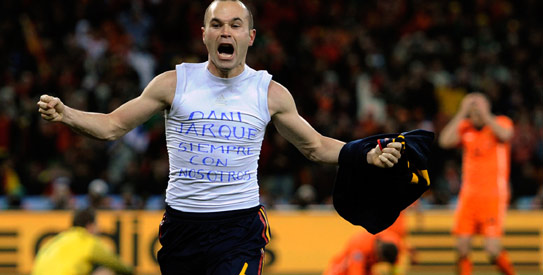
Espanyols Dani Jarque died suddenly in his hotel room while on a pre-season tour in 2009 and Sevillas Sergio Sanchez is trying to come back after surgery on a heart condition discovered by doctors in January.
The 31-year-old Garcia, however, will not return to the field after being told by doctors to give up playing.
Experts say the problem is not peculiar to Spain but the country's players' union (AFE) wants the rule on keeping defibrillators and a doctor standing by extended to lower-division clubs.
“They don’t think there are more cases in Spain, it is just the high-profile nature of the league, but it is true there seem to have been a number of cases in quick succession,” Jesus Diaz Peramos, vice-president of the AFE, told Reuters.
“We are also talking about the third and fourth tiers of football. These cases don’t grab the headlines in the same way but there have been seven or eight (collapses) this year.”
SIMILAR PROBLEMS
Part of the proceeds of world champions Spains next international friendly on March 9 will be spent on defibrillators and training courses.
The AFE has been comparing notes with players' unions in other countries.
“We all need to look for solutions together,” Diaz Peramos said. “Its difficult because the legislation is different in every country but football generates a lot of income so it isnt much to ask that some of this money can be channelled towards this issue. It would be money well spent.”
Araceli Boraita, a cardiologist and member of the government-run Sports Council (CSD), said other countries had similar problems.
“There aren’t more cases in Spain than in other countries,” Boraita told Reuters in a telephone interview.
“Its just that recently there have been more cases with a high media profile. They all end up in the news but it isn’t the case that there are more of them here than in other European countries or in the rest of the world.
“The percentages are almost identical. There are around 20 per year which is very few out of a population of 48 million.
All the studies made so far show that there is around one case per 2-300,000 young sportspeople under the age of 35.
“The cases of Puerta, Jarque, Garcia and De La Red all had different pathologies,” Boraita added.
“They all started with heart arrhythmias (irregular heartbeats) which caused a cardio respiratory halt but that is where the similarity ends. The causes have all been different.”
FITNESS TESTS
Since the Puerta case, Spain has extended rules on obligatory fitness tests for sports competitors to soccer and basketball.
The government was seeking to extend those tests soon to include those competing at regional and national levels and by 2020 to all casual sports enthusiasts, such as gym users, Boraita said.
Former Republic of Ireland international Steve Finnan, who played for Espanyol in the 2008-9 season, alongside Jarque and Sanchez, said he had found training in Spain similar to his experience in England, where he played for Fulham, Liverpool and Portsmouth.
“I can't say I saw anything different. I had one year in Spain. In England I played under Spanish managers, French managers and the training was quite similar,” Finnan told Reuters in a telephone interview.
“When I signed for Espanyol it was quite a solid test, probably one of the most solid that Ive had in my career. Maybe that was because of my age. I wouldn’t say we worked a lot harder or that it was more stressful on your body.
“(Jarque and Sanchez) were young and fit. I can remember they were two of the fittest players in the squad. It just goes to show, no matter how fit you are, it could happen to anyone.
It might just be one of those unfortunate coincidences.”