0
0

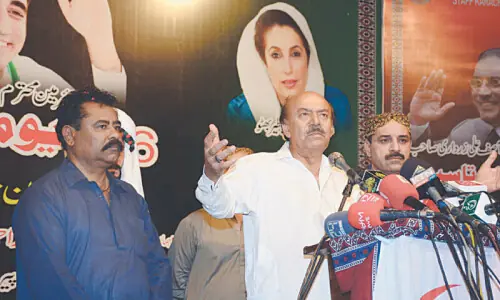
KARACHI, Sept, 16: The major problem that Pakistan is facing today is unemployment and inequality between the people and also between the provinces, observed economist Dr Qazi Masood Ahmad at a meeting held by the Irteqa Institute of Social Sciences on Sunday to briefly review the prevailing conditions, now that the elections were just a few days away. Dr Qazi is engaged with the Institute of Business Administration, and is also employed by the government in an advisory capacity.
Pakistan had to allocate 80 per cent of its annual budget to non-development expenditure, ie debt repayment and defence preparedness, and reduction in any of the two was not possible. Minimizing the expenditure was found to reduce the infrastructure, which affected investment in the private sector. Now, as one could see, the manufacturing sector in the country was almost destroyed, which gave rise to unemployment.
During the decade from the year 1988 onward, the number of unemployed, which was five per cent, rose to seven per cent. The number of people living below the poverty line was earlier 32 per cent, which had risen to 38 per cent during the decade. This meant that around 1.2 million families or 10 million people were living in poverty, Dr Qazi said.
Downsizing — which was later termed as rightsizing in the administration — rendered thousands of people jobless, which only added to the number of unemployed. It has yet to be seen as to what extent this action had improved the functioning in the departments affected by rightsizing.
Taxes were increased to meet the deficit in the budget, which only added to the cost of industrial goods. The price of utilities — electricity, oil and gas — had increased by 400 per cent since 1988, thus increasing the cost of living and adding to the poverty of the common people. It was a vicious circle — added taxes to meet the deficit, and more poverty in return — the learned speaker observed.
In 1988, the first structural adjustment in order to meet the budgetary deficit was signed with the IMF by Dr Mahboobul Haq, although the balance of payment position of Pakistan was not that bad. Thus, the country was tied with the IMF policies, which ruined the economy. Taxes were enhanced, sales tax increased, and the cost of investment kept rising at the rate of 22 per cent. Signing an agreement with the WTO also had a negative impact. Sales tax had been imposed on 4,000 items, which had destroyed the manufacturing sector. Around 4,000 units were closed, which brought unemployment and poverty into the country. The economic formula introduced by the IMF and the World Bank caused a backlash in the US and Europe as well.
Dr Qazi quoted statics to illustrate the level of inequality between the provinces. Sindh and Balochistan were the most neglected because of unequal distribution of national income and poor investment. For example, Japan, he said, had not launched a single project in these provinces, whereas several projects were launched in Punjab and the NWFP.
It was due to bad fiscal policy and inadequate distribution of resources which gave rise to poverty, despite the positive growth rate, Dr Qazi observed.—Hasan Abidi