0
0

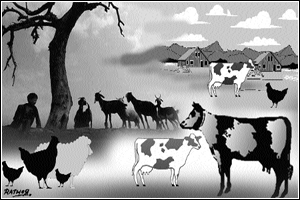 Livestock production is the second biggest economic activity after crop husbandry for rural population in Pakistan. To develop the livestock sector, technologies that are cost- effective and practicable in local conditions should be introduced on a mass scale. Rural livestock production encompasses all phases of the management of rural cattle, buffaloes, sheep, goat and draught animals.
The latest numbers and the area of private farms as classified by size has been reported by the Census of Agriculture, 1990, which is presented below (Table 1).
In the past also, many efforts were made in this regard but many of the innovations introduced were not based on the needs of small landholders, tenants and landless livestock owners.
There are 45 million large ruminants including 22.4 and 23.3 million cattle and buffaloes. Indigenous, Bos indices (also called humped or zebu cattle) belong mainly to three types based on the purpose and performance, viz; milch, draught and dual-purpose animals. Sahiwal and Red Sindhi are recognized as dairy (milch) types, Dajal and Bhagnari are heavy draught, Dhanni a medium draught and Lohani and Rojhan are light draught breeds, while Tharparker bullocks do well as draught animals and their females are good milkers so this type belongs to the dual-purpose cattle (Table 2). According to an estimate, 20 per cent of the cattle population is purebred, 5 per cent crossbred or exotic while the 75 per cent are non-descript cattle.
The increase in crossbred cattle in the past has resulted due to indiscriminate crossbreeding and readily available artificial insemination (AI) services. Conception rates in cattle have been reported as 30-60 per cent depending on weather conditions and during summer months it reaches as low as 1O per cent.
Table 2. Cattle and Buffaloes.
Table 3. Important Sheep Breeds.
Table 4. Various breeds of Sheep.
Goats are kept for milk and meat production and they can be classified into milch and meat categories. Out of total breeds, 11 famous breeds of goats in Pakistan are classified in Table 5 keeping mainly their types in view. The Beetal, Dera Din Panah (DDP) and Kamori are called “poor man’s cow” because of their good milk production. Their average milk yield is 250-310 liters for a lactation period of 90-100 days. Barbari, Chapper and Teddy are famous for meat while Pak Angora, Bikaneri, Kaghani and Khurrasani are kept for mohair and hair. The Beetal, DDP and Nachi yield good size skins. Goats usually breed more than once a year and twinning is very common (49 per cent), especially in Teddy breed that often gives 2-3 kids per kidding. Five kids per parturition have also been recorded. Table 6 shows the total goat breeds (33) and their province wise distribution in the country.
Draughts animals: There arc about 5.2 million draught animals which include camels, donkeys, horses and mules which are 0.8, 3.9, 0.3 and 0.2 million, respectively. The draught animals in irrigated areas are generally bought while in Barani areas they are farm bred. Cow and buffalo bullocks also provide traction power at the farms and roads. Camels, donkeys and mules are the main pack animals. Horses are usually used for riding and traction power.
Livestock have been kept for draught purpose and most of the meat and milk produced was consumed by the owner and his family. The average cultivar possesses a pair of bullocks but due to the onset of mechanization the draught animals are becoming distinct gradually. The work animals can start their work at the age of three and can go up to 10 to 15 years depending upon the intensity of utilization, feeding pattern and health care. However, much more scientific work is needed in this sector to find out the relationship of their feeding and management to their work performance.
Production systems: The main prevailing livestock production systems include (a) traditional rural livestock production, (b) commercial milk production and (c) desert/rangelands livestock production. Their details are given below: a) Rural Livestock Production
Most rural families rear 3 to 5 buffaloes and cattle for milk production and try to meet their domestic demand. Some people sell their extra produce to the neighbouring families. Due to the improvement of infrastructure and market roads, about 30% of smallholders are now producing milk for sale in the market. Usually male and female calves suckle the mothers and are retained during the lactation. The best males are kept by farmers for breeding and the remaining males are usually sold for slaughter whilst the females are kept for future replacements. Normally adult females are culled at the age of 8-10 years and every family tries to keep one female in milk every time.
b) Milk production: The development of urban or pert-urban commercial dairy farms is something new in livestock production; each dairy farm has about 20 or more buffaloes and cows. The large commercial dairy herds range from 100 to 500 buffaloes and cattle. The commercial livestock farm owners purchase pregnant animals with calf-at-foot from the open market. They always try to keep 5% of their animals in production. Male calves are usually sold for beef purpose. Most of the dry and non-descript animals are sold for slaughter and only a few may be returned to rural areas for the next calving.
Nomads sell their animals during the period of feed scarcity; therefore in winter the price of sheep and goats is slightly lower than prevailing in the rainy season. Under the transhutment system, human population with their livestock wealth migrates from desert areas or cold regions of northern parts of the country to the nearest irrigated or low lying lands but this always creates stress towards feed resources and affects the grazing capacity of the lands. This migration affects the feed and meat prices in the market. Now let’s dwell on some of the main measures to alleviate these riddles to uplift the production systems for the enhancement of the production potentials of the livestock.
Management: Management of a livestock is a challenging job and it must be tailored to fit the resources and goals of a farm. The following goals are suggested for a profitable business:
It pays all operating expenses; all interest on all capital invested; maintains productivity and earns a reasonable return for the operator. Both amount and type of resources very tremendously depend on climate, soil type, available buildings and equipment, capital and labour and so on.
One the characteristics of successful managers of farms is the ability to plan and he must also possess a through knowledge of livestock production.
Breeding: Breeding is one of the most important aspects of management. A good, efficient and healthy crop of animals can’t be raised if reproductive efficiency of animals is not improved. One main reason for low animal productivity in the past was intensive inbreeding, i.e.; use of bulls without any records and use of draught bulls for breeding purpose. Selected pedigree bulls of Sahiwal and Red Sindhi breeds are available in some areas for breeding purpose. Pedigree bulls are maintained by village head person (namberdar) with the assistance of the department.
Feeding: Nutrition is still a problem hampering the livestock productivity in general and milk production in particular. This area needs special and immediate attention by the researchers and the government officials. For instance, in traditional livestock farming they are fed through chopped fodder and wheat straw. In very rare home grown grains, kitchen wastes and some concentrates are offered to milking animals. On the other hand commercial livestock owners, purchase fodder and concentrate from the markets and then sale their product (milk) at a rate which can compensate all the feeding expenses including their labour costs, etc.
Labour force: An average livestock owner uses 3 to 4 of his family members as a source of labour in managing the affairs of the farm. Hired labour is also used. However, direct and open competition has produced negative effects on the livestock production.
Surveillance: There are still enormous production losses due endemic diseases every year. The rural-based livestock farmers only give their attention to life-threatening diseases and do not pay proper attention to less serious disease problems, which cause considerable economic loss. However, commercial farmers are quite alert about disease problems and usually they cull every diseased or suspected animal to save the remaining herd. Hiring the services of veterinary doctors in commercial herds is also getting importance. Infestation with endo-parasites causes huge production losses; 80 per cent animals in rice growing areas are usually affected by parasitism.
Surveillance and reporting system also needs special attention. This should be accomplished at tahsiland district levels regularly to monitor incidence from time to time and subsequent effective measures for control to make our animals as disease free. Disease diagnostic labs need to be strengthened and manned with qualified personnel.
Marketing: The marketing of livestock is an important point at which the producers turn over their stock to meat industry. Marketing is a completely neglected field. The importance of marketing as a major means to over all livestock development has not been duly recognized. The existing legislature provides for the establishment and supervision of primary markets for farm product. The livestock has not been added to the list of commodities covered by the existing regulations. The livestock markets are therefore, poorly equipped, loosely controlled and operated in an old-fashioned way. The effective and the efficient marketing of livestock and their products is important development programme envisaged for the improvement of livestock industry.
The involvement of middlemen in selling and buying raw milk is quite common. Milk reaches the city markets after long chain of middlemen who are involved from the point of produce, hauling to cities, selling to milk plants or big collectors or retailers and up til the point of sale. During this very long chain of trade, many operations take place, like mixing ice or water, skimming and churning, etc.
Pricing system: There are great seasonal fluctuations in prices of livestock products due to the fact that the livestock-based economy is uncertain as compared to other investments. Milk production increases in winter due to the calving pattern of buffaloes and cows, but at the same time the price of milk decreases in the open market without benefiting to consumers.
Similar is the case in regard to meat. There is no grading system available for meat animals and its carcass. Normally, butchers sell their meat according to their own prices, although, price fixation and stability in livestock production is a must for avoiding great seasonal fluctuations.
The following measures are suggested for improving the rural livestock production:
1. Improving the genetic potential of indigenous livestock through selection, crossbreeding and AI;
2. treatment of urea and molasses. The urea is cheap source of nitrogen while molasses provides ample energy to the ruminants;
3. economical, efficient and flexible housing plans be developed through animal production experts;
4. enforcement of vaccination schedules beside proper and timely veterinary cover.
5. control of ecto- and endo-parasites through proper dipping and drenching. Response of proper feeding and improved nutritional management is much lower if animals are infested with the parasites.
6. Improvement of breed potential and good management will increase conception rate, growth rate, milk yield and decrease calving interval.
7. price stability in livestock production is a must for avoiding great seasonal fluctuations. Implementation of sound policies can bring the livestock economy to a great certainty.
8. preservation of surplus milk in winter by converting it into powder and saving enormous amount of foreign exchange being spent on the import of dry milk.
9. replacing draught animals to beef route through fattening and finishing programmes. Also the encouragement of feedlot system for cattle, male buffalo calves, sheep, goats and other culled animals.
10. meat grading, preservation and suitable marketing are required.
11. encouragement of commercial producers by providing incentives and services.
12. proper manure handling, its preservation, timely application for increasing soil fertility and keeping pollution under control.