0
0
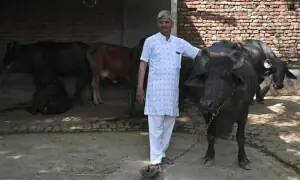
LAYYAH, Aug 3 Prices of around 400,000 cattle heads of flood-affected areas have dropped drastically as the livestock department failed to make arrangements to provide fodder to such a large number of displaced animals at the relief camps established on embankments.
During a survey conducted by Dawn in 76 villages of 14 union councils in last five days, it was found that 300,000 persons displaced by floods shifted to safer places on a self-help basis and they shifted along with them their 90 per cent of animals. The administration, however, managed to evacuate around 20,000 persons and most of them could not carry their animals along with them due to shortage of boats, losing their precious animals in the process.
Dawn witnessed that over 300,000 flood-hit people made their own arrangement to shift to safer places by paying thousands of rupees to private boat operators. The rates to shift one family on the boat, commonly called 'Kishta', were Rs5,000 to Rs10,000 per trip while normal rates never exceeded Rs1,000 per trip.
During the last six days, the rates of boat service increased 15 to 20 times and the operators fleeced flood-hit people freely. The shifting from flood-hit areas to safer places was just beginning of the miseries the flood-hit people were going to suffer as they landed in more troubles after reaching the embankments. They had to pay Rs2,000 to Rs10,000 to shift their animals to safer places at distances not exceeding five to 10 kilometres away from their abodes. This rate has also risen up by 10 times.
After going through the shifting ordeal, the owners of these animals, which would graze in the rivernie belt, found that the administration had not made any arrangement to supply fodder to the relief camps. The flood-hit people were, thus, left with no option except to sell their animals on cheaper prices.
The market price of these 400,000 animals has been estimated to the tune of billions of rupees and if the present circumstances persisted, it was likely that their market prices would reduce drastically, may be up to 50 per cent. It was feared that the cut in prices would cause Rs1.5 billion loss to the flood-hit people.
This correspondent witnessed a poor man carrying around 11 hens in a box which he sold just for Rs500, while in normal circumstances, these birds would have fetched him at least Rs2,000.
Normally, the prices of buffaloes, cows, goats and sheep stand approximately at Rs80,000, 60,000, 6,000 and 5,000 per head, respectively, according to data collected couple of weeks ago from the livestock markets being held in Chowk Azam and Layyah on every Tuesday and Wednesday.
The animal buyers of the district have rushed to relief camps to buy the livestock at throwaway prices to exploit the miseries of the flood-hit people.
Meanwhile, the administration remained busy in strengthening embankments protecting the city by deploying bulldozers, excavators and other heavy machinery at Kukarwala. All the five protection embankments and five spurs in the district are still intact and said to be in safe condition.
The Pakistan Army personnel have evacuated around 8,000 stranded people during the last three days. Two army helicopters waited for the whole day on Tuesday to start their operations but could not take off due to bad weather.
A 23-year-old man, Kazim Hussain, drowned when his floating tube got punctured near Lurkan. A bridge near Laskaniwala also collapsed on Tuesday.
According to flood control centre, the water inflow has dropped from 1,000,000 cusec to 700,000 cusec on Tuesday.