0
0


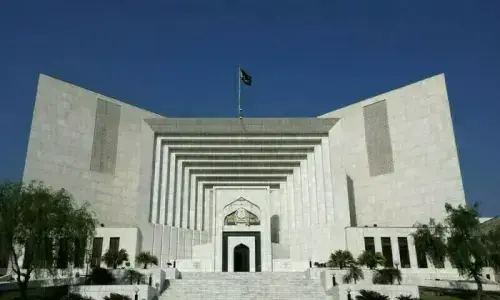
A bench comprising Justice Dost Mohammad Khan and Justice Pir Liaqat Ali directed Pesco to issue revised bills to consumers in 15 days and provide them at least seven days for payment of the revised bills.
The court directed that the consumers should not pay the present bills sent to them by Pesco.
The bench was hearing a writ petition filed by the NWFP government challenging the raises by Nepra in tariff of electricity distributed through Pesco.
The bench directed Pesco not to disconnect any connection on account of non-payment of the present bills, which were issued on the basis of the controversial tariff also including arrears.
The court directed Nepra not to make any changes in the power tariff till final disposal of the present writ petition.
The respondents in the petition are Nepra, Pesco, Pepco (Pakistan Electric Power Company), Ministry of Water and Power and the Cabinet Division.
The bench issued notices to the attorney general of Pakistan, NWFP advocate general and the respondents.
Advocate Shumail Butt appeared for the petitioner and contended that the NWFP government was a consumer of electricity distributed through Pesco.
He added that there were around 2.4 million power consumers of Pesco in the province.
He argued that since March 1, 2008, Nepra had thrice ordered much higher raise in power tariff as compared to other parts of the country and on regular basis it made automatic tariff adjustment. He contended that the accumulative increase in tariff amounted to 60 to 70 per cent.
The counsel maintained that the raises in tariff had been made arbitrarily as stakeholders were not heard.
He contended that Nepra used to conduct public hearings in Islamabad by ignoring the real stakeholders who belonged to this province.
The bench wondered that if governments had to run affairs of the country on dictation of the IMF, why the people had struggled for expelling colonial rulers.
It further observed that Wapda collected millions of rupees on account of maintenance, but people including women and children continued to die after touching naked wires.
The bench said that as compared to the continuous increase in power tariff the performance of Pescp and other power distribution companies was poor.
Earlier, the NWFP government had filed an identical petition in the erstwhile Islamabad High Court, but after its abolition in the wake of a judgment of the Supreme Court the case was transferred to the Rawalpindi bench of the Lahore High Court (LHC).
The LHC had disposed of the petition in November following which the present petition was filed in the Peshawar High Court.
A few days ago, Pesco issued electricity bills to its consumers that also included arrears, which Pesco claimed it would recover in 15 instalments from private consumers.