0
0

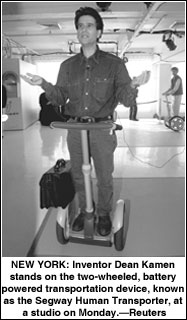 NEW YORK, Dec 3: “IT”, the much hyped invention which could possibly revolutionize personal transportation, was unveiled in New York on Monday morning on ABC’s news programme, “Good Morning America”.
Amidst reports of the war in Afghanistan and the attacks in Israel, the unveiling of “IT” took centre stage as inventor Dean Kamen demonstrated the machine in New York’s Bryant Park.
The device, the Segway Human Transporter, better known by its former code name, Ginger, can move at a speed of up to 20kms an hour and has no brakes. Its speed and direction are controlled solely by the rider’s shifting body weight and a manual turning mechanism on one of the handlebars.
“You might ask, ‘How does it work?’,” Mr Kamen, mounting one of the devices last week, said in an interview with the New York Times on a test track at his company’s headquarters in Manchester, New Hampshire.
“Think forward,” he said, inclining his head ever so slightly and zooming toward a reporter. “Think back,” he continued, effortlessly reversing course. Tilt sensors monitor the rider’s centre of gravity more than 100 times a second, signalling to the electric motor and wheels which way to turn and how fast.
Mr Kamen says the much anticipated unveiling comes now because he has had time to file for crucial patents on the technology and is ready to test it publicly. The United States Postal Service, the National Park Service and the city of Atlanta plan to begin limited field tests of the device early next year.
The 50-year-old Kamen invented the first portable insulin pump in the 1970s, then a briefcase-sized dialysis machine and more recently a stair-climbing wheelchair.
Amazon. Com and several companies that make parts for the Segway, including GE Plastics and Michelin North America, plan to use the device to try to save money by reducing the time it takes employees to move around corporate campuses and large warehouses.
At an average speed of 13kms an hour, or three times the normal walking pace, Mr Kamen says the Segway can go 25kms on a six-hour charge, for less than a dime’s worth of electricity from a standard wall socket.
The anchors of the ABC news programme and some select group of people who demonstrated the device confirmed that “IT” rode effortlessly and without a hitch as they went up and down the hurdles created to test the workability of the device on the streets.
Besides going on sale on the Amazon.com website, the thinking motor scooter would be available to the general public for 3,000 dollars.
Experts here said whether or not IT lives up to its advance billing, Ginger has supplied high-tech hopefuls in search of the next big thing with cause for optimism during a year that has bristled with headlines of economic downturn, a tech spending slump and war.
Agencies add: The machine will banish cars from the urban landscape, Kamen predicts, to make room for millions of pedestrians on Segways.
Kamen’s brainchild launched a media storm in January when Inside.com, a media industry website, reported that Harvard Business School Press had paid 250,000 dollars to an author, Steve Kemper, for a book about the mysterious invention.
Kamen, trained as a physicist and engineer, filed several US Patent Office applications earlier this year for a motorized scooter-like vehicle.
Until now, he had kept mum about the product Apple Computer tech guru Steve Jobs said would inspire urban planners to plan cities around it.