0
0

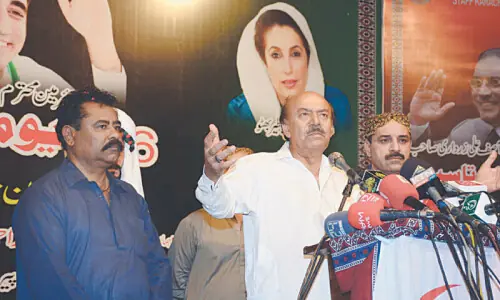
KARACHI, Feb 28: The chairman of the Institute of Electrical and Electronics Engineers Pakistan on Saturday urged the National Electric Power Regulatory Authority to set up an office in the city , which has 10 per cent of the country's population.
Speaking at the 19th multi-topic international symposium of the IEEP, its chairman, SK Pervez, expressed surprise over the fact that Nepra had no office in Karachi, which had such a large number of electricity consumers.
Nepra's licensing department Director Mr Zaigham Alvi said that the 1992 strategic plan sought to expand the country's power sector without offering government guarantees. But in 1994, when independent power producers were brought in, they were offered sovereign guarantees by the government, he added.
Answering a question, Mr Alvi observed that it would have been better if the existing utilities had been taken into confidence. He added that some sovereign guarantees, like return on investment, could have been done away with.
He said that under the strategic plan, the Karachi Electric Supply Corporation was supposed to be privatized after being divided into separate entities. He added that now the government was considering privatizing the KESC as an integrated entity.
He said the regulator had introduced a concept of multi-year tariff determination mechanism, which would remain in place even after the privatization of the KESC.
Nepra's legal adviser, Ameena Sohail, recalled that previously under the Electricity Act 1990, generation licences were issued by provincial governments. She added that these licences were now issued by Nepra.
"Under Section 38 of the Nepra Act-1997, the provincial governments have been asked to establish provincial offices of inspection. This has created an interface between the federal government and the provincial governments," she said.
The director of Nepra's consumer affairs department, Amir Zia, said that a sustained supply of power was taken for granted in the developed countries, which was not the case in Pakistan.
He added that power failures occurred frequently in Pakistan because electricity equipment had not been standardized. "In the areas governed by the Water and Power Development Authority, over 500,000 trippings below 20 minutes occurred in one year. Similarly 49,000 trippings of more than 20 minutes occurred annually. At least 6,669 transformers were damaged in one year," he said.
He said the KESC was concerned about the fact that many consumers had turned to captive power plants, generating 500 megawatts of electricity. This was not only causing a loss to the KESC but was also responsible for environmental pollution, because many captive power plants were installed in congested localities, he said.
The deputy chief engineer of the KESC, G.R. Bhatti, raised some questions about the Electricity Act 1910, and the Nepra Act 1997. Electric inspector Wali Mohammad Rahimoon said there was an overlapping between the Electricity Act 1910 and the Nepra Act 1997. He complained that the powers of the electricity inspector were generalized and classified.
Since many among the audience expressed concerns about the disparity of tariff between Karachi and other cities of the country, the IEEEP chairman announced that he would form a committee to look into the matter.