0
0

KARACHI, April 11: The revision of the prices of petroleum products should be on a daily basis instead of the current fortnightly basis. This was suggested at a meeting of the Senate’s Standing Committee on Petroleum & Natural Resources and the Oil Companies Advisory Committee (OCAC) here on Monday. Both the bodies favoured moving towards the practice of announcing the prices on a daily basis as members of the both the committees appeared of the view that the new price mechanism would cause a fluctuation of 10-20 paisa per litre in petroleum prices as against the cumulative fluctuation of Re1 to Rs2 per litre every fortnight effected under the current mechanism.
OCAC Chairman Farooq Rehmatullah told Dawn that the committees, which met at OCAC office on Monday, had already proposed the government to switch over to the new mechanism which looked feasible from consumers’ point of view.
The meeting also discussed other options like gradual deregulation of the freight pool and moves towards bringing about efficiency in the oil sector to lower the price of petroleum products.
While deliberating upon the issue of freight pool deregulation and its impact on the local prices, it was noted that if the number of oil depots and locations was curtailed to eight from the existing 29 across the country, an annual saving of Rs1.8 billion (making 20-30 paisa per litre) could be effected. Consumers might see a better price revision this way, Mr Rehmatullah said, adding that this would also encourage competition between various oil companies.
In reply to a question about any effort being made towards curtailing the ex-refinery prices, he said it was not such an easy task.
Many people in the oil sector think that the government should bring some changes with reference to the in-built support and tariff protection being enjoyed by local refineries. However, the OCAC chief said that this was an important issue and the government had to extend its support to refineries in order to avert their possible collapse.
He said that curtailing levies, like excise duty, on oil products would hardly make any big difference on the POL prices. He pointed out that the excise duty on petrol is 88 paisa a litre while there was no excise duty on diesel.
Nevertheless, the senate committee chairman has asked the CBR to review the excise duty.
Mr Rehmatullah said that there was no early solution in sight viz-a-viz the issue of offsetting the impact of the globally rising oil prices at the end users. The two committees discussed the matter with a view to provide relief to the common man as the domestic prices were moving up only because of the trend in the international market.
According to a press release, the OCAC chairman told the meeting that oil industry had made investments to the tune of Rs117 billion over the past 10 years which amounted to Rs11.7 billion on an annual basis while the oil industry profits in the year 2004 stood at Rs9 billion.
He said that despite the increase in diesel prices in the international markets during the present fortnight, oil marketing companies (OMCs) were subsidizing the price of diesel by Rs4.17 a litre which was adding to the existing deficit of Rs5 billion on account of price differential claim.
The OMCs’ margins were the lowest in the region that includes Far East. He asked the senate committee to propose an increase in the OMCs and dealers’ margin to four and five per cent, respectively, as committed earlier by the government.
Secretary-General of the OCAC Abid Saeed Ibrahim said that the OCAC had also developed new standards for the petroleum industry which had been sent to the ministry of petroleum and the Oil and Gas Regulatory Authority for a review.
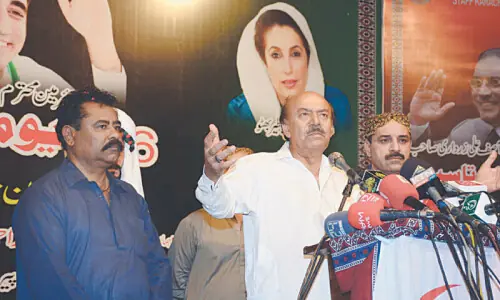
The senate committee is headed by Senator Dilawar Abbas. Senator Mir Mohammad Naseer Mengal, Minister of State for Petroleum and Natural Resources represented the government at the meeting which was attended by senators Rukhsana Zuberi, Ms Yasmeen Shah, Mouhim Khan Baloch, Sarwar Khan Kakar, Dr Ismail Buledi and Amanullah Kanari; and Additional Secretary Dr Shaukat Durrani and Director- General Oil Sabir Husain.