0
0

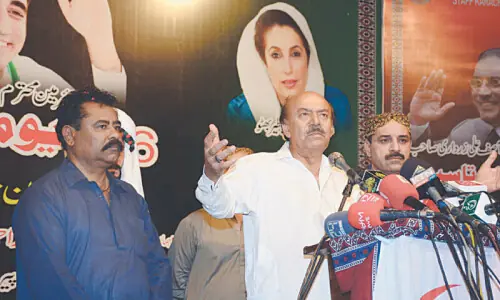
KARACHI, Oct 27: Speakers at a discussion, organized by the Centre for Development and Democracy here on Saturday, found fault with the local bodies system which is based on the principle of devolution of power.
The discussion — titled “Devolution of power: its perception and practice” — began a little late without the chief guest, City Nazim Naimatullah Khan. Except for Nisar Khuhro, other guests, such as Aftab Shaikh, Zakarya Usman and Nazim F. Haji, also did not show up.
The chairman of the CDD, Nafees A. Siddiqui, opened the discussion by saying that due to the changed situation — a reference to the Sept 11 terrorists attacks in the United States — focus had shifted from the devolution of power system introduced by the Musharraf government.
He said the idea was that the local bodies system, based on the principle of devolution of power, would solve the problems of the people at the grass roots level. He added that the discussion would explore if the idea had been translated into reality or not.
He argued that one prominent flaw in the local bodies system was that it had disenfranchised people living in the cantonment areas.
The president of the Sindh chapter of the Pakistan People’s Party, Nisar Khuhro, said the government had promised that the 150-year-old system would be scrapped and substituted by a decentralized system of power. On paper, he admitted, the system was good. But in practice, he added, the system was riddled with contradictions.
Disagreeing with Mr Siddiqi — who had said that it was too early to judge the performance of the new system — Mr Khuhro said the government had taken one and a half years, give or take a few months, to map out the local bodies system.
He said that after their oath-taking ceremony, the Nazims had been told that their meeting would take place when the rules of business had been laid down. “Nazims and councillors are still clueless as to how to go about doing their business,” he observed.
He added that according to the admission of ministers the elections had been non-party and not non-political. He observed that this had been done in violation of the fundamental constitution right of the people.
Mr Khuhro contended that the present system was not representative of the people. He explained that previously Karachi had 255 councillors. Despite an increase in the population, now the city was represented by 178 union councils.
The Nazims of the Jamshed Town and Liaquatabad, Ahmed Parekh and Dr Pervez Mehmood, also spoke on the occasion.