0
0

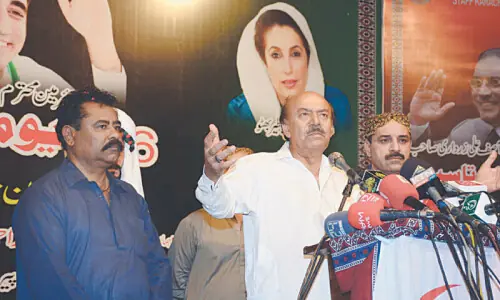
KARACHI, Feb 7: Liberal and progressive participants of the World Social Forum event held on Saturday strongly condemned the ongoing Israeli aggression in Gaza and the genocide of the Palestinian people taking place there with the “abetment” of the United States. They also deplored extremists’ acts of terrorism and the ongoing military operations in the NWFP and Balochistan.
Participants also condemned the “exploitative” capitalist system, which was trying to deprive indigenous people of their independence and rights.
Saturday’s event was organised at the Arts Council as a follow-up to the World Social Forum held in Belem, Brazil, from Jan 27-Feb 1, 2009. The main themes of activities included “mobilization against Zionist and imperialist aggression against unarmed Palestinian, Iraqi Afghan and Pakistani people and the ‘Rights of Indigenous People’, under the over-arching themes of Globalisation and Militarism, Peace, De-militarisation and Freedom of the Media & Democracy,” according to a press release.
A colourful display of folk music, symposia, a poster and picture exhibition and film, theatre and other cultural events were part of the day’s schedule. Books, films, music CDs and souvenirs were also on sale.
While endorsing the Belem declaration, the participants were of the view that the objective of wars was to create or install subservient and puppet regimes, establish political and cultural hegemony, occupy territories and control/dominate the economic resources of these regions.
Prominent speakers included former Senator and HRCP co-chairperson Iqbal Haider, M.B. Naqvi, Dr Mohammad Ali Siddiqui, Saleha Athar, Fahim Zaman, Shumaila Jabeen and Zulfikar Halepoto.
The main thrust of the day’s speeches was the rights of indigenous people, as spelt out in the UN General Assembly’s non-binding declaration of 2007, which emphasises the rights of indigenous peoples to maintain and strengthen their own institutions, cultures and traditions and to pursue their development in keeping with their own needs and aspirations.
The resolution also prohibited discrimination against indigenous peoples and promoted their full and effective participation in all matters that concern them. It further reaffirmed their right to remain distinct and to pursue their own visions of economic and social development.
It was noted that even with this progress, indigenous peoples still face marginalisation, extreme poverty and other human rights violations. They are often dragged into conflicts and land disputes that threaten their way of life and their very survival and they suffer from a lack of access to healthcare and education.
Fisher folk, trade unionists and human rights activists contended that the theme of the discussion was particularly relevant in Pakistan. Speakers were critical of human rights violations across the country, and condemned the ongoing military operations in the NWFP, FATA and Balochistan. They called for an immediate halt to military operations, and also condemned all extremist activities.
Participants at the WSF event committed themselves to the Belem declaration at the WSF in Brazil, which calls for a Global Week of Action against Capitalsim and War from March 28-April 4, 2009. The week will include an anti-G20 mobilisation on March 28, a mobilisation against war and crisis on March 30, a day of solidarity with the Palestinian people to promote boycotts, disinvestments and sanctions against Israel on March 30 and a mobilisation for the 60th anniversary of NATO on April 4, among other events.
Speakers emphasised that the ongoing global economic crisis was a direct result of the capitalist system’s characteristics, and therefore a solution could not be found within the system. They said that current efforts to fight the crisis are aimed at saving the system, while putting the burden of losses on the masses.
The WSF declaration adopted at Belem, and endorsed by the participants of the follow up moot in Karachi, held that the present system is based “on exploitation, competition, promotion of individual private interests to the detriment of the collective interest, and the frenzied accumulation of wealth by a handful of rich people. It results in bloody wars, fuels xenophobia, racism and religious fundamentalisms; it intensifies the exploitation of women and the criminalisation of social movements.”