0
0

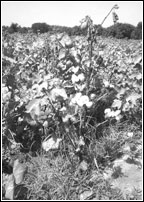 THE productivity rate of cotton, the most important fibre and the cash crop of the country, has not shown any improvement over the world average of 1,576 kg/ha because of various reasons mainly diseases.
Research work so far carried out on cotton crop in the country indicates that seedling rot or wilt, root rot, boll rot, anthracnose and different types of leaf spot diseases are the main cause of reduction in cotton yield. Premature opening of bolls (Tirak), reduction in size of leaves, species of nematodes, bacterial blights, leaf curl virus and stenosis of cotton are the other deadly diseases affecting the crop and resulting in poor production.
Among all the diseases, cotton wilt is the most deadly which causes sudden death of plants resulting in huge monetary losses to the farmers. Several species of Fusarium and Verticillium fungi causes wilt. Both these fungi differ from each other, but cause similar symptoms. The only reliable method for separating and identifying these two diseases is taxonomy of causal fungi. Both can be readily isolated and cultured from diseased plant portions.
The two fungal wilts thrive with high nitrogen fertiliser, excessive soil moisture, thin stands and deep cultivation. They survive for long periods (for at least a decade) in soil on organic matter and even on non-host plants. However, some general characteristics differentiating between the two wilt fungi may help in their identification and control.
The Fusarium wilt develops well in acid soils, is more prevalent in sandy soil, causes more injury when the nematodes injure the roots, can be transmitted internally in seed and prefers hotter soil. Whereas, Verticillium wilt thrives in alkaline soil; is more prevalent in heavy soils, does not require injury for infection, can not be transmitted internally in seed and prefers cooler soil.
The wilts start appearing at the seedling stage in case of early attack but may also occur at any stage of plant growth. Areas of reduced or patchy plant stand can be seen in affected fields, usually spreading in the direction of irrigation flows. Symptoms include seed and seedling rot, wilting, death of seedlings and adult plants, accompanied by vascular browning.
Initially, vein clearing and leaves show a distinct loss of turgor and the leaf margin between the main veins starts growing yellow, sometimes referred as leaf epinasty, followed by stunting. The stunted plants may fruit early. The yellowing spreads inward and is followed by necrosis leading to defoliation at the bottom of the plant which spreads to the top resulting in progressive wilting of leaves and stem, defoliation and finally death of the plant. The diseased plants can be pulled out easily, due to loss of rigidity. Brown, red or yellow rings of discoloured tissue are observed if the stem is cut in cross-section, mostly close to the base. The plant dies in severe cases.
The Fusarium wilt is a solid dark brown ring compacted with healthy white stems around the outer portion of the stem. The infected areas are irregular in shape and size. Water-conducting stem tissues turn brown and become inactive, resulting in wilted foliage. Leaves turn yellow between veins and eventually are shed as plants die to leave bare stems. Once the fungus gets colonised in the plant, diagnosis is confirmed by splitting the stem to reveal dark brown, vascular discolouration and streaking characteristic of wilt.
The wilt diseases mostly spread in patches, but entire field may also be affected in severe conditions. Certain strains of the causal fungus only cause symptoms when plants are also infected with root knot nematode. In those cases, galls are usually prevalent on lateral roots. Fusarium may also cause foot and root rot or bulb rot in cotton.
Cotton wilt causing both pathogenic fungi (Fusarium and Verticillium spp.) are seed-borne, may carry over for long-distance, spread from year to year by sowing infected seed; also move from field to field, farm to farm and region to region, whenever very small quantities of infested soil is transported through boots, farm equipment, vehicles, in water (irrigation and overland flows), in flood irrigation and also in infected plant material, including seed etc. The fungi sustain on the outer surface of roots of many crops and weeds and survive indefinitely in soil even for a decade. The diseased plant debris lying in the field or in the storage space also helps both the fungi to remain alive. Cotton husks, used as cattle feed, are also identified as a potential source for spread of wilt.
Scientists have reported very broad host range of both the wilt causing fungi, at the species level. More than 120 different formae speciales have been identified based on specificity to host species belonging to a wide range of plant families.
Control of wilt disease is very difficult, chemical control is very costly and almost impossible to recover heavily infected, shriveled and damaged plants. However, cultivation of resistant variety is the easiest, economical and safe method. Growers are advised to plant improved immune or resistant varieties, because these are equal to susceptible varieties in yield
However, it is necessary that growers must keep in touch with the latest information on resistant varieties and control measures. The following preventive measures can help minimise the risk of damage:
Crop rotation with non-host crop is preferable. Clean cultivation by removing infested plant materials after harvesting through deep and repeatedly tillage operations can help destroy infected plant parts from field. Good drainage improves soil conditions which help minimise the disease incidence.
Use of disease-free and certified seed or seed treatment with suitable seed dressing fungicides before sowing is also recommended. In some cases, late and deep sowing reduces disease incidence. Mixed cropping with non-host crops also helps check the disease. Mulching for 5-6 weeks with colourless plastic is recommended for soil solarisation and straw mulch helps maintain temperature for reducing the fungal growth in crop field. Uprooting and burning of diseased plants and weeds help minimise further spread of the diseases.
Proper irrigation and use of balanced fertiliser help grow healthy plants resistance against wilt and other diseases. Storage of plant waste material must be avoided. The plant waste and debris must be collected, burnt and buried to prevent spread of the diseases.