0
0

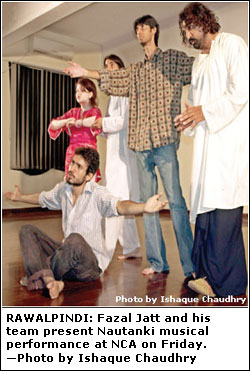 RAWALPINDI, July 11: There is a need to preserve the Nautanki musical theatre in its original form as it used to be practised around the time of Partition. The Nautanki theatre we see now has transformed with many additions.
These were the views expressed by Fazal Jatt, a major living exponent of the Nautanki musical theatre form, on Friday evening while sharing his experiences and skills with the students and the audience in the Spotlight programme, a regular feature of Theatre Department of the National College of Arts, Rawalpindi.
Today there is no original Nautanki form as practised by Phaji Shah and his disciple Aashiq Shah, father of Fazal Jatt, who brought the form of street theatre in Pakistan after Partition, said Mr Jatt who is an actor and singer participating in nautanki presentations.
First it was difficult to learn acting in any stage nautanki play for it demanded a lot of hard work and versatility and secondly the modern times demand change and transformation. It has become really difficult to perform the nautanki of the early days as it demanded time, nearly eight hours for a single play, said Fazal Jatt who has been teaching the old form of nautanki theatre in India and has completed a week-long workshop with NCA students.
He said there were 48 subjects, various folklores, which had been staged in the original form of nautanki. For a nautanki artist, it was necessary to have knowledge of classical music, the various ragas and local dialects to convey the theme successfully with music and dance. Jatt claims to have mastered more than 100 forms of taals and has been singing them during the nautanki performances.
Fazal Jatt said the commercial interests and busy life had also contributed in the decline of all classical performances in general and the nautanki in particular. “We are trying to keep the nautanki alive by making it easier and shorter for today’s audiences,” he said.
He said he was performing at different television channels to keep the nautanki alive as a distinct form of theatre different from the current Punjabi theatre.
Some students during the question-answer session criticised the government institutes that were meant for promotion and conservation of classical arts for being unable to keep the nautanki alive in its original form. They said the children of many gharanas had abandoned the traditions of their forefathers for their survival and after Fazal Jatt there would be no one left with the knowledge of this art.
Fazal Jatt and his team of actors staged a nautanki performance to enthral the audience.