0
0
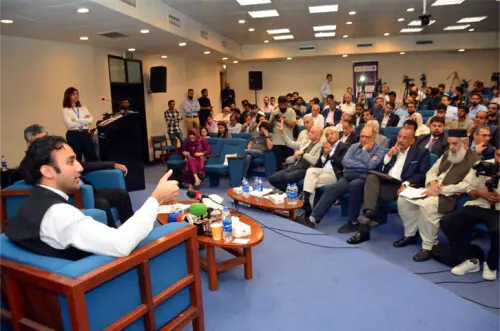
LONDON, July 1: It is not the US but Asif Ali Zardari who wants to see President Pervez Musharraf continue in his office and chief justice Iftikhar Mohammad Chaudhry remain out of his, said Fareed Zakaria, editor of Newsweek International, while participating in a wide-ranging discussion here on Monday after he had introduced his new book, “The Post-American World” at the Foreign Press Association.
He was asked why the US was blocking the restoration of the illegally deposed judiciary and hindering the new coalition government’s efforts to send President Musharraf home.
Answering the first part of the query, he said: “It is because the US believes, the only stability outside the military in Pakistan today is the PPP and Zardari has told them he does not want the restoration of judiciary.”
And Mr Zakaria’s response to the second part of the query was: “I don’t think the US cares one way or the other about Musharraf because COAC Gen Kayani is somebody it trusts. But the thing is Zardari says the whole structure will collapse if Musharraf went and there would be chaos and you know it could be for very self-interest reasons.”
He said personally he would like to see the chief justice and the 60 judges restored and he thought Musharraf should have receded on his own rather than forced to give up his uniform and other powers.
“As often happens with dictators, General Musharraf at some point stopped being liberal and modernising and engaged in power grab,” he said.
In his opinion Musharraf should not have imposed emergency, he should not have fired the judges, and he should not have replaced the Supreme Court.
Giving his views on the shape of things to come in South Asia in what he called the post-American world, he said he saw a huge shift taking place in the US which was fundamentally to view the region as a much important part of its overall geopolitical strategy, “and that is exactly because of China. The rise of China has suddenly made South Asia a crucial player.”
He thought India and Pakistan needed an interlocutor, a go-between to mediate between them because they did not trust each other and in his opinion the US was in the best position to play that role, “though at present India does not trust the US and believes it is still tilted towards Pakistan”.
“If you could manage to ease up between India and Pakistan to the point that they could simply trade with one another it would transform South Asia, transform Pakistan which today is locked out of this huge economy right next door,” he maintained.
He said for this to happen the US needs to play the role of honest broker, but that it could hope to do only if it developed good relations with India, “I am not predicting that it would happen, but what I am saying is it is happy scenario for South Asia.”