0
0

 WASHINGTON, June 26: North Korea handed over a long-delayed account of its nuclear activities on Thursday, prompting the United States to ease sanctions and propose removing it from the terrorism black list, but leaving questions about the communist state’s atomic ambitions.
US President George W. Bush cautiously welcomed the action but warned North Korea, which tested a nuclear device two years ago, that it faced consequences if it did not fully disclose its operations and continue to dismantle its nuclear programme.
“If North Korea makes the wrong choices, the United States and our partners in the six-party talks will respond accordingly,” he said at the White House shortly after the declaration was handed over to China.
“If they do not fully disclose and end their plutonium, their enrichment and their proliferation efforts and activities, there will be further consequences,” said Bush, who once branded North Korea part of an “axis of evil.”
He quickly took a step toward removing North Korea from the US list of state sponsors of terrorism, which will take 45 days, and issued a proclamation lifting some sanctions under the US Trading with the Enemy Act.
Bush’s national security adviser Stephen Hadley told reporters that easing those sanctions was “relatively minor” and that if Pyongyang failed to fulfil its obligations the United States could seek to re-impose them or push for new ones.
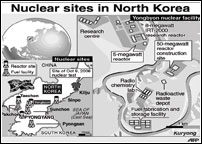
Bush also welcomed an announcement by North Korea that it would blow up the cooling tower at Yongbyon, its main nuclear complex, but said these were all initial steps by the reclusive communist country and more work was required.
In an unprecedented move, North Korea has invited western media to record the event. North Korea had already begun dismantling its nuclear facilities after talks among China, Japan, Russia, North and South Korea and the United States.
“This isn’t the end of the process, this is the beginning of the process,” Bush said, and added Pyongyang’s current actions would not in themselves end North Korea’s international isolation.
He said among other steps North Korea needed to take was a resolution of its differences over abducted Japanese citizens.
North Korea at this stage has also given no details of its existing nuclear arsenal, an issue which will be addressed in another phase of the six-party talks.
Experts said the declaration was a step forward, but deepened uncertainties about who would make further concessions, and how much other countries are willing to trust Pyongyang.
“Since this particular declaration has not included nuclear weapons or the exact number of warheads they have, that is a key concern. The other thing is whether or not the North Koreans have stopped work on the uranium enrichment programme and how far that has gone,” said Lee Chung-min, a professor at Yonsei University in Seoul.
Bush bracketed North Korea, Iraq and Iran in an “axis of evil” after the 9/11 attacks, accusing them of state-sponsored terrorism and seeking weapons of mass destruction.—Reuters