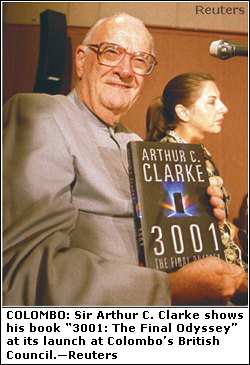
 COLOMBO: British-born science fiction guru Arthur C. Clarke died at a hospital in Sri Lanka on Wednesday after a brief illness, his aide Rohan de Silva said. He was 90.
President Mahinda Rajapakse mourned the death of Clarke and paid tribute to him as a “great visionary.” His death was a loss to Sri Lanka, the author’s adopted home since 1956, Rajapakse said.
“The president was deeply saddened by his death,” spokesman Chandrapala Liyanage said. “The president recalled attending Sir Arthur’s 90th birthday celebrations. The president believes his death is a loss to Sri Lanka.” Clarke, who in 1945 predicted the establishment of communication satellites, wrote more than 80 books. He was Sri Lanka’s best-known resident guest and has a scientific academy named after him.
The author was confined to a wheelchair but his mind remained alert.
Only a few days ago, Clarke reviewed the final manuscript of his latest novel, “The Last Theorem” co-written with American author Frederik Pohl, Clarke’s office said adding that the book would be published later this year.
British astronomer Patrick Moore, who had worked with Clarke on several writing projects, paid tribute to his “dear friend” and said his death was a “great loss.” He was ahead of his time in so many ways,” Moore told the BBC. “Quite apart from artificial satellites there were other things too. A great science fiction writer, a very good scientist, a great prophet and a very dear friend, I’m very, very sad that he’s gone.” Other tributes poured in from fans.
“A great brain and some incredibly astute predictions,” wrote a fan identified as JMK1973 on a BBC web posting. “This is a very sad day indeed,” wrote another.
“An incredible inventor of science fiction; people like him inspired today’s scientists,” added another.
Clarke marked his last birthday wishing for peace in Sri Lanka, where he had lived for the past five decades. He also ran a diving school that was affected by the December 2004 tsunami.
Clarke blew out a single candle on his cake to mark his birthday, which was celebrated at the Central Bank of Sri Lanka building within Colombo’s high security zone.
The author said he had sadly watched — for close to half his lifetime — a bitter ethnic conflict tearing up Sri Lanka.
“I dearly wish to see lasting peace established in Sri Lanka as soon as possible,” he said, referring to Asia’s longest-running war in which the Tamil Tigers’ campaign for an independent homeland has left tens of thousands dead.
“But I’m aware that peace cannot just be wished — it requires a great deal of hard work, courage and persistence,” he said in a taped message released to reporters here before the celebrations.
Although the conflict started in 1972, fighting has escalated since late 2005, when a Nordic-brokered truce unravelled.
Clarke, who also wished for evidence of extra-terrestrial life and for the world to adopt cleaner fuels on his birthday, said he did not feel “a day older than 89” as he completed “90 orbits around the sun.” “I have no regrets and no more personal ambitions,” said the writer, who was confined for the past three decades to a wheelchair because of the effects of post-polio syndrome.
Clarke’s office said he had wanted to be buried at a private, secular funeral, which was likely to take place on Saturday.
“We are awaiting the arrival of family members from Britain and Australia.
They are already on the way,” his secretary Nalaka Gunawardene said.
“Sir Arthur has also left written instructions that his funeral be strictly secular — ‘Absolutely no religious rites of any kind, relating to any religious faith, should be associated with my funeral’,” the statement quoted the author as saying.
Clarke is survived by his brother Fred and sister Mary, both of whom live in Minehead, in southwest England, where he was born. Their youngest brother, Michael, is already dead.—AFP
Selected works
THE science fiction writer was a master of both short stories and novels. Some notable titles:
— Novels:
“Childhood’s End” (1953).
“Earthlight” (1955).
“The City and the Stars” (1956).
“A Fall of Moondust” (1961).
“2001: A Space Odyssey” (film and novel 1968).
“Rendezvous with Rama” (1973).
“The Fountains of Paradise” (1979).
“The Songs of Distant Earth” (1986).
— Short Stories:
“2001: A Space Odyssey” was adapted from “The Sentinel,” a short story written in 1951.
Other favourites include “All the Time in the World” (1952), “The Nine Billion Names of God” (1952) and “The Star” (1954).
“The Collected Stories of Arthur C. Clarke” was published in 2001.—AFP