0
0

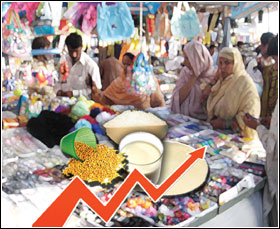 The coming Ramazan may be tougher on consumers than in previous years as market players and companies have already jacked up prices of essential food and kitchen items before the holy month, likely to begin from September14, on pretext of short supplies and rising cost of production.
There is a difference in celebrating Ramazan with religious zeal and passion for business in Pakistan as compared with other Islamic countries. Perhaps Pakistan excels in religious fervour but when it comes to profiting, our traders and manufacturers cross all limits. In other Islamic countries, heavy discount packages are announced on the eve of Ramazan and even foreign multinational companies join hands with local companies.
Here in Pakistan traders and manufacturers make every effort to increase the prices just two months ahead of the holy month so that they could overwhelm the government officials in fixing higher rates for the so-called discounted Ramazan price list. If a commodity price goes up by Rs three to five per kg ahead of Ramazan then what is the benefit for consumers if manufacturers offer Re one per kg discount.
This kind of practice of pushing up rates before Ramazan has been in vogue for decades due to lack of price checking campaigns ahead of the holy month by the government.
Flour varieties like atta no.2.5, atta fine mill and atta chakki now sell at Rs17, Rs18 and Rs19 as compared with Rs15, Rs16 and Rs17 per kg respectively in July. A 10 kg bag of fine atta now costs Rs 185-190 as compared with Rs160 two months back. Continuous increase in atta prices was triggered by increase in 100 kg wheat bag, rising to Rs1,350-1,360 from Rs1,240 in July.
Harvesting a bumper wheat crop of 23.5 million tons, followed by ban on wheat exports two months back and export of flour varieties and value-added items in August have virtually failed to provide any relief for consumers in atta prices.
Flour millers continue to increase the prices of 80 kg atta bag on the pretext of rising wheat prices while the federal government has paid no heed to the rising prices. Bread has also become costlier by Rs two to three in the last few months as a result of increase in atta prices.
The government has already disclosed hoarding of two million tons of wheat by the vested interest people in go downs and even at the petrol pumps, but it is yet to recover even few kilograms.
Milk retailers have pushed the rate to Rs 34 from Rs 30 a litre in four months despite a legal battle which has been still going on between the city government and milk retailers over price fixing issue for the last few months thus awaiting any decision in favor of consumers.
Tetra milk producers have come with new increase in rates to Rs 44 per litre on September 1 from Rs 42. Exactly a year back, it was available at Rs 37 a litre.
Besides, Nido one kg pack now costs Rs 310 as compared with Rs 295 in July this year. It was available at Rs 260 in March 2007.
The city government had taken notice of the price increase by the multinational companies in tetra milk in March this year and held meetings with their representatives but so far consumers have not seen any positive development on their favor.
The most shocking price increase came in ghee and cooking oil in the last one year because of rising palm olein prices in Malaysia and Indonesia. A five litre cooking oil of Dalda now costs Rs 530 as compared with Rs 440 in January and Rs 395 in September 2006.
Because of huge exports, rice prices have already registered a record increase this year ranging from Rs 15-30 per kg depending on the quality.
Gram pulse, a hot selling item of Ramazan used in the making of basin, has surged to Rs 48 from Rs 36 per kg in July, while masoor now sells at Rs 57 as compared with Rs 48 per kg. Arhar is now available at Rs 66 per kg as against Rs 52 two months back. In July, sugar was selling at Rs 28 as compared with Rs 30 per kg currently.
Keeping in view above increase, what has been really left for the consumers to cheer during Ramazan even if some producers and wholesalers offer a discount after already increasing the prices?
From the last year, the federal government had directed the city governments to check the prices for the whole year (on monthly basis) but the 36 officials, having magisterial powers of imposing fines and sending profiteers to jail, remained inactive, thus giving a free hand to the retailers to charge prices on their own.
One cannot ignore various reasons of price hike like gap in demand and supply, manipulation of prices by market forces, rising transportation cost, costlier imports etc but here comes a huge responsibility of the government to check these developments in the markets besides controlling profiteering and hoarding.
But unfortunately, the role of the magistrates in the last one year had mostly been confined to their office works and other responsibilities rather than properly justifying an additional responsibility from price fixing to price checking.
It has been noticed that the officials show extra guts to control prices in first seven days with random market survey but they lose enthusiasm with the passage of time.
It is really hard to check profiteering in a big city like Karachi with only 36 officials (18 DDOs Revenue Department and 18 Mukhtiar Kars). The government should find a solution to rescue the consumers by taking extra strength of officials from other government related departments.
Even after failing in Ramazan to curb inflation in food items, the plan to check prices during the last one year on monthly checking has also hit snags. The city government has issued monthly price list for just four times in the whole previous year but it has also failed to regulate prices due to lack of counter checking in the markets.
The government took the help of a rival market group in preparing monthly price list but it failed. Finally the city government has decided to issue the Ramazan price list with the help of Karachi Retail Grocers Group and Karachi Wholesalers Grocers Association who have been issuing price list for decades.
Besides, the government officials have never taken the stock of situation like collecting data regarding import, crop estimates and stocks in the market, etc before holding the meeting with the stakeholders and market players. And ultimately they have to surrender before the market forces due to lack of market knowledge. They launch the crusade against retailers without monitoring the wholesalers and producers who at times are responsible for pushing up the rates. The government has never checked the supply side of the products.
Sometimes it seems that the government undertakes the exercise of price checking as a face saving effort just to show that how much it cares for the consumers. But in practical terms price checking campaigns open a new avenue of earning for the officials.
To some extent consumers can also be blamed for giving a free hand to the retailers for charging higher prices as they do offer any resistant to any price hike. They do not have any appropriate forum where their voice can make a difference. Even many consumers’ related bodies and forum have people from elite classes and posh areas who are not bothered about price increase.
Only few consumers record complaints against retailers at the complaint centres in Ramazan as majority stay away as they think that it a temporary move to control the rates.
However, it has been noticed that most of the camps are either remained without staff or even if they are present they perform their responsibility half-heartedly. Even the Police do not cooperate with the officials who monitor prices.
All the efforts depend on the good return. If the salary of the price magistrates is not at par with the market level then he will do a routine exercise in performing his duty.
The market people know how to influence the officials having low salaries. The government must invest autonomous powers to price magistrate and his assistants with good salary and perks in order to achieve objectives.