0
0

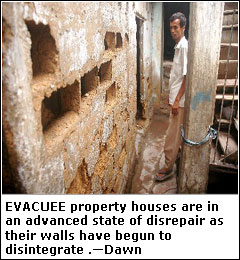 KARACHI, Aug 25: Though tenants of Karachi’s evacuee trust properties and the governmental managing board remain at loggerheads over issues of rent increase and property maintenance, the Evacuee Trust Property Board (ETPB) appears set to push through the implementation of a 2006 decision to increase the rent of such properties by an exponential 1,000 per cent. The Karachi wing of the Anjuman-i-Kirayadaraan Matruka Waqf Imlaak Board [Tenants’ Association of Evacuee Trust Property] rejects the amendment but the federal government’s ETPB points out that revenue must be generated and the currently nominal rent is spent on the upkeep of the properties.
Meanwhile, the tenants maintain that the properties are in poor repair and the ETPB does not discharge its responsibilities in this regard. “Going by the despicable conditions of the properties, the rent should be decreased,” said an outraged Atiq Mir, president of the tenants’ association’s governing body.
Decisions and revisions
Early last year, the ETPB decided that rents would increase every six years after the assessment of rent rates in the areas where the trust properties are located. In doing so, the board broke a 1990 agreement which allowed an up to 30 per cent rent increase every three years, amending the 1977 scheme concerning an annual eight per cent rise. The policy was revised in 2001 when the board decided to increase rents from 150 to 2,240 per cent but the amendment was declared void by the Lahore High Court after a four-member tenants’ committee lodged a protest.
When tenants took to the streets to protest the 2006 decision, the policy was suspended until a consensus decision could be reached. The ETPB also offered some concessions: residential units and sub-units measuring two marlas or less would pay a nominal rent of Rs10 per month while the rent of residential units and sub-units measuring between two and five marlas would be fixed at the prevalent rates, subject to an annual eight per cent increase allowed under the amended 1977 scheme. The benefit was not extended to residential-commercial units and sub-units, or residential units and sub-units that have the potential of commercial utilisation.
In a surprise move last month, the ETPB decided to go ahead with the increase. “As a result, a person who used to pay Rs287 in rent now has to cough up Rs4,000 per month,” said the tenants’ representative, Mr Mir. He pointed out that “most of the trust properties are located in areas such as Soldier Bazaar, Aram Bagh, Saddar and Jubilee and in these places, almost all the residential buildings can be converted to commercial use.”
According to the administrator of the ETPB Karachi, Khawaja Shahid Nazeer, however, “commercial and commercial-residential properties constitute only 30 per cent of the total trust properties across Pakistan. How else will the government generate revenue? The one- to five-marla properties constitute some 60 to 70 per cent of the total and we aren’t even touching them.” According to Mr Nazeer, the trust properties – some 50,000 of them, including residential, commercial agricultural lands – have been rented at nominal rates which are spent on maintenance and for running welfare institutions such as schools, clinics or places of worship for minority groups.
Repairs left undone
In response, the tenants claim that for years, they have been taking care of their properties themselves. “According to the law, every three years the tenant can withhold up to two months’ rent for maintenance,” said Mr Mir. “These old buildings are in frequent need of repair but if we replace merely a termite-infested door, we are told that we are overstepping the law.” Complaining that the board takes matters too lightly, Mr Mir added that “the greater our urgency, the more chances they have for under the table deals.”
ETPB’s Mr Nazeer, however, lays emphasis on the need to follow procedure. “These people should understand that they are not the owners of the properties,” he commented. “They should submit an application asking the ETPB’s permission to carry out repairs. And if they go ahead with maintenance work without permission, they are not to claim costs from the board later. Furthermore, extending residential or commercial space is not maintenance or repair work.”
Controlled by the ministry for minorities and with its main headquarters in Lahore, the ETPB was set up in 1960 to oversee evacuee properties attached with religious, educational and charitable trusts left behind in Pakistan at partition. Earlier, this had been the settlement department’s responsibility under the Displaced Persons (Compensation and Rehabilitation) Act 1958 and the Displaced Persons (Land Settlement) Act 1958. Properties in the custody of the ETPB include only those converted into trusts before 1947 by their original owners, and many of the tenants are poor settlers who came to Pakistan without any claims.
Headed by Lt-Gen (retd) Zulfiqar Ali Khan, the ETPB has 16 members including government officials, private-sector representatives from all four provinces and senior members from the Board of Revenue of each province. The private sector representation from Sindh comprises Karachi-based businessman Divan Menglani and Hyderabad-based advocate M. Prakash.
‘Why change it?’
According to the 2006 policy, the board will assess properties and fix new rents every six years, despite the annual eight per cent increase.
In ETPB administrator Mr Nazeer’s view, “rents are usually increased by 10 per cent annually but here there is only an eight per cent increase. Reassessments are also carried out in the cases of deserving people and if tenants are unhappy with our decision, they can lodge their grievances with the district administrator. If they are still unhappy, they can file a complaint with the zonal administrators or even the chairman of the board. After that, they may approach the federal secretary or the high court, benefits that were not available under the old terms and conditions.”
But as Mr Mir of the Anjuman-i-Kirayadaraan Matruka Waqf Imlaak Board put it, “There are 25,000 to 30,000 tenants in the country and six to seven thousand in Karachi alone. We all object to the new policy. Why change something that was settled in 1990?”