0
0

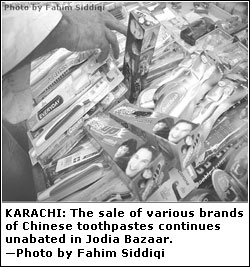 KARACHI, Aug 23: The sale of Chinese toothpaste in local market has not felt any impact despite the campaign in US and elsewhere against the product allegedly containing poisonous substance because it enjoys only 2.5 per cent market share.
Some retailers in Jodia Bazaar are offering Chinese toothpaste at very cheap rate besides selling a packet of Chinese toothbrush at Rs10 carrying three brushes of different size.
However, the local producers of toothpaste (excluding Unilever and Colgate Palmolive) do not feel threatened over the marginal presence of Chinese toothpaste in the market as they claim to grab 75 per cent of the market (120 million tubes of different sizes per annum) out of total market size of 175 million tubes per year.
They claim that 40 million tubes are being produced by two leading multinationals, while toothpaste imported and smuggled from some countries stand at 15 million tubes per annum in which Chinese toothpaste has a paltry share of only five million tubes.
According to world media reports, the US Food and Drug Administration (FDA) was of the view that the Chinese toothpaste could contain diethylene glycol, which has been blamed for the deaths of at least 50 people in Panama last year. These brands are usually sold at “bargain” retail outlets, the FDA said.
“Pakistan is the only country in Asia where local producers of toothpaste virtually dominate the market. Chinese toothpaste may have scared the consumers in US but it definitely do not pose any threat to Pakistan,” Chairman Pakistan Toothpaste and Hygiene Care Manufacturers Association (PTHMA) Irfan Ahmed Sarwana told Dawn on Thursday.
He said the local consumers were totally unaware of the campaign launched in the US and other countries. They are also buying the Chinese toothpaste because it is cheap.
“Chinese toothpastes lack taste, flavor and quality and that’s why Pakistanis have not yet accepted it despite cheap prices,” he said adding that Chinese toothpastes were selling at Rs6 to Rs20 depending on the size.
“We are not threatened by entry of the Chinese toothpaste in the market because we are already beating them on both price and quality,” he said.
He said Chinese toothpaste could not compete with locally made products as 10 manufacturers were offering good quality toothpaste at reasonable price.
Meanwhile, an executive of a leading multinational toothpaste company, who asked not to be named, said that there had been no reports of fake or sub-standard Chinese toothpaste in the local market.
The company has always urged its consumers to use only trusted toothpaste brands made by reputable manufacturers, he said.
“Our experience elsewhere in the world has been that the fake toothpastes lack key formula ingredients such as fluoride and are often produced with poor quality controls,” he added.
The executive said that the local producers had adequate capacity to meet the market needs. “Today we make up for about 98 per cent of toothpaste production, which market data puts at bout 7,400 tons annually,” he added.