0
0

LONDON, Aug 12: The US “surge” of troops in Iraq is likely to fail, a British parliamentary committee said as it delivered a critical report on London's foreign policy in the Middle East.
“It is too early to provide a definitive assessment of the US 'surge' but it does not look likely succeed,” the House of Commons Foreign Affairs committee said in a wide-ranging document. The Commons is Britain's lower parliamentary chamber.
“The committee believes that the success of this strategy will ultimately ride on whether Iraq's politicians are able to reach agreement on a number of key issues.” Instead, it called on the government to set out what action it was taking to foster political reconciliation between Sunni and Shia Muslims and Kurds in Iraq. And it called for evidence of Iran's backing for insurgents in the south.
The report comes as Prime Minister Gordon Brown, like his predecessor Tony Blair, faces pressure to withdraw British troops.
There is growing disquiet, including within the military, that its presence is hindering rather than helping Iraq.
British troops are suffering mounting losses from the regular mortar attacks on their bases at Basra Palace and Basra Airport in the south of the country. Elements within neighbouring Iran have been accused of complicity.
But Brown, who has admitted that “mistakes” were made in post-war Iraq, has refused to change policy.
He is due to announce his future strategy on Iraq to parliament in October.
Already, there is speculation that he will outline a phased pull-out, to switch the focus to Afghanistan, where 7,000 British troops are fighting the Taliban.
The assessment will come after US General David Petraeus and the US ambassador to Iraq Ryan Crocker deliver a report to Congress mid-September on the effectiveness of the 30,000-strong “surge” in and around Baghdad.
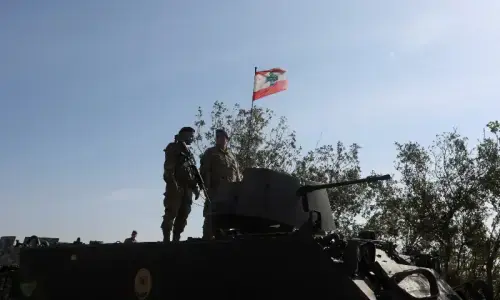
Elsewhere, lawmakers renewed criticisms of Blair's Middle East policy and particularly his refusal to call for an immediate ceasefire during Israel's conflict with Hezbollah militants in Lebanon last year.
Coupled with Iraq, lawmakers said British foreign policy had damaged the country's reputation in the Arab and Islamic world and could affect its ability to influence the political situation in the Middle East.
Brown's administration needed to work to improve and restore the country's standing as an honest broker in the region, they added.
On the Israel-Palestinian issue, British and Western governments' attitude towards Hamas had helped seal the fate of the fledgling national unity government and had failed to resolve factional violence, they said.
As a result, the committee urged a rethink on British policy on Hamas, which the European Union and the United States deem a terrorist group. It suggested the government deal directly with moderate members to help the peace process.
With Blair now special envoy for the Middle East Quartet of the UN, EU, United States and Russia, his mandate should be widened from Palestinian institution building to direct talks with Hamas and other parties, it added.
But it said the so-called “Roadmap for Peace” — brokered in 2003 and envisaging a two-state solution — had largely become an “irrelevance”.
“The unwillingness of the Quartet to challenge robustly the failure by both sides to meet their obligations has undermined the usefulness as a vehicle for peace,” it said, although it added that its basic objectives should remain.
On Lebanon, the committee urged direct engagement with moderate Hezbollah lawmakers in parliament. And it said more should be done to forge links with Syria because of its significant role in most of the key issues affecting the region.—AFP