0
0

KARACHI, July 29: Today, a family earning even Rs20,000-Rs25,000 a month cannot think of owning a house. This was observed by Tasneem Ahmad Siddiqui, known social scientist, in his lecture on weekly lecture on “Katchi Abadis: Why they crop up? What is the solution?”
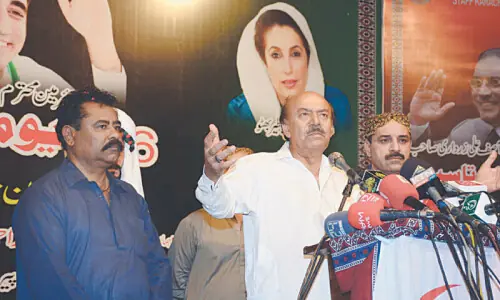
The event, presided over by Programme Director of the Urban Resource Center Zahid Farooq, was the latest of a series of lectures organised by the Pakistan People’s Party at the People’s Secretariat on different topics.
Mr Siddiqui, the architect of the “Khuda Ki Basti”, a welfare programme aimed at providing low-cost housing units to the poor, said that housing has emerged the most pressing problem being faced by the lower and middle class people in urban areas.
How could the people with a monthly income of 5,000 afford even a rental residence after spending 70 per cent of the amount on the most essential requirement, food and clothing? he questioned. He noted the widening gap between the rich and poor over the past seven/eight years, and pointed out that thousands of people were living in subhuman conditions in slums.
He also referred to an interesting aspect of evolution by saying that every generation of those having a resident in some posh locality grew taller and healthier than the previous one, while the successive generations of those living in katchi abadis registered a downward trend vis-à-vis health and height of their individuals.
“The reasons are malnutrition, health hazards, poor living conditions, lack of a sound sleep, etc.,” he said.
He pointed out that 50 per cent of the city’s population lived in Katchi abadis and belonged to the skilled or unskilled working classes.
He said these people had never been a burden on the state. Nothing came cost-free for them. They would buy and build their houses on their own and pay of the scarce utility tariffs at a much higher rates. Tracing the history of katchi abadis, he said the phenomenon was noted immediately after the Partition with the influx of migrants but it had now grown into an “organised land-grabbing” having been resorted to by the land mafia in complicity with police, revenue officials and elected representatives.
Mr Siddiqui said the government had abandoned development of housing schemes for the low-income groups under the pressure of the World Bank. The WB-dictated development programme delayed construction in the housing schemes by 15 to 20 years, he said, adding that as a result, the schemes like Surjani, Gulzar-i-Hijri, Shah Latif Town, etc., could not be developed promptly and perfectly.
Zahid Farooq criticised the government saying that the old settlements inhibited by the lower-class were being bulldozed to make way for the mafia’s commercial plazas.