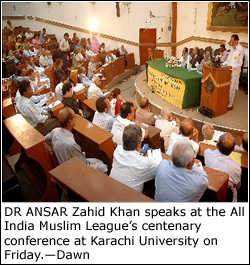
 KARACHI, July 20: Though a lot has been written about the freedom movement, most of it is marred by sentimentalism and emotion and it is high time we started looking at history with an objective eye.
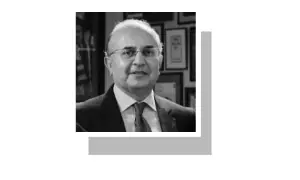
This was the thrust of Dr N.A. Baloch’s speech at the inaugural session on Friday of a two-day international conference being held at Karachi University to celebrate the centenary of the All India Muslim League. Dr Baloch, who is the former vice-chancellor of Sindh University and the founder vice-chancellor of the International Islamic University in Islamabad, was chief guest at the occasion.
Other prominent speakers included Dr Ansar Zahid Khan, General-Secretary of the Pakistan Historical Society, Prof Sharif-ul-Mujahid and Ms Sadia Rashid of the Hamdard Foundation. Leading scholars from India, Bangladesh and the UK, including Indian political scientist Prof Dr M. Aslam Jawed, were also in attendance.
Dr Baloch said that people who forgot their history lost their national identity. He observed that though there is nothing wrong with being emotional about one’s history, there comes a time in every nation’s evolutionary process that maturity replaces emotionalism. He said that it was high time we became critical of ourselves and analysed the past so that a new course could be plotted for the future.
Dr Ansar Zahid Khan deflected criticism by some quarters who considered that such conferences were a waste of resources. He said seminars like these helped raise public awareness and provided a platform for a meeting of minds.
Prof Sharif-ul-Mujahid observed that the purpose of holding this conference was to rekindle interest in the Muslim League and to assess its triumphs and failures. He said that the decade of 1937-47 was the League’s most active, as before this it was largely a “paper organisation.”
He noted that the creation of Pakistan was the League’s biggest achievement and pointed out that in an editorial, a British newspaper of the time (1947) had observed that Pakistan was the most major achievement of the Muslims after the fall of the Ottoman caliphate.
“However, we have not done justice to the Muslim League,” he lamented, as far as scholarship was concerned.
Indian scholar Prof Aslam Jawed delivered his comments in Urdu, saying that he was glad to be able to speak in his mother tongue. He succinctly summed up the latter history of Indian Muslims, starting from the decline of Mughal rule after Aurangzeb, to the nadir of the Indian Muslim nation following the defeat of 1857, mentioning the machinations of the British in pursuit of their policy of divide et impera – divide and rule – along the way.
KU Vice-Chancellor Prof Dr Qasim Raza Siddiqui, in his presidential address, said that conferences like these provided opportunities for history to be set right, free from prejudices, while Dr Syed Jaffar Ahmed, Director of the Pakistan Study Centre pointed out that though the All India Muslim League’s centenary was in 2006, logistical issues had pushed the conference to 2007.