0
0

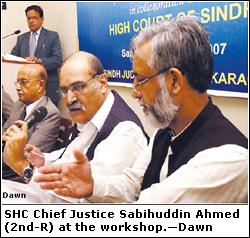 KARACHI, July 14: The judiciary cannot work in isolation and must be aware of the grievances of the people in order to alleviate them. Keeping this in mind, members of the bench must deal with elected representatives.
This was the message the Chief Justice of the Sindh High Court, Sabihuddin Ahmed, gave to the 23 (out of the total 24 invited) district and sessions judges who attended a workshop held at the Sindh Judicial Academy here on Saturday.
He was replying to the objections raised by some judges over the inclusion of “political” individuals in the soon to be formed Citizen-Court Liaison Committee (CCLC) in Sindh.
The workshop was organised under the aegis of the Access to Justice Programme (AJP), which is funded by the Asian Development Bank, and the Provincial Programme Management Unit, Sindh, in collaboration with the Sindh High Court.
Catching the spirit
Propelled by the devolutionary spirit ushered in by the Musharraf government in 2001and based on similar committees already working in the NWFP and Balochistan, the AJP hopes to replicate what its representatives describe as a positive experience in Sindh. A source in the AJP claimed that the Sindh CCLC should be formed within a month.
Mohammad Afzal Kahut, Programme Director of the AJP, gave details of the composition of the committees. He said the district/sessions judge would chair each committee at the district level, while the president of the district bar association, naib nazim, EDO (law), district ombudsman, women and representatives of civil society were suggested as possible members of the committees.
‘Save us from the politicians’
However, the mention of the naib nazims’ inclusion in the committee elicited a somewhat impassioned response from some of the judges, with one judge asking the speakers to “save us from the politicians.”
This was the point when Justice Sabihuddin Ahmed stepped in to assuage the fears of the honourable judges.
“Freer public opinion is a check. Judges must insist that there are no closed door meetings. There can be no personal favours. We have to cope with the situation,” he said, adding that members of the press should also be included in the CCLCs.