0
0

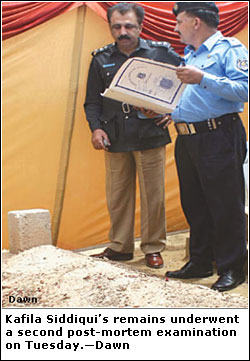 KARACHI, July 10: Forensic experts who carried out a second post-mortem examination on the remains of Canadian national Kafila Siddiqui on Tuesday said the victim’s first autopsy left a lot to be desired.Ms Siddiqui died under suspicious circumstances in Islamabad and an autopsy was performed at the city’s PIMS medical complex.
“The first post-mortem examination was very substandard,” said Dr Umar Memon, chairman of the medical board constituted by the Sindh government and head of the department of forensic medicine at the Dow University of Health Sciences.
“It does not even provide guidelines for the investigator, which is essentially why the procedure is conducted,” he told Dawn, adding that the unsatisfactory report was one of the reasons for the concern voiced by Ms Siddiqui’s family.
A mobile X-ray unit was taken to the graveyard to carry out radiography tests. Sources said that the body’s organs were found to be intact and the only indication of an earlier autopsy was an incision in the abdomen. Tissue samples were collected for toxicology, while radiology was also performed.
Dr Memon said that the presence of water in the grave caused difficulties in exhuming the body, which was also affected by the brackish water. “However, the provisional report will be sent to the relevant authorities in a day or two, while the entire process – including the chemical examiner’s report – will take ten to 15 days,” he said, adding that the investigation officer would then decide where the samples were to be sent for analysis.
On the condition of anonymity, a source on the medical board told Dawn that no major clue suggesting the cause of death had been found in the post-mortem examination. However, Ms Siddiqui’s family’s assertions that she had been starved had been established as unfounded. The source added that the body’s forehead bore evidence of violence and a blood clot was found in the left eye.
The four-hour-long post-mortem examination was carried out at North Karachi’s Mohammed Shah graveyard in the presence of Ms Siddiqui’s widower, Salman Qaiser, who pointed out that the mark on the forehead of the deceased had not been mentioned in the PIMS autopsy report and doctors had not collected blood and urine samples.