0
0

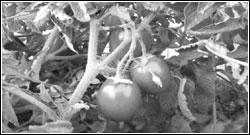 TOMATO is a major vegetable which has achieved tremendous popularity over the last century. It is grown commercially wherever agronomic conditions permit. Tomato, both for processing and fresh market, has become one of the most important crops in agriculture. Growers are continually being innovative by direct seeding into the field as well as growing plants in the green house.
Tomato cultivars today have to compete in an ultra competitive market, and the seeds from these cultivars have to fulfil even more qualifications than the seeds of their predecessors. After harvest, seeds start deteriorating, moving inexorably towards death. Among properties of vigorous seeds are rapid and uniform germination and the rate of uniformity of germination generally declines as seeds deteriorate.
Tomato is one of the most popular home garden vegetables. Originating in Central and South America, tomato was thought by early American colonists to be poisonous and was not recognised as a useful vegetable until the 1800s. Eaten raw or in innumerable cooked dishes, today tomato is an almost daily part of the family diet. When grown as staked plants, tomato requires a relatively small amount of space, yet is capable of producing four to five kg or more of fruit per plant. Tomato is low in calories and a good source of vitamin C.
Modern agriculture demands that each emerging plant grow rapidly and develop uniformly under a wide range of environmental conditions. Every farmer is sensitive to the need for rapid, uniform seedling emergence. Crops should be given a good start to grow tall, strong and healthy. There are more chances to get maximum yield potential in those seeds that can germinate rapidly by obtaining a uniform and vigorous plant stand whereas stunted and sick plant growth is reported for slowly growing seeds.
Many seeds from freshly harvested tomato seed lots often fail to germinate due to presence of dormancy (a block to the completion of germination). Dormancy has also been reported even in one-year-old tomato seeds and it results in erratic and unacceptable seedling’s emergence, causing problems for tomato production.
Low temperature also affects tomato plant growth at seedling stage which results in direct loss of yield. Tomatoes cannot tolerate frost. The timing for planting/sowing outside is therefore a key to successfully growing tomatoes. If tomato seeds are to be sown directly outside (not really suitable in cooler climates), they must be sown when the soil temperature is (and will remain) above 10C -- any lower the temperature the seeds will not germinate.
Where seeds are sown under cover (poly tunnels or cloches) or indoors, the aim should be to sow the seeds so that they reach the stage where they can be transplanted outside. Tomato plants take roughly seven weeks from sowing to reach the transplanting stage.
Some plants are resistant to cold, salinity or drought by accumulating a large quantity of organic osmo-protectant solutes. These solutes protect plant against freezing, heat, drought or salinity. Breeding is the suggested way to improve stress tolerance in crops with the natural ability to accumulate osmo-protectants. In crops with poor or no solute accumulating ability, genetic engineering is a way to increase stress tolerance.
Tomato crop suffers significant yield losses due to low temperature. Breeding to develop cold tolerant tomato cultivars takes about 10 years. Recent research has shown that seed priming in which seeds are soaked in water or salt solutions for specific period followed by re-drying before sowing and external application of osmo-protectants are relatively cheaper and quicker ways for better stand establishment and cold stress tolerance in tomato.
The seed producing agencies and growers both suffer a lot due to the production of low quality of seed that is one of the major yield constraints in fruit-bearing vegetables like tomato grown in Pakistan. The import of tomato seed is very expensive which is poor farmers cannot afford. This is very important to discourage import of vegetable seed and overcome the risk of diseases and quarantine. There is a need to enhance quality of local seeds.
Tomato is among crops which are responsive to priming. Priming technology can be applied to improve emergence, seedling growth and stand establishment under non-optimal conditions, leading to a maximum yield under a range of conditions. By improving establishment problem of tomato under low temperature, it would lead to increase in annual income of the tomato industry. Thus, different seed priming strategies along foliar application can be helpful in breaking seed dormancy, improving germination and seedling vigour, resistance to cold and ultimately achieving good harvests of tomato.