ISLAMABAD, March 8: An opposition senator on Thursday claimed that the state of emergency proclaimed by former prime minister Nawaz Sharif in May 1998 could only be lifted by parliament through a two-third majority.
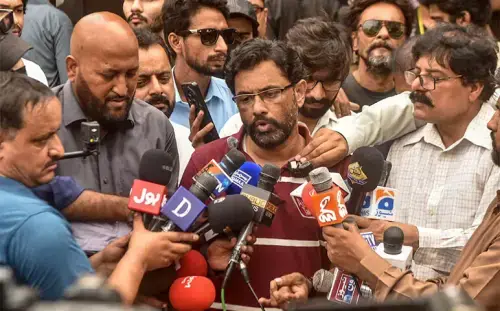
Commenting on reports regarding possible imposition of emergency ahead of general elections, Senator Babar Awan told reporters here at the Supreme Court that the emergency imposed by the Nawaz government had never been lifted.
The emergency rule, he explained, was continued by President Pervez Musharraf through the Provisional Constitution Order (PCO), Order Number 1 of 1999 after the military coup.
Citing proclamation of emergency Order No 2-10/99-min.1 of October 14, 1999 he said the order stated: “In pursuance of deliberations and decisions of chiefs of staff of the armed forces and corps commanders of the Pakistan Army, General Pervez Musharraf proclaims emergency throughout Pakistan and the whole of Pakistan will come under the control of the armed force.”
He said that section 3 of the order further stated that the proclamation would come into force at once and would deemed to have taken effect from October 12, 1999 meaning that emergency proclaimed by the Nawaz government was given continuation, which in turn meant that Pakistan had remained under the state of emergency since May 28, 1999.
The continuation of emergency was also given constitutional protection under the Legal Framework Order (LFO) under the Chief Executive Order No 24 of 2002.
Later with the help of the Muttahida Majlis-i-Amal (MMA), he explained, the LFO was shaped into the Seventeenth Constitutional Amendment and a new Article 270AA was inserted in the Constitution to legalise the state of emergency.
Article 270AA, which deals with validation of laws, suggested that: “The proclamation of emergency of October 14, 1999, all president’s orders, ordinances and chief executive orders, including the PCO order No1 of 1999 and all other laws made between October 12, 1999 and the date in which this article comes into force are hereby affirmed and adopted to have been validly made by the competent authority and shall not be called in question in any court of law on any grounds.”
He said that the article further affirmed that laws and enactments would continue to be enforced till ‘altered, repealed or amended by the competent authority’, adding that it had “never been altered, repealed or recalled.”
Under sub-section 3 of Article 270AA, parliament is the only competent forum to do away with the emergency through a two third majority, he said.