0
0

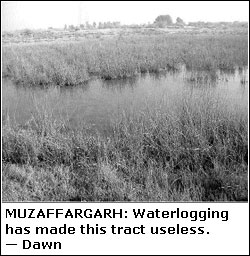 MUZAFFARGARH, March 2: A vast area of 200,000 acres has been waterlogged and damaged by salinity owing to seepage in the Muzaffargarh canal, leaving many a farmer in financial crunch over the last couple of years.
More and more area is being affected with every passing day as the government has failed to check the situation, allege farmers. Built in 1964, the Muzaffargarh canal spreads over 74 miles and irrigates 700,000 acres.
Malik Ghulam Fareed, of Hamdaniwala, owns 40 acres but his two sons work as labourers in a local jute mills to make both ends meet.
“Until the 1980s, I was leading a prosperous life and owned livestock. But gradually my land got waterlogged and exposed to salinity which made me think of going for other means of subsistence. Now with my land lying barren, I have sent my sons to work in mills.
“There was a time when I used to employ people to work on my land but now my sons are doing menial jobs,” deplored Ghulam Fareed who is not the only victim of waterlogging and salinity.
 Several hundred families have suffered great losses due to the situation. A visit to Mahmoodkot, Hamdaniwala, Kloowali Darri, Pir Barkhurdar, Bhakkar Noon, Budh and many other areas along the Muzaffargarh canal revealed that there were farmers who had not reaped a single harvest in the past 20 years.
“We have repeatedly asked our elected representatives to get the (Muzaffargarh) canal bricklined, but to no avail,” protested Advocate Malik Naseem Abbas Budh whose land has faced massive damage in the recent years.
Waterlogging and salinity have not only affected fields, but in several villages many houses had been rendered unfit for habitation.
“The people living along the canal have to re-build their houses after every five to 10 years because whenever it rains, it weakens the building structures,” said Syed Farhat Abbas Shah of Mahmoodkot.
Many families have changed their means to livelihood; some have taken to dairy business while many others have shifted to urban areas where they earn their livelihood by doing odd jobs or even selling vegetables.
Earlier, areas within a radius of two to five kilometres of the Muzaffargarh canal were affected, but with the passage of time the damage was extended to a massive scale and now hundreds of thousands of acres had been damaged.
An irrigation department official, Riaz Almani admitted that neither government nor his department had so far taken any concrete measure to check the menace. In 2002, he said, the department with the help of World Bank had estimated that $800 million would be required to brickline the canal and the proposal was sent to the Executive Committee of the National Economic Council for approval.
No development had, however, taken place on the project and the government had also failed to recompense the victims.