0
0

KABUL: A chuckle rang out from under the blue burqa as the mother of eight rifled through a mound of children's sweatshirts. ''Yes,'' the woman said, ''life is better today. I can go shopping by myself.''
An Afghan barber smiled as he recalled a shop full of customers waiting to shave their Taliban-mandated beards. The eyes of the janitor at the town cinema lit up as he described Northern Alliance fighters rolling into town.
''That's when the music started,'' said the janitor, Jan Mohammed.
Five years ago on Monday, on Nov. 13, 2001, the Taliban regime that had imposed a harsh brand of conservative Islam fled Kabul as Northern Alliance fighters backed by a US-led coalition poured in. Residents celebrated in the streets with music and laughter. Men flocked to barber shops to shave their long beards.
No official celebrations were held on Monday, and no Afghans approached in street interviews even knew it was the five-year anniversary. But many smiled at the memory of the Taliban's fall, though some also lamented the country's deteriorating security situation.
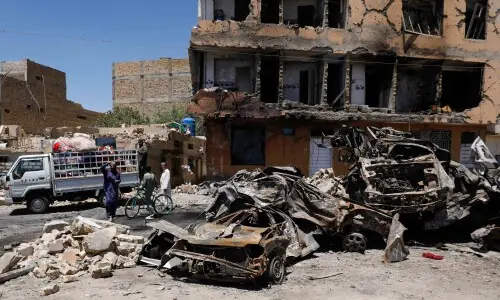
A new high-level report released on Sunday found that violence has risen fourfold over 2005 and that more than 3,700 people have died in 2006 because of insurgency-related violence.
Still, Pashtun, a 40-year-old mother who goes by one name, said she appreciated the fact she could go shopping by herself before Kabul's heavy winter settles in.
''The years the Taliban were in Kabul, I was like a prisoner,'' she said, as other female shoppers nodded in agreement. ''For five years I had to stay at home.''
Pashtun still wears the all-covering blue burqa worn by a majority of women in Kabul. She said it's tradition for women in her family to wear it, but that she has friends who now only wear a headscarf.
The Taliban forced all women to cover themselves and did not allow females to leave home without a male escort, meaning widows who had lost husbands in Afghanistan's decades of strife had to rely on other family to survive.
''I came to work that day and started shaving beards,'' said Mohammed Hesa, a 22-year-old barber. ''People were lined up outside the shop.'' None of his 10 customers in the shop on Monday brought up the five-year anniversary.
''Today we have a lot more freedom,'' he continued. ''Then your beard was not under your control. Your wife was not even under your control. If you walked with her in the street the Taliban would stop you and ask 'What is your relationship with her?'''At the town's central cinema, Mohammed said he was happy when the Taliban fell, thinking Afghanistan would see a new era of freedom and security.
''But it's not that good now,'' he said. ''The other big problem today is figuring out how to feed your children.''
Afghanistan enjoyed a relative period of calm in the years after the US-led invasion launched in October 2001 to oust the Taliban for hosting Osama bin Laden. But insurgents have this year launched a record number of roadside bombs and suicide attacks, and there have been heavy clashes between insurgents and Afghan and Nato security forces, particularly in the southern and eastern provinces near the border with Pakistan.
A report released on Sunday by the Joint Coordination and Monitoring Board said violence has increased fourfold this year, though a senior Western official involved with the JCMB said the report also shows the Afghan government is making progress.—AP