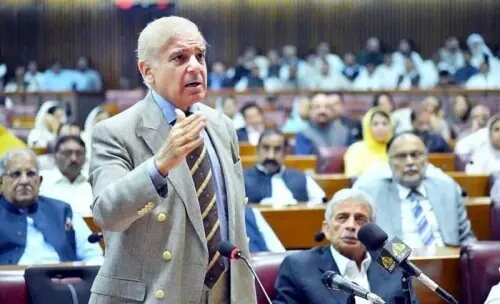
KARACHI, Oct 22: President Gen Pervez Musharraf has made an impassioned plea for legislation against ‘rowdyism’ that has traditionally greeted a president’s address to parliament.
The president, wearing a grey suit and a self-satisfied smile, made the suggestion on a Sunday evening TV show whose interviewer, known otherwise for abrasive questioning, seemed to exercise considerable restraint.
“I would urge the National Assembly to pass a bill to put an end to the kind of spiteful heckling and pandemonium that accompanies a presidential address to parliament,” he said.
President Musharraf has so far shied away from addressing parliament — a constitutional requirement under Article 56.
“And I am not making this suggestion because of my own concerns. I have seen this in the past. Since the presidential address is televised, there is an obvious need for formulating a code of conduct by lawmakers,” he explained.
President Musharraf feared that great political instability would come about if former prime ministers Benazir Bhutto and Nawaz Sharif were allowed to stage a comeback before the 2007 parliamentary elections. But he promised that if Ms Benazir and Mr Sharif sought to meet him, he would consider their request.
Answering a question, the president rubbished claims made by Gen Anthony Zinni, who headed the US Central Command from 1997 to 2000, that it was the army leadership who had advised Mr Sharif to accept the US proposal for an immediate withdrawal of troops from Kargil in 1999.
Gen Zinni was sent to Pakistan as a special envoy of then US president Bill Clinton during the Kargil crisis. In his book, “Battle Ready”, he dispels the general impression that it was the civilian leadership in Pakistan that sought Washington’s help for arranging a respectable withdrawal from Kargil.
President Musharraf insisted that there was no truth in Gen Zinni’s assertions. Speaking on a string of rebuttals issued after the recent launch of his controversial memoirs, “In the Line of Fire,” President Musharraf said Ali Kuli Khan’s memory was playing a trick on him.
Mr Khan, a retired lieutenant-general, was chief of general staff when Gen Musharraf was appointed army chief by Mr Sharif. The Sandhurst-trained serviceman criticised the presidential memoirs and, in a lengthy diatribe issued to newspapers, said that Gen Musharraf had sought to malign him.
President Musharraf said he knew Mr Khan’s calibre because he [Gen Musharraf] had been his instructor. He recalled that Mr Khan had made out a strong case for the dismissal of the prime minister and the president.