0
0

 SUGARCANE is an important cash crop of Pakistan. It has helped in the growth of sugar industry, uplifted the socio-economic conditions of farmers, and contributed in the economic development.
It is the biggest source of revenue. It contributes billions of rupees to national coffers in the form of duties and taxes. In recent industrial advances cane is not only confined to sugar production, but its bi-products such as alcohol, chipboard, and dozens of others industrial chemical compound are manufactured during processing.
This crop is cultivated in different agro-climatic conditions and various soil types extending from lower to upper Sindh. Lower Sindh has coastal climate having long days, moderate summer and mild winter, and has well drained alluvial soils. The climate and soils of central Sindh is also favourable for profitable cane production.
The upper Sindh has extreme climate but with fertile alluvial soils and available irrigation resources it has established the crop and industry on economic footing.
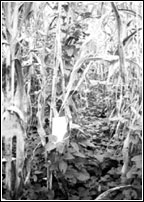
Sugarcane is a long duration crop; hence farmers have to wait 10-14 months to get the return of their investment from fields. It is planted by keeping adequate space in between the two rows. This space remains unused until full plant development and short duration crops can be grown in vacant space without affecting cane yield.
In addition, it is labour-intensive, high inputs user and serious competitor of cotton and some other garden crops. The economics of sugarcane is questioned when farmers earn more profit from other crops. Thus, farmers follow various intercropping practices to increase more income per acre.
In early stage it grows slowly and can accommodate a number of short duration crops. Major intercrops combination in sugarcane identified are: sugarcane + sunflower; sugarcane + onion; sugarcane + wheat; sugarcane + coriander; sugarcane + mustard; sugarcane + tomato and sugarcane + cabbage and spinach.
Intercropping has been recognised an excellent practice to increase total yield, high monetary returns, and greater resources utilization and fulfil the diversified need of farms. From intercropping practices, pest management benefit has been realised due to increased crop diversity, and intercropping reduced smut disease of sugarcane by interrupting the smut spores.
It also offers opportunity to farmers to engage in nature’s principle of diversity on their farms, also superior quality of cane juice could be produced by intercropping with soybean. The gross monetary returns have been recognised as highest economic benefit earned from intercropping cane with potato and lowest from pure cane. It was also found that sugarcane with potato intercropping was the most profitable combination, followed by sugarcane onion and sugarcane coriander inter-cropping.
The economics of different inter-crops was worked out and found that sugarcane + onion + wheat were the best combination which gave maximum net profit. In addition, it was found that sugarcane + onion, sugarcane + potato were found to be best inter-crops combination.
Moreover, it was found that sugarcane + potato + vegetable amaranth was profitable, followed by sugarcane + onion intercrops. Also that sugarcane and maize intercrops showed good results but maize competes with the sugarcane for light and water and results inter-cropping reduced cane yield.
Inter-cropping in sugarcane generally requires more labour, thereby creating productive employment opportunities and generating higher incomes. Many studies indicated that inter-cropping increase the grower’s net income, creates the employment opportunities for landless and owner household families.
Unfortunately, however, very little research effort has been made pertaining to input use, seasonal pattern of production and other practices followed by farmers. Individual researchers, provincial organizations and universities undertook the studies on economics of sugarcane.
Very little is known about the cost of production and profitability of inter-cropping in sugarcane and factors affecting yield by various inter-cropping. The advantages of inter-cropping have been recognized by the farming communities, but very recently it has increased the real interest among researchers and policy makers that sugarcane grower’s are earning huge income from their fields by adopting various inter-cropping practices. There are number of short duration crops which can be intercropped in sugarcane. These are:
Autumn crops: Potato, tomato, chillies, onion, garlic, carrot, turnips, cabbage, knoll kohl, lettuce, coriander, peas, lady’s finger, linseed, fennel, sarson, raya, sunflower, lentil and wheat.
Spring crops: Lady’s finger, chillies, tomato, mung, onion, tobacco, and sunflower.
For successful inter-cropping some critical precautions should be taken:
The inter-crop should not be taken as a major crop. It is grown just to have some additional income. Planting of inter-cropping should be done in inter-row spaces and plant to row spaces should be critically maintained to avoid undue competition. Three to four feet inter-row space should be adopted for inter- cropping.
Wider row planting should be preferred as it reduces the chance of inter- crop competition with least effect on cane growth and tillering. For vegetables, ridge planting is preferred. However, garlic, linseed, sunflower, raya and wheat may be planted on flat.
The crop variety should be selected which is short stature and of short duration. Long duration raya or late planted sunflower may suppress cane growth. Sunflower has not much depressing effect on cane when planted in September, October or November planted cane.
However, this combination is not fruitful in spring cane. In some cases relay cropping may produce better results–vegetables to be planted first, on trenches/ridges, and sugarcane to be planted in furrows in latter stage. Vegetables like chillies and onion have proved much remunerative in cane. Time crop should be ready for harvesting before February for autumn season crops (wheat, lentil, and garlic is an exception) and by April-May for spring crops.
Organic manures (FYM) are mandatory for raising a profitable inter-crop. Exhaustive crops like sunflower and maize may also give well inter-crop yield in land inter-cropped with organic manures.
Fertilizer requirements of inter-crops should be fully met. For good germination, planting of a small grain crops should be done in optimum “wattar” condition maintained in inter-row spaces or on beds. Over flooding of beds/ridges should be avoided. Weeds should be kept under check by suitable herbicides or manual weeding.
Soon after harvesting of inter-crop, the cane crop has to be paid full attention for timely inter-row cultivation and meeting its fertilizer requirements.