‘Country’s first sponge park’ to save rainwater, cut urban flooding risk
KARACHI: A water sensitive sponge park, which was recently inaugurated in Gulberg Town, will help manage rainwater as it has the capacity to hold up to 100,000 gallons during the monsoon events, experts associated with World Wide Fund for Nature-Pakistan (WWF-P) said on Friday.
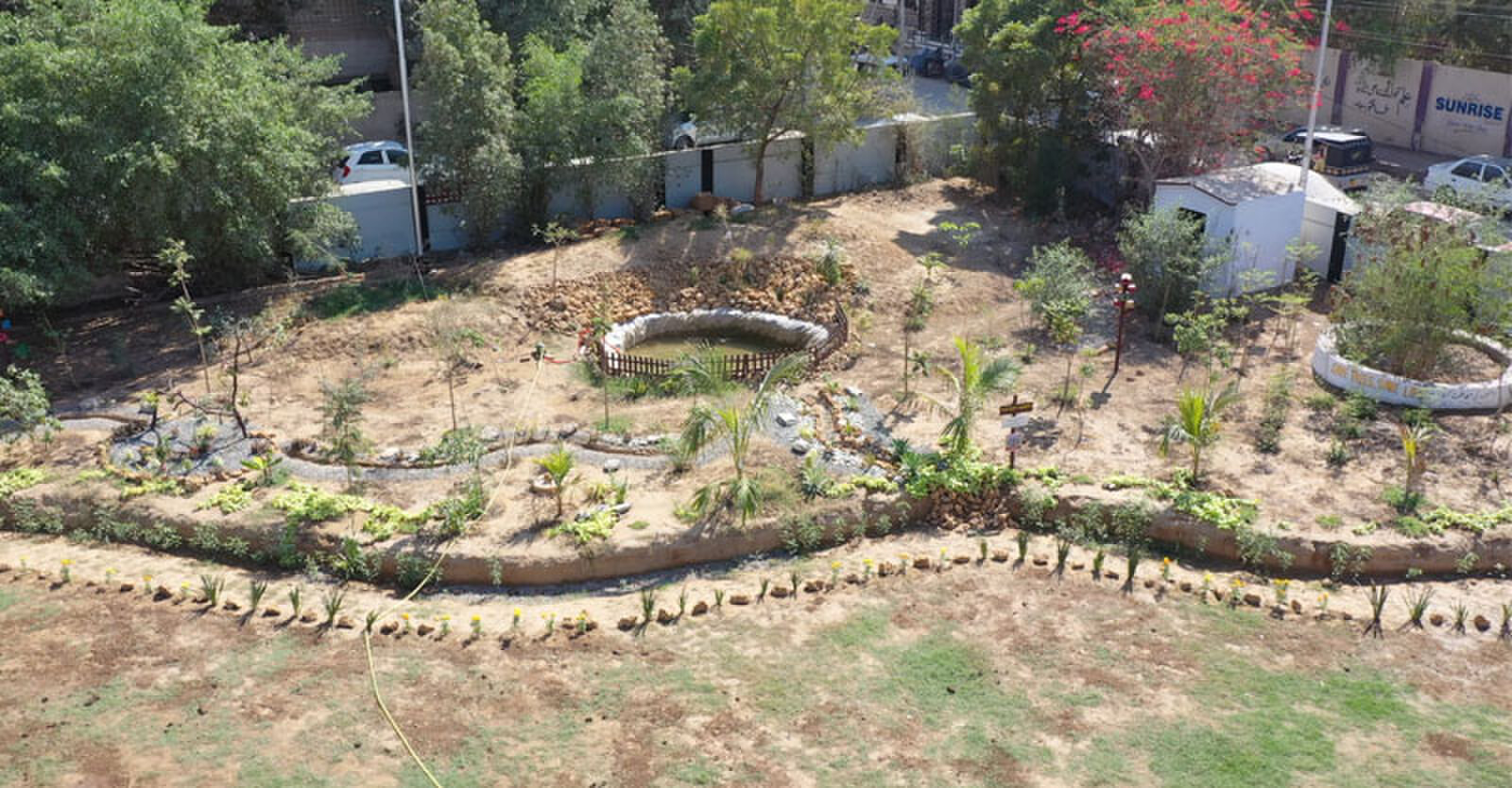
The WWF-P in collaboration with the Gulberg Town Municipal Corporation and GSK (GlaxoSmithKline) has introduced a unique urban green space design at Jamali Park in Federal B Area, Block 8, to manage rainwater, enhance infiltration and reduce surface run-off.
The experts described it as a practical example of how local governments can turn climate commitments into actual demonstrable experience.
Spread over one acre, the redesigned park now has rain gardens — green spaces that temporarily hold runoff in shallow planted areas, allowing it to support groundwater recharge after some retention and permeable pathways allow water to pass through to the soil below — bioswales and permeable pathways that allow the park to behave like a sponge.
Beyond the sponge elements, the park has introduced features such as native trees and dedicated biodiversity zone and a pollinator zone, which have been established to improve habitat for urban wildlife.
A community learning area has also been made part of the sponge park to allow the visitors the experiential learning opportunity and connect with nature.
The Jamali sponge park, according to officials, is a model that other municipalities can adapt, as the city loses much of the rainwater that falls on its paved streets and concrete paths, flowing into drains and eventually reaching the sea.
It was officially inaugurated as Pakistan’s first water sensitive sponge park at a ceremony that brought together representatives from government, academia, civil society members, corporate partners and local residents.
Jamali Park in Gulberg has rain gardens, bioswales and permeable pathways that let it soak up rainwater like a sponge
“The successful collaboration in redesigning the public park into a sponge space offers a practical example of how local governments can turn climate commitments into actual demonstrable experience in the public spaces residents use every day,” said Anum Farhan, senior programme adviser Asia – conservation, advocacy and policy, WWF UK.
Naeem Ashraf Raja, director of the Biodiversity Programme at the Ministry of Climate Change and Environmental Coordination, commended the WWF-P’s newly introduced sponge park intervention as a demonstration of how urban green spaces can support biodiversity and contribute to the goals of the Global Biodiversity Framework.
Sohail Ali Naqvi, director freshwater programme, WWF Pakistan highlighting the value of the Jamali Park as a demonstration site, emphasised that this water sensitive park put climate and water policy into practice.
“From nature-based features that support groundwater recharge and native vegetation, the park offers practical approaches to sustainable urban water management that municipalities can replicate and scale up across Karachi and other cities in Pakistan,” he said.
Gulberg Town Chairman Nusratullah shared that the town planned to replicate similar nature positive concepts in other parks across Gulberg.
As Karachi’s municipalities work to expand green cover, experts say, Jamali park shows how parks development and rehabilitation works can also complement the rainwater management and ground water recharge, promote urban biodiversity, reduce urban heat island effect and improve overall microclimate of the area.
Published in Dawn, November 14th, 2026