The C5’s Afghan security paradox becomes more pronounced at the 8th Moscow format
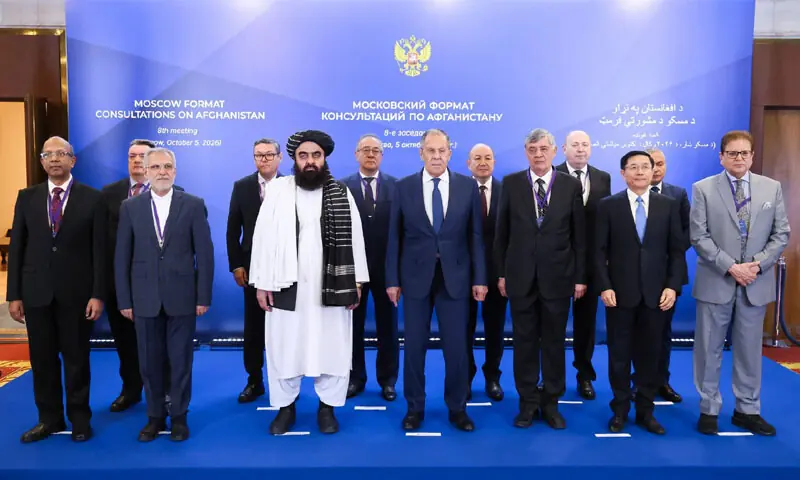
Security quagmires emanating from Afghanistan to Pakistan are similar to existential threats extending to Tashkent, Ashgabat, Astana, Dushanbe and Bishkek. The region’s glaring Afghan security paradox became more pronounced at the 8th Moscow Format involving fellow participant countries, China, Russia and Iran.
Ideally, the latest regional attempt to resolve the Afghanistan quagmire through confidence building measures should have produced a joint communique. Instead, Kabul’s disagreements on the lexicon, language, orientation and narrative regarding its role in promoting or harbouring transnational terrorism resulted in a historical development. For the very first time, the Moscow Format failed to issue a joint statement with Russia as the host nation expressing deep regret.
The Taliban’s defiance on terrorism
The Taliban’s defiance is ironic as no such objections were raised during the last format meeting in October 2025. Furthermore, this failure to generate joint understandings is not simply a diplomatic upset, but constitutes an existential threat towards achieving regional normalcy.
While Kabul consistently has consistently sought diplomatic recognition, unfettered economic assistance and regional integration since the 2021 US withdrawal, it has not demonstrated an iota of flexibility on the subject of terrorism. This applies to countries that have otherwise called for integrating instead of isolating Kabul through economic engagement and prospective regional connectivity including Turkmenistan, Uzbekistan and Kazakhstan.
The Taliban have, however, simply refused to acknowledge that the problem exists which presents several quagmires for Central Asian.
While neighbouring Pakistan rightly castigates the Taliban regime for harbouring the terror outfit Tehreek-i-Taliban Pakistan (TTP) on its soil, Central Asia security remains imperilled by the presence of terror groups including the Islamic Movement of Uzbekistan (IMU), the Khatiba Imam Al-Bukhari, the Jamaat Ansarullah — which specifically targets Tajikistan — the transnational Islamic State of Khorasan Province (ISKP) — which poses a threat to Eurasia and the international community — and Al Qaeda.
According to the UN’s 38th Analytical Support and Sanctions Monitoring Team Report, published months before the 8th Moscow Format, many of these terrorist organisations have Central Asian centric ideologies threatening state security and economic connectivity prospects. This includes investments in the approximately 11,000 km Trans Caspian International Transport Route (TITR), which remains a key economic priority for the region amid heightened instability in the Middle East impacting supply chains and oil price volatility. Export revenues from uranium ores, tungsten and copper for countries such as Kazakhstan and Turkmenistan can only be achieved if stability in Afghanistan is guaranteed. Kabul, however, refused to acknowledge its role in promoting transnational terrorist networks.
Instead, its rebuffing of Pakistan’s claims at the Moscow Format suggests that the Taliban remains impersonal to terrorist organisations operating in the Northern Badakhshan province lying in close proximity to Central Asian states such as Tajikistan.
The East Turkistan Islamic Movement (ETIM), for example, operates from Badakhshan as its major operations hub while aiming to jeopardise relations between China and Tajikistan. In November last year, an attack killed three Chinese workers in the Khation region of Tajikistan while later in the same year, another attack on Chinese nationals working for the China Road and Bridge Corporation resulted in two deaths. While Dushanbe demanded more action from the Taliban in 2025 amid the ETIM not claiming responsibility, the presence of the terrorist group on Afghan shores continues to pose an existential threat to Tajikistan.
A regional security issue
The Taliban’s muted response on terrorism is, hence, not limited to the Durand line alone. Kabul continues to provide ample operational space for bigoted ideologies to fester and sophisticated digital networks espousing extremism to take hold.
This includes the brazen dissemination of the ‘Sadoi Khorasan’ magazine, a publication produced by the Al Azaim Foundation of the ISKP. It directs non-Pashtun readers including Tajiks to join ISKP recruiters against the secular ‘apostate’ regimes of Tajikistan and Uzbekistan. Kabul’s lack of action against digital radicalisation processes, hence poses more central questions for Central Asian republics calling for economic integration with Afghanistan instead of isolating it.
Difficult policy decisions need to be made, amid Afghan authorities showing little flexibility in Moscow and a poor domestic track record of accountability.
Such defiance or plausible deniability (as some would call it) also questions Russia’s approach. While Moscow recognised the Taliban regime and removed it from its list of banned terrorist organisations in April 2025, its goal of destroying the ISKP remains unfulfilled.
While it is true that the Putin regime’s rationale for according recognition is based on maintaining influence to offset or rival the West, the Kabul regime’s apathy towards terrorism and leveraging of Western funding to keep its controversial regime intact punctures that objective. Since assuming power in 2021, donor funding as humanitarian assistance totaling $8 billion has allowed the regime to stay afloat. Such funding has not translated into economic prosperity or reform though, with widening trade deficits, a cash strapped economy and lack of action on militants indicating that Western humanitarian assistance has not translated into eschewing of militancy.
It is also clear that Pakistan as Kabul’s immediate neighbour has exhausted almost every diplomatic channel. Visits by foreign ministers, NSAs and the DG ISI have not resulted in tangible progress with the latest Taliban objection to the language used during the 8th Moscow Format serving as a clear indication that Kabul is exercising plausible deniability on militancy.
Hence, Central Asian states with a stake in regional connectivity ranging from Kyrgyzstan and Tajikistan via the CASA 1000 project and Turkmenistan and Uzbekistan from seaports and railways through TAPI and the UAP railway project remain less assured than before.
For these Central Asian states, the Afghanistan security quagmire constitutes a palpable threat with Kabul’s latest defiance in Moscow exemplifying just that.