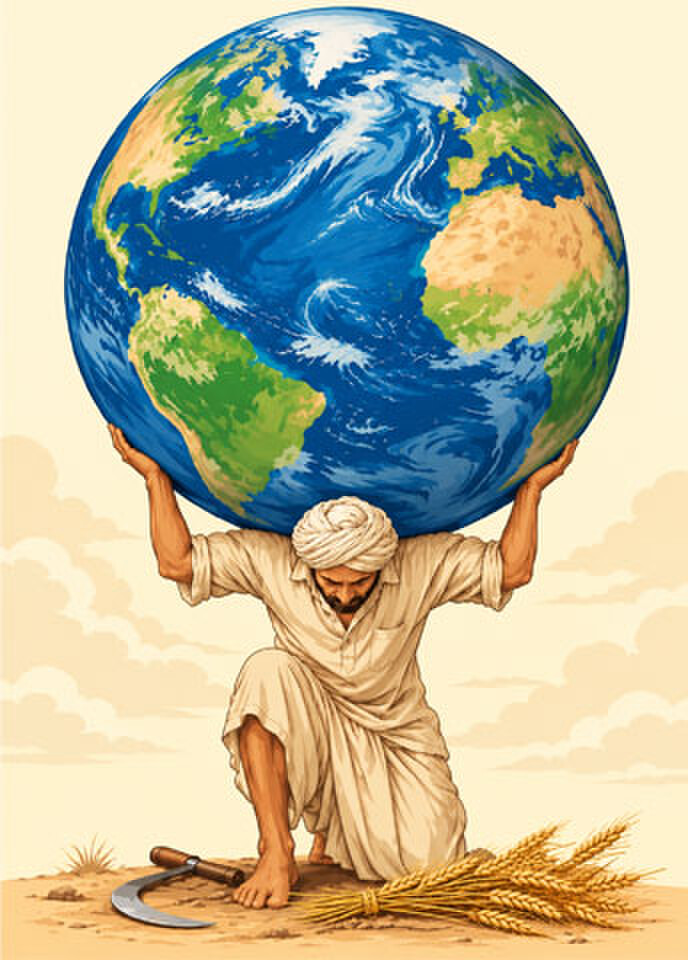
The claim that agriculture was never meant to be an income-generating activity sounds strange in an age that measures everything by return on investment. But no country can sustain its economy without securing its food supply. Food comes before the economy. It is the ground the economy stands on.
Farmers, of course, must earn a living. But that is only part of the question. The larger issue is how the state regards the sector. A government that treats agriculture purely as a business expects it to pay for itself, absorb its own risks and survive or fail on its margins. A government that recognises agriculture as a condition of national survival protects it before it fails.
Almost every serious country has chosen the second view. Pakistan has never quite decided.
China, the US and Europe all recognise that agriculture needs state support. Pakistan has yet to make the same systemic commitment to its farmers
FOOD BEFORE THE MARKET
Consider China. It has retained the market mechanism while building a system of state support around agriculture. Beijing sets minimum prices for wheat and rice, subsidises agriculture inputs and machinery, underwrites crop insurance, invests heavily in irrigation and maintains substantial grain reserves.
When market prices fall below specific thresholds, the state can step in through its procurement system. The logic is plain. The future of the food supply will never be left to this season’s arithmetic.
The United States, often held up as the model of market-driven agriculture, arrived at the same conclusion by another route. Its farms are large, mechanised and commercially sophisticated. They are also supported by the Farm Bill, commodity programmes, revenue protection schemes and a vast crop-insurance system, with premiums subsidised by the federal government.
American farmers have access to mechanisms that help them weather price collapses and bad harvests. Even one of the world’s most commercially oriented agricultural systems relies heavily on public risk management.
Europe does the same through the Common Agricultural Policy: direct payments, rural development funds, environmental support and market interventions. The objectives include sustaining farming communities and keeping agricultural land in production.
GESTURES ARE NOT A SYSTEM
This carries a lesson Pakistan rarely draws. When a European or US product enters the world market, it arrives with the state’s support already built into its price. The Pakistani farmer competing against it has far less protection; sometimes, he competes alone. What looks like competition between two farmers can, in reality, be competition between a farmer and a treasury.
The exposure is worst for the small farmer. A large enterprise has capital, storage, machinery and a bank that will take its call. A man with five acres has a harvest. One flood, a failed monsoon, a collapse in the mandi [market] price can wipe out a household’s income for the year. The state cannot abolish weather. But it can decide who carries the loss, and whether that loss is allowed to end a family’s farming altogether.
Pakistan does support agriculture. Support measures include subsidised credit, procurement arrangements, fertiliser and tractor schemes, irrigation projects and provincial programmes. Punjab’s Kissan Card gives eligible farmers seasonal credit for inputs. None of this is nothing. But it is a set of gestures, each responding to the last crisis, and gestures do not add up to a system.
A farmer may get subsidised credit and still find fertiliser unaffordable. He may get a tractor and still have no water, no electricity and nowhere to store the crop. He may bring in a good harvest and sell it the same week, when prices are at their lowest, because he cannot afford to wait. He may be promised a procurement price and then wait months to receive payment. Pakistan subsidises agricultural inputs but leaves the farmer largely exposed to income uncertainty, production risks and poor market access. The support reaches the field. It rarely reaches the farmer.
TAXING WITHOUT PROTECTING
And then comes Pakistan’s favourite remedy: tax the farmer. The belief is held with rare unanimity, in drawing rooms and on television, by people who have never sold a maund of wheat: that agriculture escapes taxation, that the escape is the size of the fiscal hole, and that closing it would settle the country’s accounts.
In 2025, the four provinces amended their agricultural income tax laws as part of reforms sought by the International Monetary Fund, bringing the rates closer to the federal income tax schedule. Punjab and Sindh have since deferred the application of the highest rates, an indication of the political influence wielded by landed interests in both assemblies. A landowner earning from a thousand acres should pay what a factory owner pays, and this essay defends him nowhere.
But the arithmetic refuses to do what the belief requires. The 2024 agricultural census counted 11.7 million farms, three million more than in 2010. Six in 10 were smaller than two and a half acres, while the average farm size had shrunk to about five acres. The farmer working those acres may harvest just enough to recover his costs, with little or nothing left that a tax officer would recognise as taxable income.
Agricultural income tax collections have historically been negligible compared with the national budget. This is unlikely to change because much of the wealth in Pakistani agriculture is concentrated among a relatively small number of large landowners, while production risks are borne by millions of farmers.
WHAT THE STATE OWES ITS FARMERS
No country that feeds itself looks to its farms to balance the budget. China, the US and Europe are net payers into agriculture, by wide margins. A state that cannot deliver fertiliser to a small farmer on time, and then turns up to collect tax from him, has confused the direction of the obligation.
Small and medium farmers produce the country’s wheat, rice, maize, cotton and sugarcane, as well as its vegetables, fruit and milk. They do this with little capital and a great deal of uncertainty. What they produce keeps rural Pakistan alive and keeps the cities fed. This is a national service performed at private risk, and it should be recognised as one.
That recognition means treating the essentials of farming as public infrastructure. Small farmers growing food crops need affordable fertiliser and certified seed, reliable irrigation, soil testing, extension services, storage, crop insurance and accessible credit. These are as fundamental to food security as roads and electricity grids.
The aim should be to make farming economically viable, not to guarantee profits. A farmer who farms badly may still fail. A farmer who farms well should not be ruined simply because the state left him exposed to the weather and the world market.
There is a harder argument beneath the economic one. A country that cannot feed itself buys its food with foreign exchange it does not have, from suppliers it does not control and at prices set elsewhere. It becomes hostage to a currency shock, a blocked shipping lane, a bad harvest on another continent. An army does not correct that. Neither does a growing GDP. Food is where sovereignty begins.
A food system is judged by four things: whether the farmer survives, whether the village holds, whether the city eats at a price it can pay, and whether the soil and the water are still there afterwards. Profit appears nowhere on that list. Producing more is the easy part; a country can produce more for a decade while all four measures deteriorate.
This means planning before the shortage, before the flood, before the import bill arrives. This includes strategic reserves, climate-resilient seeds, water management that assumes the next drought, transparent procurement paid on time, modern storage, insurance that pays. It includes policies that do not change with the minister and support that reaches the farmer rather than the patron, the distributor or the middleman.
Pakistan has treated its farmers as a problem to be managed when the wheat runs out. They are the reason it has not yet run out. The economy is how a country makes money. Agriculture is how it stays alive.
The writer is an essayist concerned with power, politics and culture. He can be contacted at suhaib.ayaz@gmail.com
Published in Dawn, EOS, November 8th, 2026