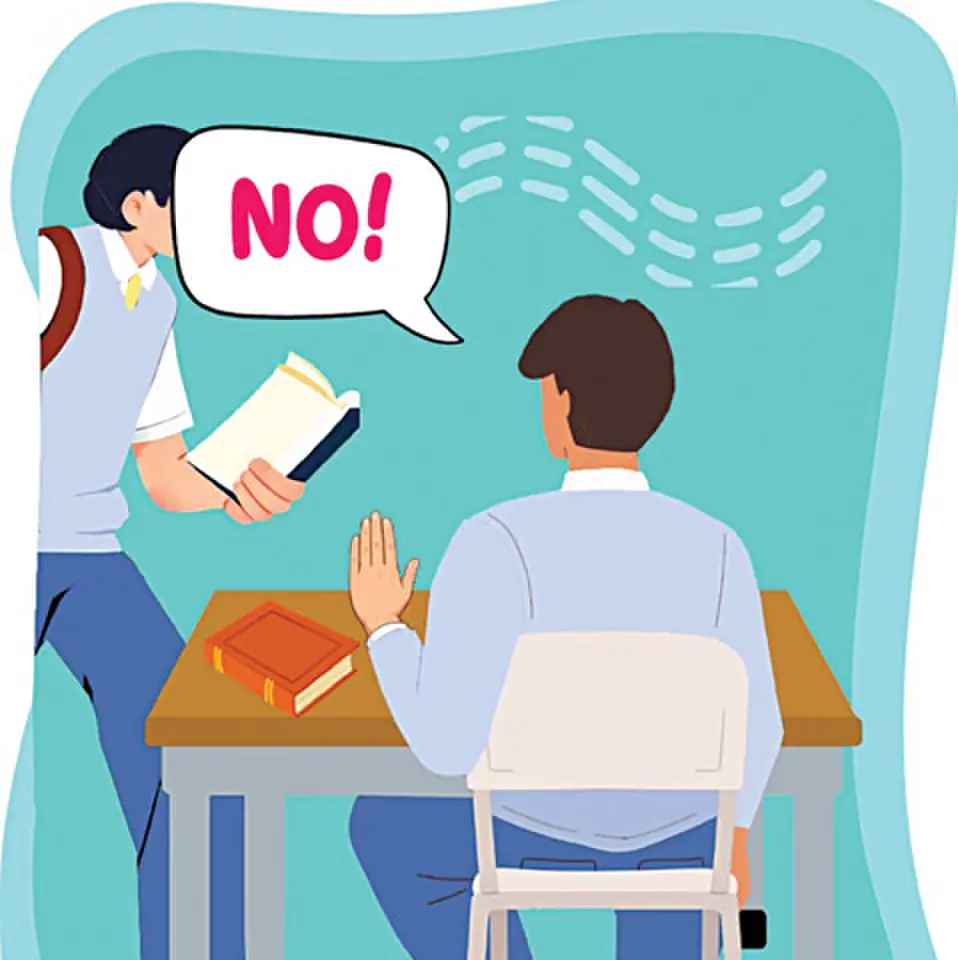
Sami was known as the most helpful student in his class. He helped everyone, not because he always wanted to, but because he couldn’t refuse. He feared that saying no would make others dislike him.
Whether it was homework, a school project or another task, students turned to Sami because they knew he would never refuse. He did their work, believing that otherwise, no one would be his friend.
One day, a classmate asked, “Can you complete my work, please?”
Sami had his own assignment to finish, but he agreed. The problem was that his classmate’s work wasn’t just two or three pages; it was 17 pages! Instead of doing his own work first, Sami spent two and a half hours completing the other student’s assignment. By the time he finished, he was exhausted and had no time left for his own work.
The next day, he quietly handed the notebook to his classmate, frustrated that someone else’s work had left his own unfinished.
Later, when the teacher asked for Sami’s assignment, he admitted that he hadn’t completed it, knowing he would be scolded.
Although he wasn’t punished, he felt miserable for taking on a burden that wasn’t his to carry.
The following week, the same student asked Sami to do his science homework. This time, it was a research-based assignment, but Sami neglected his own research to finish the other student’s work.
Once again, Sami was scolded. This time, he was punished and had to stand outside the classroom for the entire period.
“Why does this only happen to me? Why can’t I say no?” he wondered.
Sami returned home feeling helpless. He spent hours searching for a solution but couldn’t find one.
The next day, his class teacher, Miss Aliza, noticed that he seemed dejected.
“What happened, Sami?”
“Nothing, Miss. Nothing,” he replied awkwardly.
Sensing that something was wrong, Miss Aliza called him over during break time.
“Sami, I know something is bothering you. You can tell me. I will listen,” she said.
After a few moments of silence, Sami finally opened up.
“I help everyone because I’m scared they’ll stop being my friends if I say no. But I keep leaving my own work unfinished. I don’t know what to do.”
Miss Aliza smiled gently. “Sami, helping others is good, but not at the expense of your own responsibilities. Homework and assignments are a student’s responsibility. How will others learn if they don’t do their own work? You can help them understand it, but you shouldn’t do it for them.”
“But what if they stop being my friends?” Sami asked.
“A true friend will understand when you cannot help,” Miss Aliza replied. “You can be kind without agreeing to everything. Saying no doesn’t make you a bad person or a bad friend.”
“Then what should I say when someone asks me to do their work?”
“You can politely say, ‘I won’t be able to do your work, but I can explain it to you if you want.’”
For the first time, Sami felt he had found a solution.
The next day, the same student approached him again.
“I need your help, Sami. Can you check whether my work is correct and complete what’s left?”
Sami hesitated, but gathered his courage. “Sorry, I have my own assignment to complete. I can help you understand the questions, but I cannot do the work for you.”
“But…” the student began.
“You might think it’s rude, but it isn’t,” Sami replied. “I’m just giving priority to my own work.”
The student paused before asking, “Okay. Can you at least explain the first question to me?”
Sami smiled. “Of course.”
That day, Sami completed his own work on time and felt happy and relieved. Over the next few days, he noticed that although students still asked for his help, they began respecting his time. He also realised that his true friends didn’t abandon him just because he sometimes said no.
From then on, Sami continued helping others without neglecting his own responsibilities. He finally understood that saying no is sometimes necessary and that kindness doesn’t mean putting everyone else’s needs before your own.
Published in Dawn, Young World, November 7th, 2026