PAKISTAN’S request for a $10 billion Exchange Stabilisation Support Facility from the US Treasury involves one of Washington’s most powerful, but least understood financial tools.
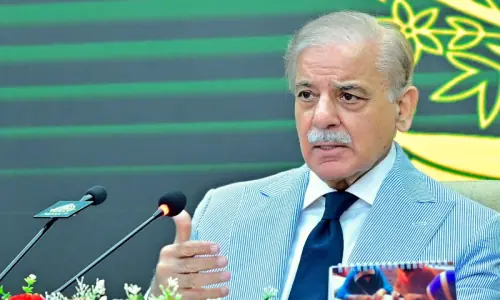
Finance Minister Muhammad Aurangzeb requested the facility, with a maturity period of up to five years, during a visit to Washington earlier this month.
The request comes as Pakistan continues to face external financing pressures, including the need to maintain foreign exchange reserves, meet international debt obligations and support stability in the currency market.
Unlike traditional assistance programmes from multilateral lenders, an arrangement through the US Treasury’s Exchange Stabilisation Fund (ESF) would represent a direct bilateral financial mechanism between Washington and Islamabad.
From Mexico in 1995 to Argentina last year, the US has quietly deployed its Exchange Stabilisation Fund to rescue struggling economies
If approved, an ESF-backed facility could provide Pakistan with additional liquidity at a critical juncture.
It could also help the State Bank of Pakistan manage external payment pressures, including import financing and debt servicing, while strengthening market confidence in the country’s ability to meet international obligations.
Agha Adeel Saadat, a former International Monetary Fund (IMF) economist who now works for a US financial firm, said such a facility could provide Pakistan with “an important financial buffer” by strengthening foreign exchange reserves, enhancing investor confidence and reducing short-term external financing risks.
“At a time of heightened geopolitical uncertainty in the Middle East and continued volatility in global oil prices, Pakistan remains vulnerable because of its dependence on imported energy,” he said.
“A stronger reserve position would enable the State Bank of Pakistan to better manage exchange-rate volatility, meet external debt obligations and cushion temporary external shocks without disrupting economic activity.”
For Pakistan, which has repeatedly sought external support to manage balance-of-payments crises, an ESF facility would represent a new form of financial backing from the US.
The key question remains, whether Washington considers the request an appropriate use of the ESF, and whether both governments can agree on the structure and conditions of such assistance.
If approved, the facility would become one of the most significant recent bilateral financial arrangements between Pakistan and the United States. However, it would not by itself resolve Pakistan’s long-term economic challenges.
Mr Saadat cautioned that the proposed facility should be viewed as “a bridge to stability rather than a substitute for structural reforms”.
He said Pakistan would still need to broaden its tax base, expand exports, improve productivity and exercise greater fiscal discipline by curbing non-essential public spending, including luxury official purchases and other discretionary expenditures that strain public finances.
Dr Shahzad Latif, a Chicago-based political economist, argued that Pakistan’s long-term economic health cannot depend on periodic external assistance.
“Instead of relying on piecemeal financial support, Pakistan needs a long-term strategy centred on attracting foreign direct investment, building industrial capacity to reduce imports and expanding exports,” he said.
“That would reduce pressure on foreign exchange reserves, strengthen the rupee and broaden the country’s tax base, helping address Pakistan’s balance-of-payments challenges over the long haul.”
Dr Latif added that bilateral financial arrangements can also have geopolitical implications.
“Countries receiving such assistance should remain mindful that strategic or diplomatic expectations may accompany major bilateral financial facilities,” he said. “In my view, Washington could seek broader regional policy concessions, including encouraging Pakistan to move toward the Abraham Accords, although no such condition has been announced in this case.”
For now, Pakistan’s request remains a proposal rather than an approved US financial commitment.
What is the ESF?
The proposed facility would rely on the US Treasury’s ESF, a mechanism created to respond to international monetary crises and provide emergency financial support to foreign governments.
According to the US Congressional Research Service, the ESF has “broad authority to conduct foreign exchange operations, extend short-term credit and enter into currency swap arrangements with foreign governments and central banks”.
Unlike regular government programmes funded through annual congressional appropriations, the ESF operates through its own resources, including earnings from investments, interest income and US holdings of International Monetary Fund Special Drawing Rights (SDRs).
Established in 1934, the ESF was designed to allow the executive branch to respond quickly to international financial disruptions.
Under 31 U.S.C. Section 5302, the Treasury Secretary has broad authority over the fund. While the President must provide Congress with a written report and justification when certain ESF loans extend beyond six months, lawmakers do not have statutory authority to block deployment of the funds.
This structure gives the Treasury flexibility to act rapidly during financial emergencies.
The ESF has been used several times to support foreign governments facing financial crises.
According to CRS, the US Treasury has carried out 126 credit operations involving foreign governments, including short-term loans and currency swap arrangements.
One of the most prominent examples was the 1995 Mexican peso crisis. After Congress rejected a proposed rescue package, the Clinton administration used the ESF to help assemble approximately $20 billion in currency swaps, loans and guarantees to support Mexico’s financial stability.
The ESF has also supported arrears-clearance operations. In 2008, it helped Liberia clear overdue obligations to international financial institutions, while a similar mechanism was used in 2021 to assist Sudan in clearing arrears to the IMF and World Bank.
The US Treasury also established a $2.5 billion currency swap arrangement with Argentina in 2025 to provide emergency liquidity.
Published in Dawn, August 1st, 2026