ISLAMABAD: A parliamentary panel on Tuesday expressed serious concern over the challenges faced by children with dyslexia, emphasizing that their educational future and prospects must not be compromised due to the absence of appropriate identification, institutional support and remedial interventions.
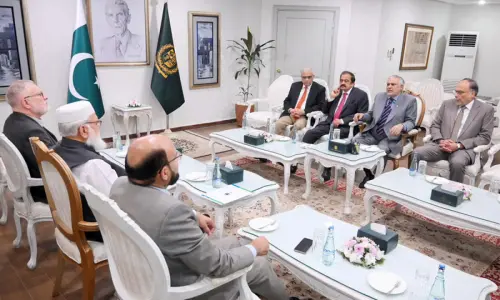
National Assembly Standing Committee on Federal Education and Professional Training, which met here at Higher Education Commission (HEC) with Dr Shazia Sobia Aslam Soomro in the chair, besides other agenda items, discussed issues of children with dyslexia.
Committee underscored that, following the enactment of the Dyslexia Act, it has become imperative to ensure its effective implementation and to address the issues confronting children with dyslexia in both public and private educational institutions.
The committee stressed the need to provide appropriate academic facilitation to such children across various subjects, particularly mathematics, in accordance with their individual learning needs.
Furthermore, the committee resolved to raise the matter on the floor of the Parliament to advocate appropriate relaxation and accommodations in the curriculum, assessment and examination systems, ensuring that children with dyslexia are not disadvantaged or denied opportunities for admission to higher education on account of their learning difficulties.
The committee also emphasised that the Ministry of Federal Education should incorporate dedicated budgetary allocations, along with provisions for the recruitment, capacity-building and professional training of remedial therapists, psychologists and specialized teachers, into its regular budgetary framework and policy planning to ensure a sustainable and institutionalized support mechanism for children with dyslexia.
Committee was told that National Institute of Psychology (NIP), a Centre of Excellence at Quaid-i-Azam University is collaborating with the Federal Directorate of Education (FDE) to develop and implement a structured remedial support system for children with dyslexia in schools across Islamabad. The NIP officials apprised the committee that the initiative would be implemented in five distinct phases to ensure the systematic identification, assessment and provision of targeted remedial support to children with dyslexia.
The Committee was further informed about the National Dyslexia Diagnostic Tool, which is being used to identify children with dyslexia through a comprehensive assessment of various developmental and learning domains. The tool comprises four key components, namely, Cognitive and Perceptual-Motor Assessment, Language and Phonological Assessment, Social-Emotional Checklist, and Child Problem Checklist.
These components are designed to facilitate the identification of children experiencing difficulties associated with dyslexia and to support the formulation of appropriate remedial interventions based on their individual needs.
Meanwhile, the committee was briefed by HEC Chairman Dr Niaz Ahmad Akhtar that according to the QS World University Rankings 2027, a total of 18 Pakistani universities have secured positions in the global rankings, reflecting the growing international recognition of Pakistan’s higher education sector. Notably, he said two Pakistani universities have been placed among the world’s top 500 institutions, namely Quaid-i-Azam University, Islamabad, ranked at 381, and the National University of Sciences and Technology (NUST), Islamabad, ranked at 384. Furthermore, a total of 11 Pakistani universities have secured positions among the world’s top 1,000. The committee was told that HEC has introduced a fully online and paperless Degree Attestation System, replacing the previous attestation mechanism.
The Committee was apprised of the key challenges confronting universities, which primarily include governance-related matters, financial constraints, issues concerning the assessment and evaluation of faculty members, and shortages of qualified human resources. It was further informed that the HEC regularly issues policy guidelines to universities.
The Committee was also informed that the availability of adequate human resources remains a significant challenge for universities, adversely affecting their administrative and academic capacity. Dr Niaz told the committee at around 20 task forces had been constituted to examine priority areas and submit their recommendations for improvement in higher education sector
Published in Dawn, November 4th, 2026