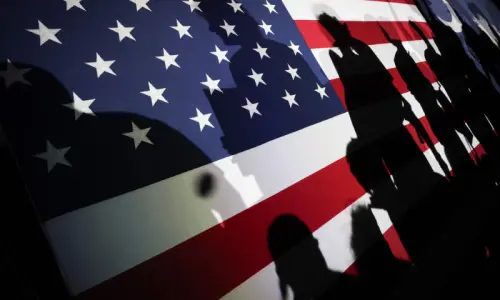
THE most disturbing aspect of United States President Donald Trump’s recent address to the United Nations General Assembly was not merely his threat of ‘annihilation’ against Iran. It was the setting in which the words were spoken. The UN was on the premise that disputes should be managed through law, diplomacy and collective action rather than military coercion. Yet, the speech offered a stark reminder of how differently that principle can operate when the state hurling the threat possesses overwhelming power.
Trump’s message reflected a broader transformation in international politics: military strength is increasingly being presented as a substitute for diplomatic legitimacy. His defence of the US campaign against Iran, emphasis on American military superiority and warning of further destruction conveyed the impression that negotiations take place under the shadow of force. Such rhetoric matters because powerful states do not merely conduct foreign policy; they also influence what becomes normal in international relations.
The scenario has serious consequences for the Global South. Smaller states are repeatedly encouraged to respect international law, settle disputes peacefully, and avoid unilateral use of force. Yet, when powerful states appear able to interpret or circumvent those same constraints, the credibility of the entire system suffers.
If military superiority becomes the principal currency of international influence, other states have incentives to respond by expanding their own military capabilities, strengthening rival alliances or pursuing stronger deterrence. This can create a cycle in which insecurity produces militarisation, militarisation produces suspicion, and suspicion makes diplomacy increasingly difficult.
If international law is to retain authority, accountability cannot depend primarily on military weight, economic influence or veto power. The UN does not need more speeches defending the universality of its principles. It needs institutions capable of making those principles matter when they are inconvenient for the powerful.
As such, without that credibility, the architecture of international legal system may remain standing while the confidence supporting it will gradually disappear.
Sanaullah Mirani
Ghotki
Published in Dawn, November 3rd, 2026