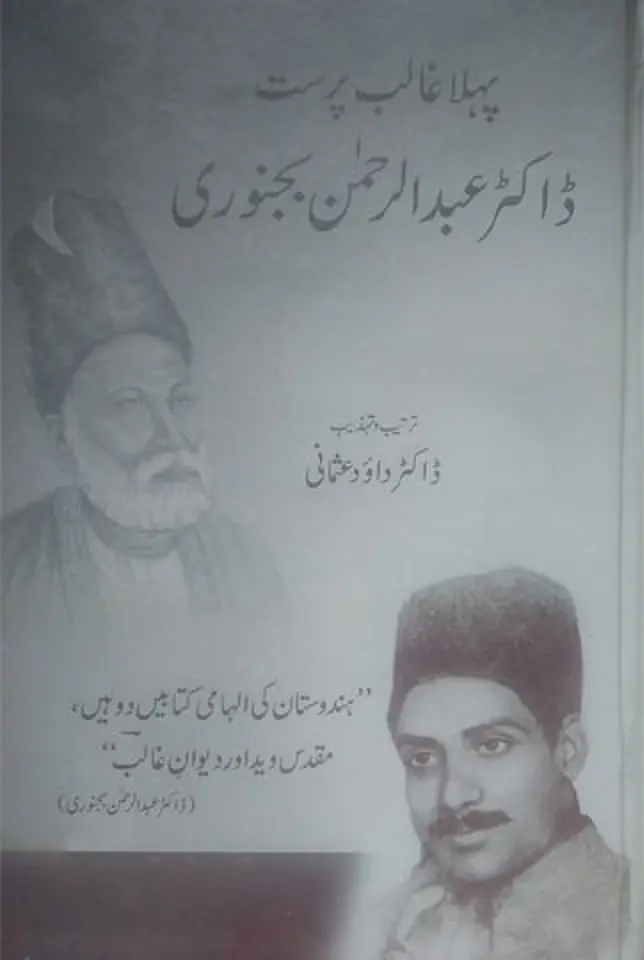
“HINDUSTAN ki ilhaami kitaaben do hain, Ved-i-Muqaddas aur Divan-i-Ghalib”. The essence of these words may be translated as: India’s divinely-inspired books are two, the Vedas and Divan of Ghalib.
These oft-quoted words, penned by Abdur Rahman Bijnori in the beginning of his preface to Ghalib’s Urdu divan, are preceded by two of Ghalib’s Persian couplets that say: had the poetry been the constitution of the world, my divan would have been as famous and as high as the Pleiades; and had the poetry been the religion of the world, my divan would have been the holy scripture of that religion. Bijnori was convinced of what Ghalib said in these couplets, it seems, and tried to convince others, too. His famous preface to Ghalib’s divan is more of an impressionistic praise than an objective critique.
Abdur Rahman Bijnori was indeed one of the most appreciative and ardent admirers of Ghalib and is believed to be ‘pehla Ghalib parast’, or the first devotee of Ghalib, as put by a critic. Well, one may disagree as Altaf Husain Hali had written Yadgar-i-Ghalib (1897), the first book on Ghalib’s life and art. It proves that Hali was truly the first and the most devoted admirer of Ghalib, justifying Ghalib’s evident misdemeanours as well as some serious lapses. But Dr Dawood Usmani seems to agree with the critic who thought Bijnori was the first devoted admirer of Ghalib, as shows the title of the book Dr Usmani has compiled: Pehla Ghalib Parast: Dr Abdur Rahman Bijnori. It is a collection of articles on Bijnori, written by some well-known critics and scholars.
A question often raised is: when was this preface by Bijnori written and whether or not it was meant for a newly-discovered manuscript of Ghalib’s divan known as Nuskha-i-Hameediya. Imtiaz Ali Khan A’rshi, a specialist on Ghalib, in his article included in the book says Bijnori was already working on a new edition of Ghalib’s divan, as Moulvi Abdul Haq had asked him to, and had finished writing the preface. But Nuskha-i-Hameediya, a manuscript of Ghalib’s divan, handwritten in 1821, was discovered in Bhopal’s library in August 1918. Bijnori began studying it, too. But Bijnori died on Nov 7, 1918. Moulvi Abdul Haq published Bijnori’s preface in 1921 in quarterly Urdu under the title ‘Mahaasin-i-Kalaam-i-Ghalib’. Mufti Anwaarul Haq published the newly-discovered Nuskha-i-Hameediya in 1921 with Bijnori’s preface. It caught the fancy of readers and was later on published separately in a book form.
Dr Usmani has discussed only the critical aspects of Bijnori’s works and has not written anything about Bijnori’s life in his brief foreword. Dr Abdur Rahman Bijnori was a poet, scholar, critic, essayist and is often described as a genius. An article in the book mentions Bijnori’s year of birth as 1885, saying that Bijnori’s exact date of birth was not known. Hadeeqa Begum in her PhD dissertation Naqd-i-Bijnori says Abdur Rahman Bijnori was “probably” born in 1885. An MPhil thesis on Bijnori, by Saeeda Bahauddin, says Bijnori was born on June 10, 1885. But all these assumptions are incorrect. An article by Syed Haamid Husain, also included in the book under review, quotes Bhopal’s old official record that says Abdur Rahman Bijnori was born on June 10, 1887. Bijnori was born in Seohara, district of Bijnor, and his surname was Siddiqi, adds Syed Haamid. One wishes that Dr Usmani had a few annotations on such self-contradictory parts of the book, enabling the reader to arrive at the right conclusion. Other articles included in the book are by some renowned scholars such as Rasheed Ahmed Siddiqi, Mohiuddin Qadri Zor, Syeda Jafer, Usloob Ahmed Ansari, Syed Abdullah, Ibadat Barelvi, Gian Chand and some others.
Dawood Usmani has previously compiled and published in a volume critical and research articles on Divan-i-Ghalib’s Nuskha Hameediya, penned by prominent scholars, in a separate book a couple of years ago. What surprises one is that neither in that book nor in the one under review, has he reproduced Bijnori’s preface. It would have been beneficial if he had included Bijnori’s original preface in this book. The present volume includes quite a few unnecessary articles and opinions — mostly adulatory and sounding repetitive. The 656-page book devotes about 400 pages to appreciate Bijnori’s preface, which itself spreads little over 100 pages. Cutting back on some articles could have made room for Bijnori’s preface. Published by Karachi’s Rang-i-Adab, the book leaves the reader wondering what Bijnori’s preface might have been and where to find it.
Published in Dawn, November 2nd, 2026