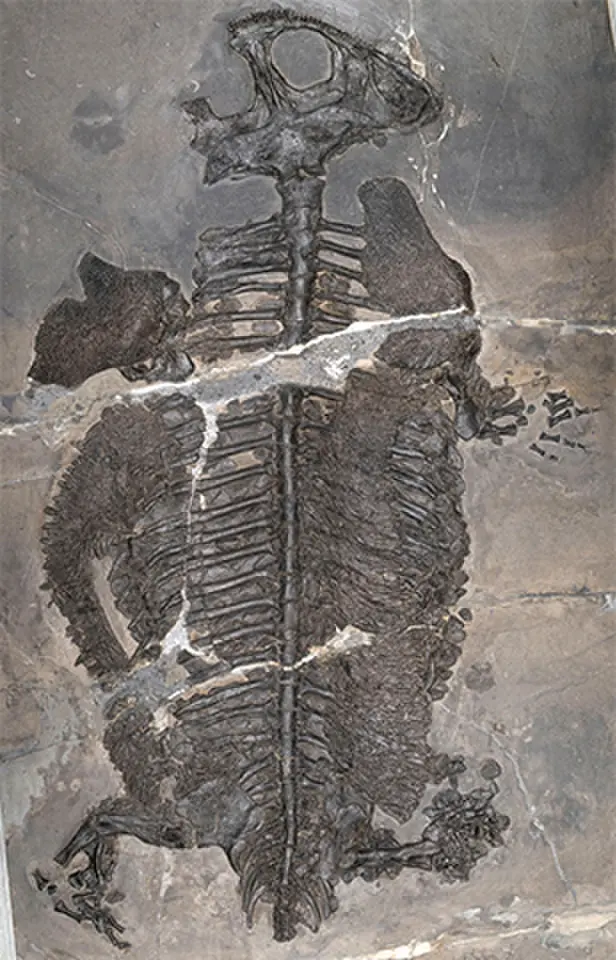
WASHINGTON: Amphibians rely on their permeable skin for the crucial functions of breathing and drinking, a wonderful adaptation in freshwater that is subverted by the salt in seawater. As a result, there has been no known amphibian extinct or extant with a fully marine lifestyle. Until now, that is.
Researchers have discovered in China’s Guizhou Province two nearly complete skeletons of an amphibian that lived in the sea about 237 million years ago during the Triassic Period, with a flat, disc-shaped and armored body and a wide mouth indicative of a bottom-dwelling suction feeder that ambushed its prey.
The creature, named Gerrothorax maritimus, measured about 30 inches long and predated the dinosaurs.
“The most important finding is that there was an early amphibian that lived in the sea full-time,” said paleobiologist Ryosuke Motani of the University of California, Davis, one of the leaders of the study published in the journal Nature Ecology & Evolution.
It was unearthed in rocks that formed from ocean sediment, and was found near fossils of an ichthyosaur a type of marine reptile called Guizhouichthyosaurus that was about 23 feet long. Ichthyosaurs were the apex marine predators of the time, and justified the amphibian’s bony body armor.
Its use of suction feeding is suggested by the shape of its mouth and the structure of its throat. Suction feeding occurs when an aquatic animal quickly expands its mouth cavity to create a drop in pressure, drawing water and prey inside.
“The skull is flat and wide with a large mouth, having many small conical teeth,” paleontologist and study co-author Da-yong Jiang of Peking University in China said. “It is a bottom animal, a suction feeder that lived on a muddy to silty seafloor. It would likely capture anything that swam by, such as fish, worms and maybe cephalopods,” Jiang said, referring to squid relatives.
The wobbegong, a bottom-dwelling and suction-feeding shark of comparable size, is a good present-day analog, Motani said. The researchers said Gerrothorax maritimus evolved from armoured freshwater ancestors. Fossils of a closely related armored freshwater amphibian were previously discovered.
There are more than 8,000 species of living amphibians such as frogs, salamanders and legless caecilians. Some can withstand brackish water, saltwater and freshwater mixing where bodies of water like rivers meet the sea.
Published in Dawn, October 28th, 2026