LAHORE: Pakistan should prioritise empowering local governments (LGs) over creating new provinces, a task force report has recommended, calling for constitutional guarantees of their powers, functions and share in provincial resources to make grassroots democracy effective.
Prepared by the BNU Centre for Policy Research (BCPR), the report proposes amendments to Articles 140-A and 160 of the Constitution, direct elections of mayors and council heads, and the transfer of administrative authority, staff and budgets to elected local bodies.
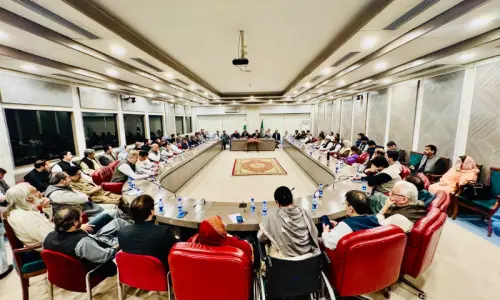
The recommendations were discussed at the launch of the report, attended by Punjab Assembly Speaker Malik Muhammad Ahmad Khan as chief guest, amid renewed political debate over proposals to increase the number of provinces, reportedly to as many as 12.
Addressing the gathering, Mr Khan said constitutional protection for local governments was imperative, arguing that democracy could not deliver its benefits to ordinary citizens without meaningful devolution of powers to the grassroots.
Suggests empowerment of LGs instead of creating new provinces, direct election of mayors
He said local governments had remained ineffective because authority and resources were concentrated at the provincial level. Even the creation of new provinces, he observed, would not meet public expectations without a robust local government system.
Devolution was not merely an administrative requirement but a fundamental right of citizens to participate in governance, he said, adding that empowered local institutions could address public problems and regional grievances closer to people’s homes.
Mr Khan said more than 80 members of different political parties in the Punjab Assembly had voluntarily expressed their willingness to join a parliamentary caucus on local governments. The assembly had also unanimously passed a resolution seeking constitutional protection for local bodies.
He traced the country’s administrative structure to its colonial past, saying the governance system had failed to adequately recognise the importance of local representation. Effective local autonomy, he added, was essential for national cohesion in a country with diverse social and regional interests.
The report argues that strengthening local governments offers a more practical and less costly route to decentralisation than creating new provinces. While provincial reorganisation would require a constitutional amendment under Article 239, Article 140-A already provides for elected local governments and requires provinces to devolve political, administrative and financial responsibility and authority to them.
Under its key constitutional proposals, the task force recommends expanding Article 140-A to specify local government responsibilities through a constitutional schedule covering education, healthcare, water supply, sanitation, local roads, waste management and community development, including initiatives for women, youth and minorities.
It also calls for amending Article 160 to ensure provincial finance commissions operate on a fixed schedule and transparent methodology, guaranteeing local governments a minimum share of provincial resources instead of leaving allocations to provincial discretion.
The report recommends direct elections of mayors and council heads, clearly defined functions for union, tehsil or town, and district governments, and legally regulated, judicially reviewable procedures for suspending elected councils.
It proposes transferring Grade-16-and-below staff and their associated budgets to local government control. In major cities, metropolitan corporations should exercise direct authority over development authorities, water and sanitation agencies, and mass transit systems, it says.
Former federal minister Shafqat Mahmood identified the lack of political commitment as a major obstacle to local government reform. Provincial governments, he said, were reluctant to devolve powers partly because they feared losing political influence to opposition parties. He also highlighted capacity constraints at village and union council levels.
Published in Dawn, October 28th, 2026