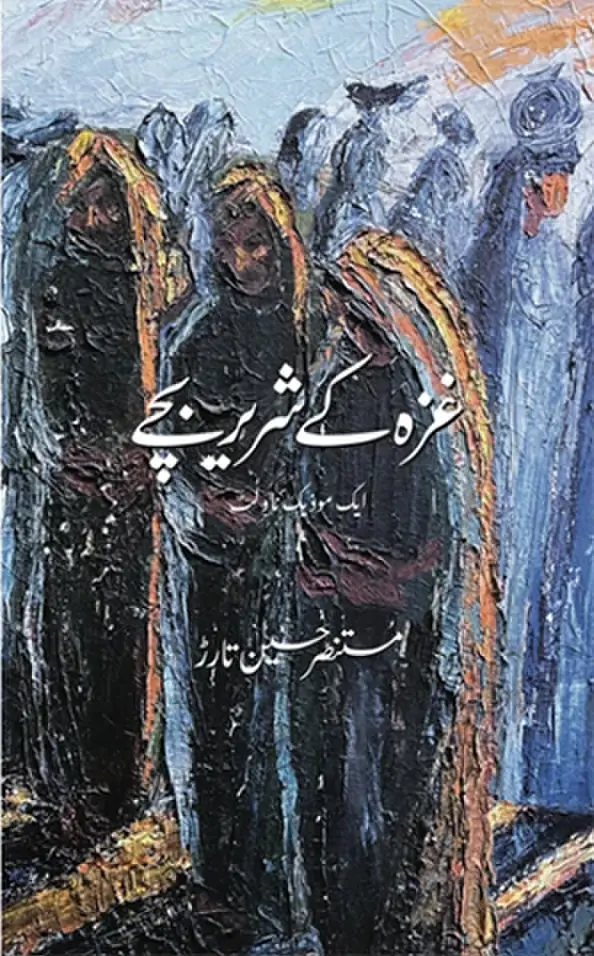
Ghazza Ke Shareer Bachay
[The Rascal Children of Gaza]
By Mustansar Hussain Tarar
Sang-e-Meel
ISBN: 969-35-3775-0
80pp.
They were permitted to execute anyone from that neighbourhood without hesitation. Thus, when she spotted the weary woman on her claimed property, she shot her and immediately ended the woman’s life. At that moment, the deceased woman’s father arrived in the field to retrieve his daughter’s motionless body; the woman then fired again and also took the life of the elderly man.
The tone of this scene is one of cold and ruthless violence. The description of the killer’s actions is matter-of-fact and devoid of any emotion or remorse. The fact that the victims were allowed to be executed without hesitation adds to the perception of a brutal and lawless society. The lack of hesitation from the killer also suggests a chilling indifference to the value of human life. Overall, the tone conveys a disturbing and unsettling atmosphere, leaving the reader to contemplate the dark and lawless world in which these events take place.
The above scene unfolding in the pages of Mustansar Hussain Tarar’s novella Ghazza Ke Shareer Bachay [The Rascal Children of Gaza] is not taken from any Hollywood action movie, but from the harsh reality faced by the unfortunate and helpless people who call Gaza home. Regardless of age or gender, no one is safe from the relentless attacks that occur on a daily basis, even in hospitals and schools.
The basic story revolves around one of the many Muslim families of Gaza, which includes the parents and their three children. Their residential apartment building has been completely destroyed due to Zionist bombardment. A child, trapped under the rubble and counting his last breaths, is thinking about his siblings and parents. An unseen voice persuades the child to keep speaking continuously.
Mustansar Hussain Tarar’s new novella builds a mosaic about the Gaza genocide, combining snippets of real news and existing poetry with a fictional narrative that is torn from the pages of newspapers
The child does not know what has happened to the rest of his family, but the circumstances are such that he understands that, just like him, his remaining family members are trapped under the debris and have probably died. Meanwhile, his hand somehow catches hold of his little sister’s hand, which goes completely still after moving for a short while. Thus, the child narrates the painful account of the catastrophe that befell him and his family.
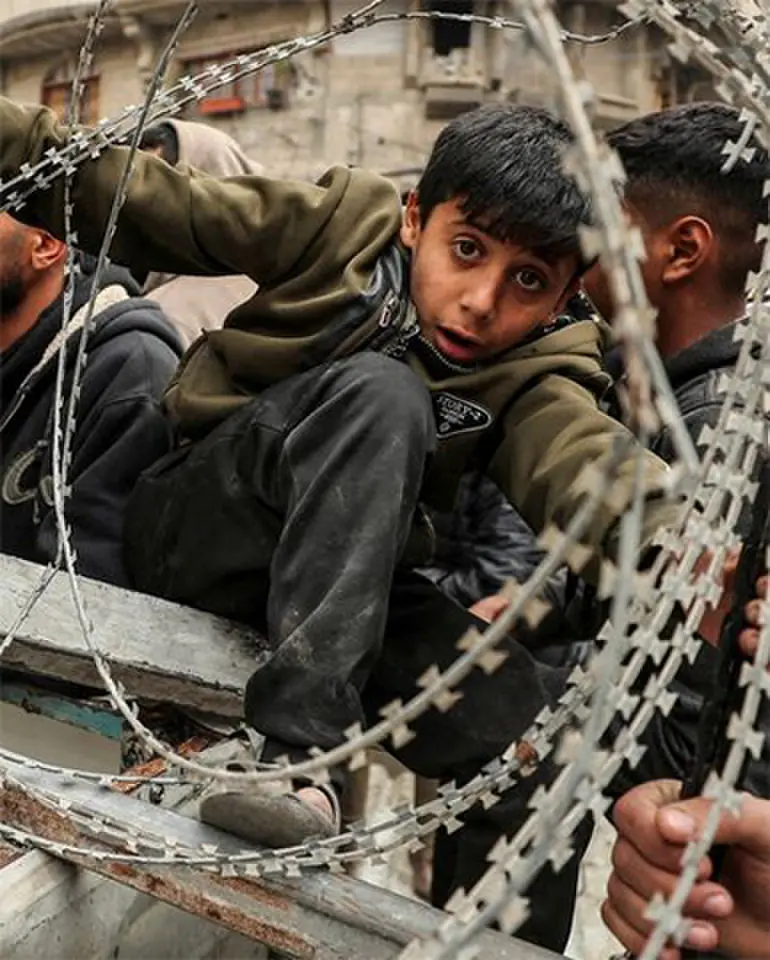
The protagonists shift continuously. The narrative focus pivots from the child lying under the debris to his grandfather, whose unnamed village is located just four kilometres outside Gaza City. The old man shares his own grievance: how his beloved olive groves were unlawfully seized, forcing him into an adjacent wasteland, where he could only watch from afar and mourn the ruin of his orchards. He used to care for his olive trees the way a parent might care for their children, bathing them and talking to them. Now, those who forcibly took his land from him neglect his trees.
This elderly man’s daughter is the mother of the children buried under the rubble described at the start. He recounts how he repeatedly implored his daughter and son-in-law to flee Gaza City with the children and seek refuge in his village, but his son-in-law steadfastly refused to abandon their home. In any case, he does not have his village anymore either.
This story is fiction, but the reality is real. It captures the current devastation in Gaza — not bound to a single day or hour, but charting the grim map of an active genocide. To strip away the fiction, Tarar has included actual newspaper headlines and few interviews from volunteer doctors on the ground.
Tarar starts his novella with a famous poem ‘Oh Rascal Children of Gaza’, written in August 2014 by Palestinian poet and songwriter Khalid Juma (born 1965 in Rafah, Gaza) during an earlier Zionist slaughter. The poem contrasts the lively, mischievous noise of children with the devastating silence left in their absence, ending in a plea for their return. This poem’s title is also borrowed by Tarar for the novella’s title.
Through calling his story a “mosaic novel”, Tarar has cleverly used a metaphor to convey a deeper meaning. Just like the ancient art form of creating images with small fragments of materials, this novel pieces together different poems and stories to form a bigger picture.
The most heartbreaking aspect of the inhumanity and barbarism on display is the lack of action from the rest of the world. It’s as if we are all spectators, watching a movie, but with the realisation that it’s, in fact, happening in real life. Tarar’s tone throughout this novel is of despair and frustration towards the inaction of the world in the face of such atrocities.
The novella may have few characters, but the story that unfolds holds the essence of what the writer wants to draw attention to. As the rest of the world goes on with their day-to-day lives with the assurance of another tomorrow, there are people in Gaza who are trapped under collapsed roofs, taking their last breaths as they reminisce about their past lives.
Tarar employs a profoundly poignant and sombre narrative style that allows the reader to experience the events he describes. He aims for each reader to not merely read but to deeply empathise with the suffering of the innocent who were cruelly slain, as well as to witness the brutal actions taking place every day.
I would recommend this book to readers of all ages and genders, as it is crucial for everyone to begin understanding the horrors the real world can unleash if we fail to take action to stop it.
The reviewer writes short fiction in Urdu and is currently working on her first novel
Published in Dawn, Books & Authors, October 25th, 2026