At London’s Courtauld Gallery, the exhibition ‘Salman Toor: Someone Like You’ brings together 19 paintings made by Salman Toor since 2019, alongside a separate display of drawings.
This is the first major European solo exhibition by Toor, who now lives and works in New York. The exhibition’s curator, Elena Crippa, says Toor’s paintings are akin to “short stories, if not portraits.” We encounter people partway through an evening, without knowing everything that brought them there.
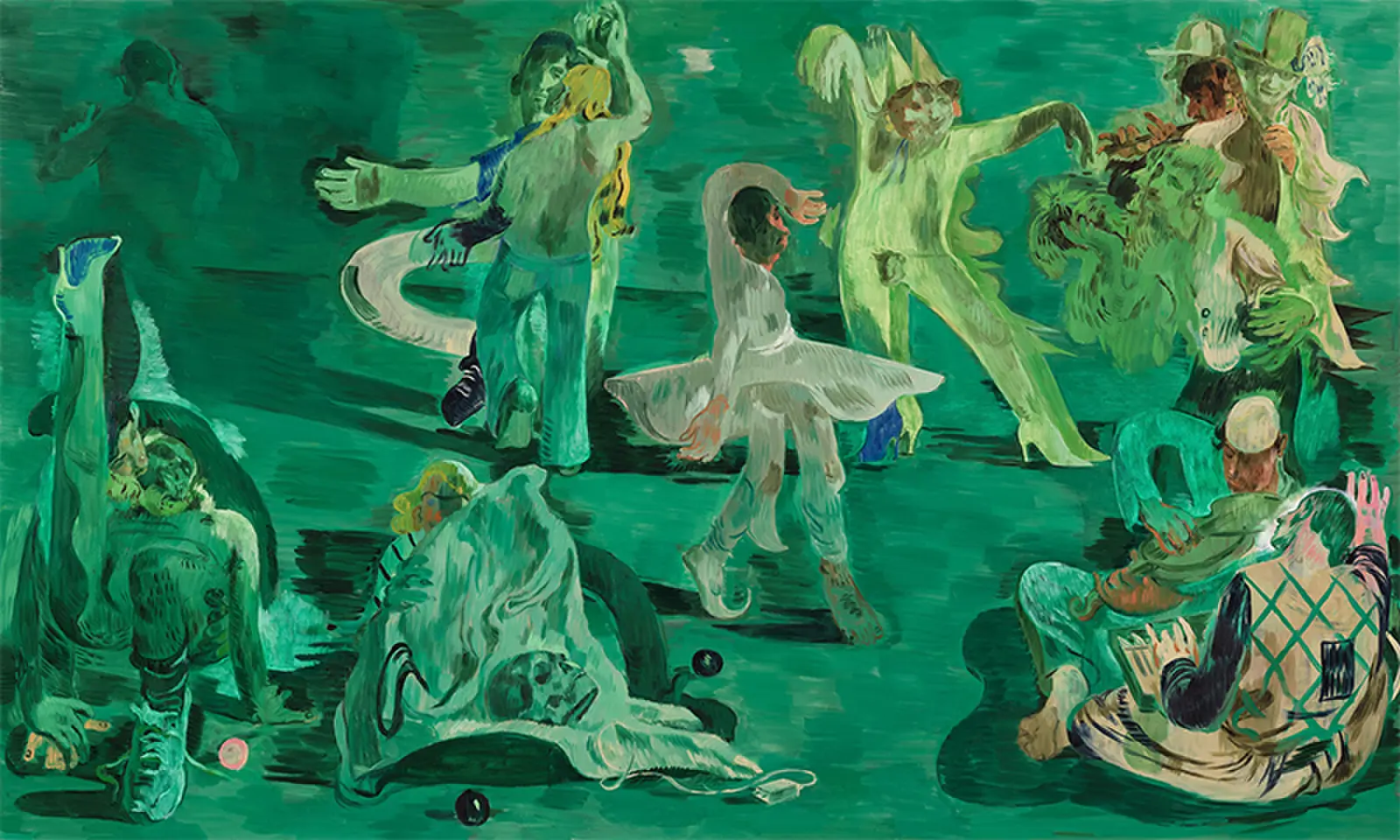
The central dancer in Salman Toor’s Ghost Ball (2023) wears a traditional Pakistani khussa on one foot while the other foot is bare. His mismatched feet suggest the difficulty of inhabiting several cultural realities and the pleasure of moving between them without explanation. Around him, bodies whirl through an emerald atmosphere, accompanied by musicians, embracing couples and a voguing figure. The dancers share a space without sharing an emotional state. Exuberance sits beside solitude and pleasure itself seems to require effort.
In The Bar on East 13th (2019), a bartender with plaits, ribbons and painted nails faces the onlooker across a counter. A cut citrus fruit, knife and shallow glass occupy the foreground, a couple kiss at the right. He seems both available and withdrawn, his working expression withholding his feelings. Toor’s encounter with Édouard Manet’s A Bar at the Folies-Bergère (1882) during a Courtauld visit in 2017 helped conceive this painting. Returning his bartender to that collection makes the exhibition a conversation across time.
In his first major European solo exhibition, Salman Toor explores desire, cultural identity and distance
Crippa draws attention to how everyday technology brings these inherited pictorial languages into the present. In Bar Boy (2019), a phone illuminates a young man’s face within a crowded room. In Pillow Fight (2022), two naked figures tumble across luminous bedding, one raising a pillow overhead. The laptop at the foot of the bed complicates their intimacy. As Toor asks in the wall text, is the scene being watched by technology or performed for it? Domestic pleasure acquires an audience, whether invited or imagined.
In Museum Boys (2021), a sleeping figure shares a vitrine with an inverted urinal recalling Marcel Duchamp’s Fountain (1917), as intimacy becomes an exhibit. Fag Puddle with Carriers (2026) draws upon Lorenzo Lotto’s The Entombment (c.1550–55), highlighting the solemnity found in Toor’s vulnerable figures. In Wandering Beggars (2022), ragged companions move with an unstable, almost dancing rhythm. Their closeness turns dependence into companionship. The recurring clown nose lends Toor’s figures a self-mocking air, while making their vulnerability harder to overlook.
Such vulnerability extends beyond the canvas. Against the pressures surrounding openly expressed queer desire in Pakistan, the ordinary intimacies found in these paintings carry a particular weight. In Back Lawn (2021), lovers embrace among vegetation while a family gathers nearby. Affection for home persists alongside the need to escape its supervision.
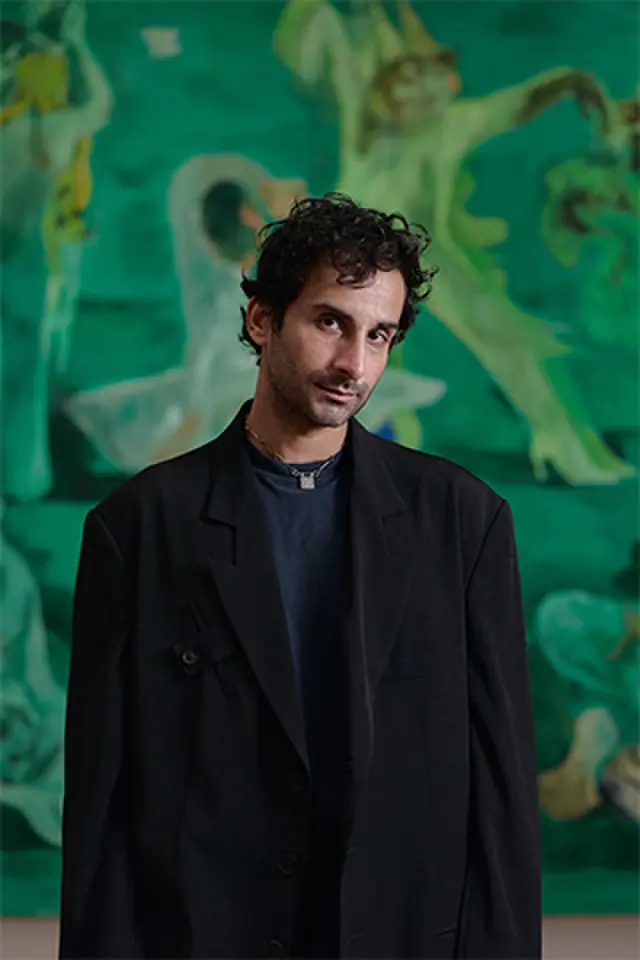
The art writer and curator Aziz Sohail’s accompanying catalogue essay, ‘You Probably Think This Work Is About You’, offers a Pakistani artistic context. Toor admired Colin David’s portraits and nudes, and Zahoorul Akhlaq also belonged to the visual culture of Toor’s upbringing. Anwar Saeed provides another connection through queer desire, solitude and green’s sensual possibilities. Sohail’s discussion of dosti and yaari situates friendship within South Asian emotional histories.
The drawings offer another entrance into this world. Their gestures, postures and spaces between bodies make relationships legible with an economy that complements the paintings’ luxuriance. Humour passes through both, sometimes as invitation, sometimes as a defence against the discomfort of being seen. Even in company, these characters retain something inaccessible. Their freedom includes the right to remain partly unknown.
The longer one looks at many of Toor’s drawings and paintings, the more they invite an autobiographical reading, their figures emerging as possible alter egos, leaving us to wonder where a life revisited ends and a life reinvented begins. ‘Someone Like You’ gives them the freedom to be complicated and leaves us awestruck for how we look and interpret.
‘Salman Toor: Someone Like You’ is on display at Courtauld Gallery, London, from October 2, 2026-January 10, 2027
The writer is an art critic, curator and educator who spends his time between Birmingham and Lahore. He can be reached at
aarish.sardar@gmail.com
Published in Dawn, EOS, October 25th, 2026