INTRODUCTION
This story should have been written long ago. Much earlier. But, as always, life intervened. Now, here I am, at the age of 75, with a breast cancer diagnosis in hand, wondering whether time will grant me the luxury to finally tell my story. As Munir Niazi once wrote, “Hamesha dair kar deta hoon main [I am always too late].” I suppose that verse was written with people like me in mind.
When I say life got in the way, I mean it in every sense: my temperament, the weight of world affairs, years of activism and, now, the relentless demands of grandmotherhood. I often imagine my late husband, Ahfaz [journalist Ahfaz-ur-Rahman], smiling down from the heavens, amused: “So now you’re doing for the grandchildren all that you never managed to do for me or our kids.” And yet, knowing the perfectionist he was, I can just as easily imagine his disapproving frown: “You should be asserting yourself. Why are you putting up with their tantrums? You’re 75 for God’s sake. What’s wrong with you?”
Ahfaz was never pleased with my domestic efforts. My children, thankfully, are more generous. They tell me I may not have been the most structured or hands-on mother, but that my love was unwavering, that I cared for them in the best way I knew how. What I was lax in providing, they say, was tarbiyat, that essential Urdu term for life training and everyday discipline.
And they’re not wrong. What else could you expect from someone like me? I was raised under the wing of an overprotective, sheltering mother. Well into my university years, I still relied on her to buy my clothes. Me, the so-called independent leftist and feminist, was hopelessly ill-equipped for life’s practicalities.
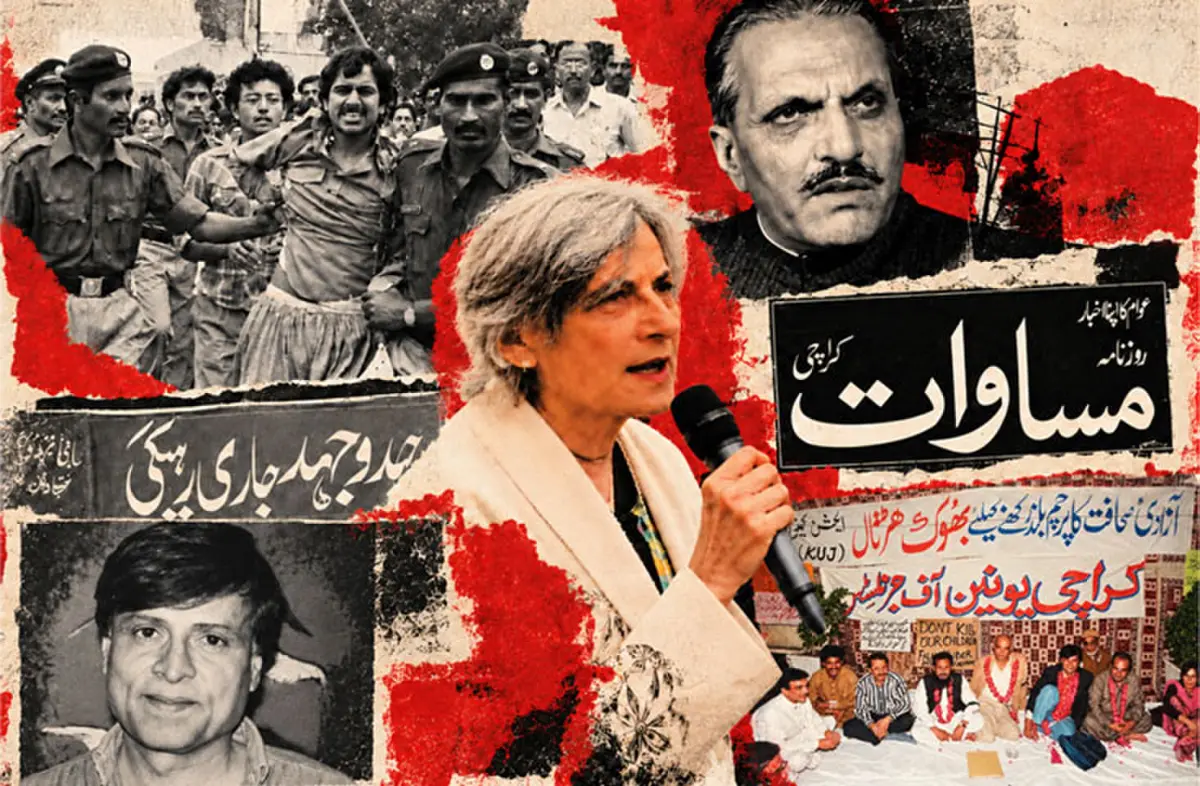
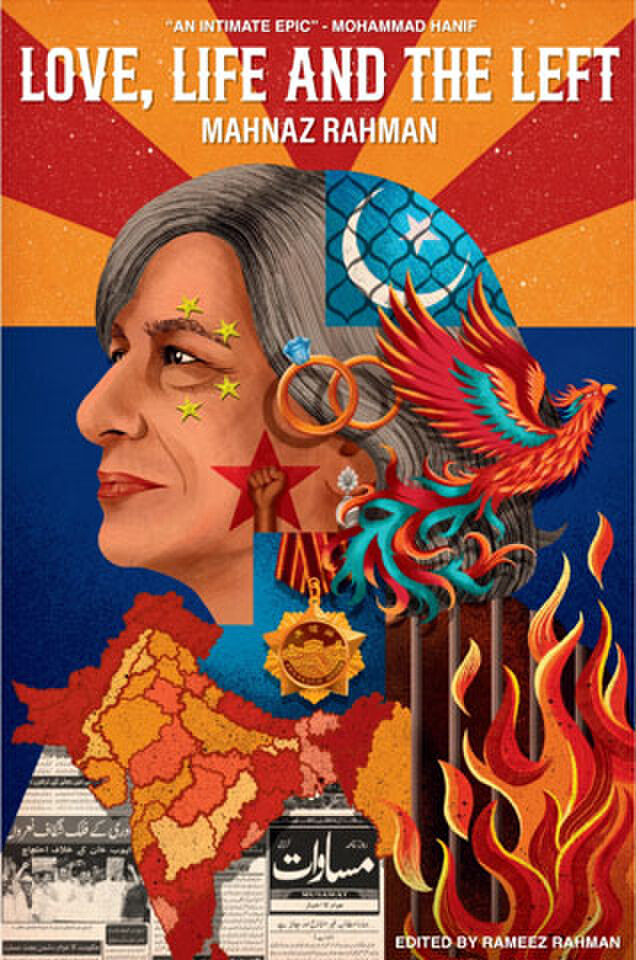
The recently published memoirs by Mahnaz Rahman detail her life as a journalist, leftist activist and rights advocate, presenting an unvarnished account of its challenges, triumphs and setbacks, especially during Gen Ziaul Haq’s 11-year-long dictatorship. This was a time when Pakistan’s journalists faced censorship, arrests and brutal state reprisals. It is a story of youthful idealism, resistance and quiet determination. Eos presents, with permission, excerpts from Love, Life and the Left, published by Jumhoori Publications…
A walking paradox, I could live alone in a university hostel in Karachi in the sixties, embrace socialism and communism in my youth, defy my parents and marry for love… and yet, I couldn’t cook a decent meal or manage a household without chaos. As my mother often said, I was sifar bata sifar (zero upon zero) in practical life.
That same impracticality, of course, followed me into marriage. Despite being a revolutionary and a man of rare integrity, Ahfaz had certain traditional expectations of me at home; expectations I simply could not meet. I remember telling him once, quite sincerely, “Apart from your temper and your traditional expectations from me, you are like a saint.” But true to his sensitive nature, he didn’t take it as a compliment. He sulked. He grumbled. He took offence. And there I was thinking I was praising him. Such was our chemistry: spiced with friction, layered with love.
Today, ironically, I perform acts of service for my grandchildren with a kind of reverence that I never afforded my husband or even my children. They’ve succeeded in enlisting me into their army, one where I march to their tunes, attend to their smallest whims, and revolve my world around their joy and comfort. It is for them too, partly, that I have delayed writing this memoir for so long. Only now, when cancer has knocked on the door, have I finally sat down to write. Better late than never, they say. I hope that sentiment holds true for both of us, dear reader.
Let me be clear: this is not an act of self-congratulation. If I were a writer of books for the sake of books, I could have published volumes drawn from the thousands of columns and articles I’ve written. But this is something else. This is an attempt, perhaps my only real attempt, to make peace with the whirlwind of a life I’ve lived. A life of relentless movement, sporadic reflection, and very little calm contemplation. This book is my bid to reflect, not in guilt, but in peace. I won’t sugarcoat anything. You will find, in these pages, my story warts and all.
This memoir is also, in part, for the young activists and leftists of today. I hope you’ll learn from our generation’s missteps, but also from our moments of grace, our acts of resistance, our quiet strength. Yes, I have inverted the cliché. In these dark times, you deserve to hear not only what we did wrong but also what we did right. And if ever you feel disillusioned, remember what our beloved Rosa Luxemburg once said: “You lose, you lose, you lose, you lose, and then you win.”
BEFORE ZIA, THERE WAS BHUTTO
It’s easy to forget now, drowned in the inky shadow cast by Gen Ziaul Haq’s dictatorship [1977-1988], that the seeds of oppression, and thus resistance, were sown earlier, under the regime of none other than Zulfikar Ali Bhutto.
Though Bhutto inspired a generation with his populist slogans, his government did not shy away from cracking down on a free press. In the foreword to Ahfaz’s Freedom of the Press: The War on Words (1977–1978), [journalist] Wahab Siddiqui recalls how the Pakistan Federal Union of Journalists (PFUJ), buoyed by the clear promises of the [Pakistan] Peoples Party [PPP] upon its rise to power on December 20, 1971, held high hopes, only to see them quickly shattered.
Within just two months, the government banned three publications: the Lahore-based fortnightlies Punjab Punch and Zindah, and the monthly Urdu Digest, all under martial law orders. Their editors were not only imprisoned but also barred from editing any publication for 10 years, without even the chance to face trial under normal legal procedures. Notably, even though Zindah and Urdu Digest had previously attacked the PFUJ with serious accusations, the union still protested the ban and the editors’ arrests. The PFUJ demanded their release and the lifting of the bans or, at the very least, that they be tried under the regular legal system.
The Bhutto regime used economic pressure to suppress dissenting media, withdrawing government advertisements and cutting off newsprint to critical publications such as Hurriyet, Nawa-i-Waqt and Jasarat. These tactics intensified, culminating in the closure of several newspapers under emergency laws in 1973. By 1974, the dismissal of 18 workers at Musawaat (Lahore) triggered a significant resistance movement led by APNEC [All-Pakistan Newspaper Employees Confederation] and the PFUJ.
It is important to note that the above is not intended to draw a false equivalency between the monstrous dictatorship of Zia and Z.A. Bhutto. For all his flaws (and there were many), Bhutto was a democratically elected leader with a visionary agenda and a deep connection to the people, qualities that set him entirely apart from Zia. Whatever criticisms one may have of Bhutto, he is in no way, shape or form comparable to a brutal autocrat like Zia.
Rather, the intention of the preceding paragraphs was twofold: first, to underscore that the trend of press suppression, entrenched during [Gen] Ayub Khan’s rule, had only intensified during Bhutto’s tenure in the 1970s; and second, to highlight that the PFUJ had already begun to resist such repression.
In that sense, the confrontations with Bhutto’s government served as critical preparation for the graver battles the PFUJ would face during Zia’s brutal regime.
‘ZULMAT KO ZIA KYA LIKHNA’ [WHY WRITE DARKNESS AS LIGHT]
Then came July 5, 1977, a date burned into our national memory like a scar. Gen Zia overthrew a democratically elected government and unfurled a regime so repressive, so suffocating, it nearly crushed the country’s spirit.
Almost immediately, Zia issued a secret memo to his martial law administrators warning them: “Beware of the left. Beware of a united front of journalists, workers, and students.” And yet, ironically, and beautifully, it was precisely that alliance, with farmers joining in, that would coalesce just months later.
The first blow was personal. Zia’s regime terminated PFUJ president and Pakistan Times Karachi Bureau Chief, Minhaj Barna. Barna was my friend Rukshana’s uncle (and the brother of [leftist politician] Mairaj Muhammad Khan). He was also Ahfaz’s guru in trade unionism, someone Ahfaz respected and loved above anyone else in the journalist fraternity.
The allegation against Barna sahib was hilarious in that he was charged with writing articles for Al-Fatah, whose editorial policy was deemed contradictory to the dictates of the [state-owned] National Press Trust [NPT]. Al-Fatah was further deemed guilty of promoting ethnic nationalism (sound familiar? Nothing in the ruling elites’ attitude has changed!).
On the 23rd of December, 1977, the PFUJ roared in response. The national action committee of PFUJ and APNEC issued a fiery ultimatum: reinstate Barna or face a national uprising. Under growing pressure, Zia’s government relented, for then. But the beast was only licking its wounds.
THE SILENCING OF MUSAWAAT
[The PPP-owned] Musawaat, my former, and Ahfaz’s [then] current, paper became the martial law regime’s next victim. It never had a huge circulation but that had changed in the wake of Bhutto’s incarceration, wherein Musawaat’s circulation had now soared. That alone made it dangerous in Zia’s eyes.
The regime seized the Sheikh Sultan Al Nahyan Trust, the trust that owned Musawaat’s printing press, and issued a decree: no printing without clearing massive dues and obtaining a no-objection certificate. Every other [printing] press, afraid of Zia’s wrath, refused to touch Musawaat. And so, in a single swoop, two hundred journalists and press workers found themselves without a job, including Ahfaz.
Every morning, journalists and workers would gather in the paper’s Karachi office, clutching hope like fools, only to return, empty-handed by evening. Though writing for another newspaper at that time, on a couple of occasions I accompanied Ahfaz to Musawaat. I still remember those tired faces. And among them was the editor, the legendary writer Ibrahim Jalees, who ran from ministry to ministry trying to revive the paper. However, this was all to no avail, as the government had no intention of allowing Musawaat to publish again.
One day, while sitting in that broken-down office, Jalees suffered a heart attack and was gone by morning. A giant felled not by illness but by the quiet violence of censorship and despair.
‘MS BHUTTO, IS THIS A NEWSPAPER OFFICE OR A WAREHOUSE?’
In honour of Jalees sahib, the workers organised a memorial at the office, an office, as I mentioned earlier, so run-down and dusty, it barely looked like a workplace. Broken furniture, leaking roofs, creaking floorboards. Still, the city’s literary and journalistic luminaries came to pay tribute. I wasn’t personally present at this memorial, but it turned out to be a significant one. What follows was recounted to me by several journalist friends.
Shabbar Azmi was the president of the Musawaat Employees Association while Ahfaz was, at that time, the general secretary of the Karachi Union of Journalists (KUJ). As the event was going on, a loud commotion was heard. The attendees were greeted with the unannounced arrival of [Z.A. Bhutto’s wife] Nusrat Bhutto and [daughter] Benazir. My former office’s infamous staircase creaked under the weight of history as they climbed up. Everyone was surprised, because it was the first time any prominent PPP leader had visited the Musawaat office since the crackdown began.
Nusrat Bhutto looked visibly dejected due to what her husband was enduring at that time. When she saw the office, she seemed gobsmacked by its pathetic condition. There weren’t any proper, fully functional chairs available to offer them. Some colleagues managed to unearth two chairs which were in a relatively better condition, so that they could eventually sit down. After Shabbar gave his introductory remarks, he asked Ahfaz to come and speak.
However, Ahfaz said that he would speak from the audience, where everyone turned to look at him. As I’ve mentioned before, Ahfaz was, at that time and indeed throughout his life, the embodiment of the proverbial “angry young man.” Apart from lambasting the Zia dictatorship, he took the opportunity to also lambast the PPP leadership for their apathy. He turned to Nusrat Bhutto and said, “See for yourself, is this an office or an abandoned warehouse? The roof leaks, the floor creaks, the furniture is broken!”
Nusrat Bhutto listened to his remarks and later got up to give her own speech. During her speech, she criticised the Zia regime for its oppression. Ahfaz, still angry, interrupted: “The Bhutto regime was also very oppressive.” Ms Bhutto was stunned for a few moments. She continued her speech. The event proved to be an important milestone in the movement. Later, we discovered that Nusrat Bhutto had been quite impressed by Ahfaz’s honesty.
Three days later, Musawaat’s chief photographer Altaf Rana came running to Ahfaz: “Nusrat Bhutto wants to meet you.” Ahfaz was incredulous: “She doesn’t even know my name.” But she did. She had asked to meet “the young man with bitter words.” That was Ahfaz; raw, blunt, burning with honesty.
And that was the movement: willing to speak truth even when it burnt bridges, even when it cut through allies. Because what we were fighting was bigger than party, ideology or reputation. We were fighting a regime built on fear and silence. And we chose to speak.
THE CHEQUE FOR 180,000 RUPEES
When Ahfaz arrived at the Bhutto residence, the air was thick with tension. Waiting there were Musawaat’s top administrative officers: Chief Editor Badruddin, Manager Noor Muhammad and Chief Accountant Hashim. But it was Ahfaz whom Begum Nusrat Bhutto was waiting for.
She welcomed him warmly and asked directly: “What do you think we should do?” Ahfaz replied: “Your senior party leaders would know better than me.” But Nusrat Bhutto insisted. “No, I want your opinion.”
With characteristic clarity, he laid it out: “The government claims it shut down Musawaat over unpaid dues. If we pay those dues, we remove their pretext. And we expose their real motives for what they are.” She sighed deeply. Not because she disagreed, but because she was surrounded by voices urging her not to waste the money. “They all say it will be for nothing,” she admitted. “That Zia is just using this as an excuse.” “Yes,” Ahfaz said, “but let’s take away that excuse.”
Ahfaz’s insistence on paying the dues stemmed from a strategic reason: many members within the PFUJ were anti-PPP and were arguing that the closure of Musawaat was not an attack on press freedom but merely a legal issue arising from non-payment. By ensuring the payment of dues, Ahfaz aimed to strip those opportunistic elements within the PFUJ of that excuse, leaving them no place to hide behind procedural justifications.
At that, Nusrat Bhutto called for a cheque that had evidently already been prepared. She signed it, one lakh and eighty thousand rupees, and extended it toward Ahfaz. “These people are telling me not to give this,” she said, “but I want you to take it. Do what needs to be done.” Ahfaz, stunned, pushed the cheque back. “I’m just a magazine editor. It should go to the administration.” She refused. “I want to give it to you.”
Eventually, they struck a compromise: she would hand it to the officers, but only if Ahfaz went with them. Together, they marched off to the Press Trust office to submit the cheque. The Press Trust took the cheque, but the printing ban on Musawaat remained. The deception was plain. As Ahfaz had predicted, this would be the final straw.
Now, the moral high ground was no longer up for debate. The PFUJ and APNEC had been handed the justification they needed to escalate the struggle. The state had lied. Musawaat had paid. And still, the voice of dissent was silenced. As mentioned at the beginning of this chapter, the PFUJ was primed for action and this latest act by the brutal martial law administration served as the last straw. Barna sahib, as the president of PFUJ and APNEC chairperson, took immediate notice of this deception by the government.
In December 1977, PFUJ started a full-fledged movement against the closure of Musawaat. However, unlike its earlier fights against Bhutto, this was going to be a tougher fight, with the martial law administration ruled by army boots.
There was no political support that could be found, save for the PPP and some small leftist groups. The rest of the political parties either joined the government or were, at the very least, supportive of Zia’s regime. Even senior leaders such as Wali Khan supported Zia insofar as he (Wali Khan) supported the slogan of “Accountability before elections”, basically ratifying Zia’s stance.
LT GEN MUJIBUR RAHMAN AND JAMAAT-I-ISLAMI’S UGLY ROLE
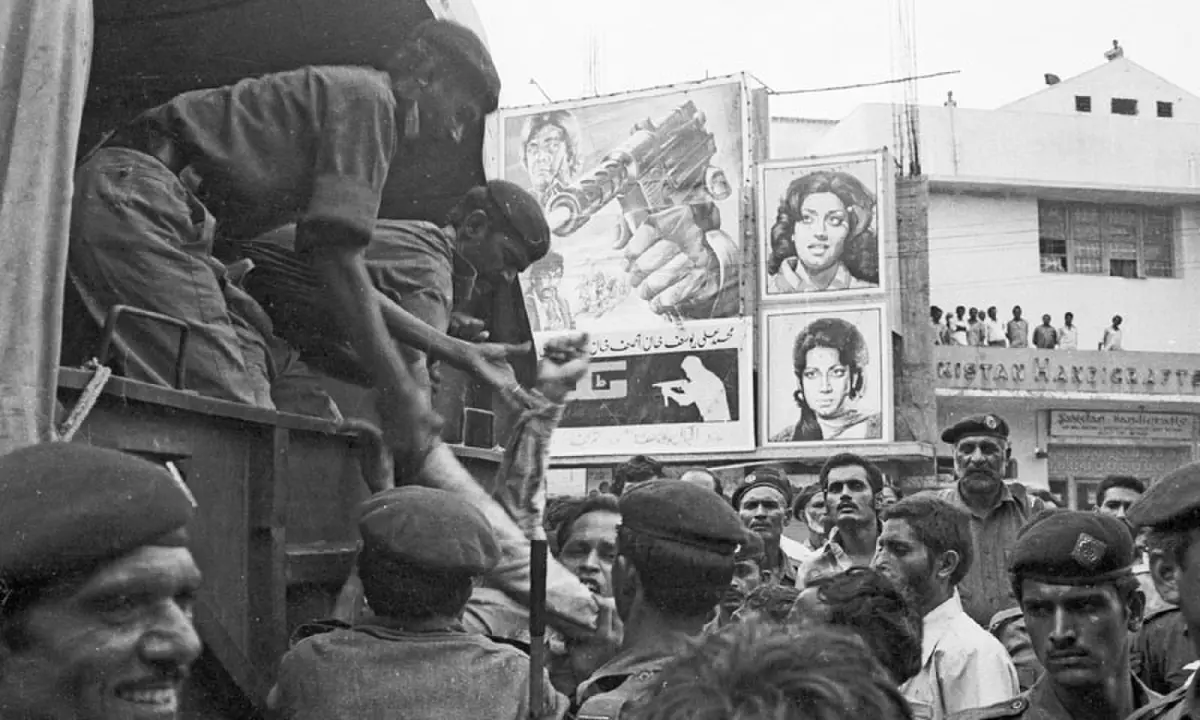
In this movement, Minhaj Barna led the charge, supported by a formidable core team: Nisar Usmani, Hafeez Raqib and Ahfaz. The PFUJ’s plan was audacious. Journalists from across Pakistan would travel to Lahore and Karachi in coordinated waves to voluntarily court arrest, a nonviolent strategy that would keep the flame of protest alive and the jails full.
The movement gained momentum and journalists from all over the country came to Karachi to court arrest in batches. From April 30-May 30, 1978, more than 120 journalists who came from various cities to court arrest in Lahore were arrested and sent to different jails of the Punjab province. Ahfaz was one of these journalists.
Then, in July 1978, journalists from all corners came to Karachi for courting arrest and were sent to different jails of the Sindh province. After going to jail in Punjab, Ahfaz was released and barred from entering Punjab. He returned underground in Karachi, helping coordinate the next round of protests. Now joined by workers, students, peasants and members of the Hari Committee, the movement grew teeth.
Zia’s regime struck back. His information secretary, Lt Gen Mujibur Rahman, a master of psychological warfare, unleashed a campaign of vilification and infiltration. The Jamaat-i-Islami, always ready to act as the establishment’s attack dog, called the PFUJ “seditious”, “communist” and “traitorous.” They even turned comrades against each other.
I still remember one particular day very well. Ahfaz had to go to Lahore in connection with the movement. I came to see him off at the house-gate. A white-bearded gentleman had come to pick him up. He was a calligrapher and, if I remember correctly, his name was Naseemul Haq Usmani. Both left Karachi together but did not return together. Their paths diverged. Why? Zia’s government had succeeded in infiltrating the ranks of the PFUJ and it turns out the calligrapher had sold out. But this was just the start.
A few days later, [sports journalist] Rashid Ahmed Siddiqui, in cahoots with the martial law administration, formed a separate PFUJ! About this traitorous act by those shameless journalists Ahfaz wrote in his book: “Two deeply shameful and reprehensible incidents occurred during this movement. On May 13, 1978, three journalists were publicly flogged on the orders of a military court, an act so disgraceful that it drew strong condemnation from journalists and democratic voices across the world. Just five days later, a group of four journalists arrived in Islamabad. They were welcomed at the airport by senior officials from the Information Department, and both national television and radio broadcast the news of the ‘arrival of PFUJ and APNEC leaders in Islamabad.’
“On the very same day, Zia’s information secretary, Gen Mujibur Rahman, met with these turncoats. In this meeting, all parties agreed that PFUJ and APNEC were ‘subversive’ organisations, a label that was not new. (Zia had once publicly declared that he would hang Minhaj Barna and his next seven generations.) The result of this meeting was a treacherous plan to form a puppet union, later known as the Rashid Siddiqui Group.
“These traitors struck the deal in exchange for promises of power and money. Rashid Siddiqui, an otherwise ordinary reporter, was later elevated to the top position at Daily Mashriq and NPT. The other three collaborators were similarly showered with lavish rewards. They certainly received their material prizes from Zia, but history, too, gave them a reward of its own, branding them forever as immoral cowards.”
Gen Mujibur Rahman may have been a master of psychological warfare, but he failed to break the spirit of Minhaj Barna and his associates. The PFUJ and APNEC executive committees ensured a steady stream of activists stepping forward to court arrest, an unrelenting pressure that proved nerve-wracking for the military junta. The Workers’ Coordination Committee also announced its participation in the movement. In addition, the Hari Committee and several student organisations joined the struggle.
Nisar Usmani, Hafeez Raqib and Ahfaz-ur-Rehman went underground to organise the court arrest campaign. The three constantly changed their hideouts, sometimes staying at [architect] Arif Hasan’s house, at other times at [then university teacher] Taj Haider’s place, or occasionally at the home of [journalist] Ghazi Salahuddin’s father. Shamim Alam and Altaf Siddiqui handled the duties of communication and coordination. As Ahfaz mentions in his book, [journalist] Irshad Rao and Wahab Siddiqui also played key roles in organising batches of potential arrestees.
The Karachi police were desperately searching for Ahfaz. They swore they’d catch Ahfaz. “Once we get our hands on him,” they sneered, “we’ll beat him senseless.” During this time, while Ahfaz was in hiding, I would occasionally go to meet him in secret, often taking little Fayfay [daughter] along with me. I remember, one day, Ahfaz smiled shyly and said to me, “Hafeez Raqib says Mahnaz will get us all arrested with these rendezvous.”
Once, Ahfaz was hiding at Taj Haider’s house and Fayfay and I went to see him. Taj Haider, who later joined electoral politics and became a senator, was Ahfaz’s close friend. That day, he took Ahfaz and me in his car all the way to ‘Bund Murad’, a secluded spot by the Hub River. At that time, this remote area outside the city was rarely visited, even by picnic-goers. Perhaps he simply wanted to give Ahfaz a break from the constant mental stress he was under. The two of them thoroughly enjoyed splashing about in the water while I sat on the bank with my feet dipped in the cool river.
On the drive back, I couldn’t shake the thought: what if the police stopped us and discovered that the very man they were frantically searching for was right there, sitting in Taj Haider’s car? They wouldn’t have spared Taj either. And yet, that was the kind of bravery and unwavering commitment our friends showed without hesitation.
IF INDIRA GANDHI HAD FACED PFUJ
Despite all this, despite betrayal and oppression, the movement held strong. On October 10, 1978, the struggle reached its end. More than 400 people had been jailed, including workers, peasants, students, journalists. The final blow was delivered by the moral force of hunger strikes.
When Minhaj Barna began his hunger strike in Sukkur Jail, it sparked a chain reaction across the prisons of Sindh. The state’s iron fist trembled. The newspapers may have blacked it out, but the nation heard the roar of defiance. The government backed down. The prisoners were released. And Musawaat, silenced for so long, returned to print.
This was a landmark movement and a historic victory, one so significant that even our neighbours took notice. India Today, in a powerful editorial, observed that had India possessed a principled and formidable organisation like the PFUJ during its own political crisis, Indira Gandhi would never have succeeded in imposing the Emergency in the country!
Excerpted with permission from Love, Life and the Left by Mahnaz Rahman, published by Jumhoori Publications
The author is a journalist, writer and women’s rights activist
Published in Dawn, EOS, October 25th, 2026