In December 2021, Pakistan enacted a law promising to transform the way rape cases were investigated and tried in the country, with specialised courts expected to deliver verdicts within four months. Nearly five years later, the numbers tell a different story.
Between 2021 and mid-2026, the four provinces registered 47,452 cases across five categories of rape-related offences, yet convictions remain few, thousands of cases have been cancelled or left unresolved, and the government’s own records reveal significant gaps in accountability.
From Punjab’s extraordinarily high number of registered gang-rape cases to the prolonged trials in Khyber Pakhtunkhwa (KP), the data exposes a criminal justice system in which registering a crime is only the beginning of a long and uncertain journey towards justice.
Pakistan’s Anti-Rape (Investigation and Trial) Act, 2021 was enacted to establish specialised courts, crisis centres, trained investigators and speedy justice. Five years later, the federal government is struggling with the basics of the system, thus making justice for rape victims fragmented, sluggish and difficult to measure. The data in this article is all sourced from Pakistan’s Ministry of Law and Justice.
The Anti-Rape Act was aimed at pushing an ordinary criminal justice process rapidly through special courts, specialised police investigation units, hospital-based crisis cells, forensic procedures and a national sex-offender register. However, the government’s monitoring data suggests a complicated story. It seems the system has been built and, in some areas expanded, but its components continue to remain disconnected.
This investigation examines the figures behind those cases, tracing what happens from the moment a complaint is registered and a first information report (FIR) is filed, to the investigation, prosecution and final verdict. By analysing provincial data alongside the procedures established under the Act, it explores where cases are stalled, why accountability remains elusive and whether the legal framework has delivered the change it was designed to bring.
The findings offer a closer look at the distance between registering a crime and securing justice.
Pakistan’s Anti-Rape Act, enacted in 2021, promised faster trials and a more effective system of justice. Yet, an examination of provincial and national data reveals a troubling gap between the registration of rape cases and their resolution, raising questions about how the law is being implemented and where the system continues to fall short…
PUNJAB TOPS THE CHARTS
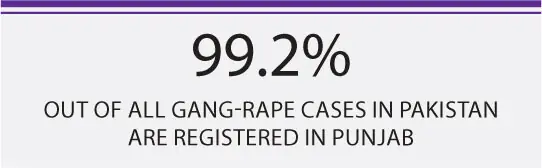
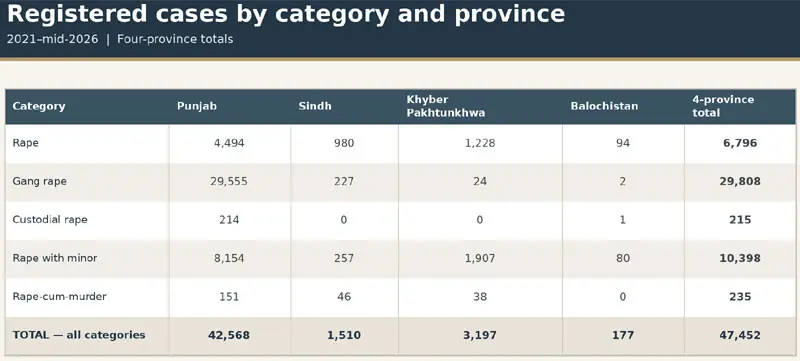
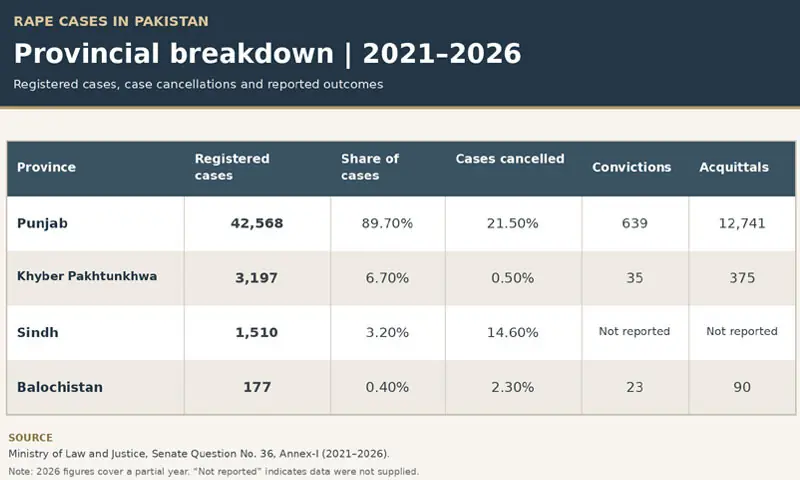
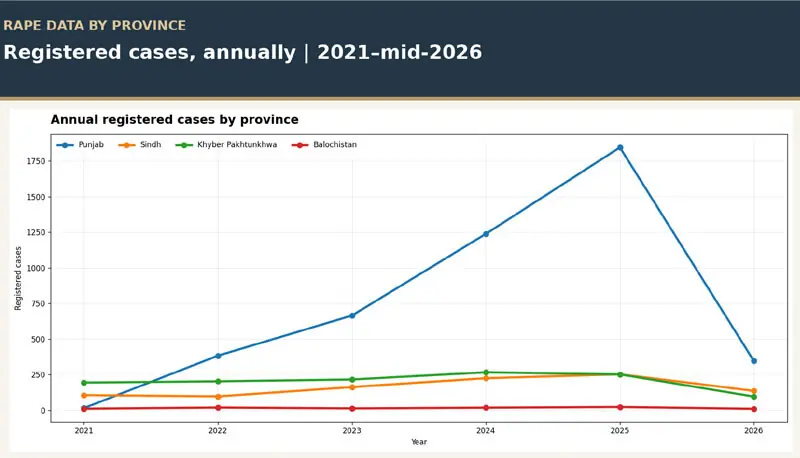
Between 2021 and mid-2026, Punjab has accounted for 89.7 percent of all the registered rape cases across the country. Gang-rape alone makes up 62.8 percent of the total national rape-related data, but Punjab has a share of 99.2 percent of all registered gang-rape cases.
In Punjab, gang-rape cases account for 69.4 percent of the total caseload and its 29,555 registered cases are 6.6 times its 4,494 cases of single-perpetrator rape. Every other province shows the inverse pattern. Sindh records 4.3 single-perpetrator rapes for every gang-rape, KP 51 and Balochistan 47.
In Punjab’s first four weeks of reporting after the implementation of the Act (December 4-31, 2021), the province recorded 1,011 gang-rape cases and 15 single-perpetrator rape cases. Hence, Punjab’s figures begin on the same day the Anti-Rape Act was published in Pakistan’s official gazette.
By 2022, the ratio of registered gang-rape cases to single-perpetrator rape cases in Punjab was 16 to 1. By 2025, the ratio had narrowed to 3.4 to 1 because rape cases had increased to 1,846 by 2025 and gang-rape cases had decreased from the previous year to 6,300.
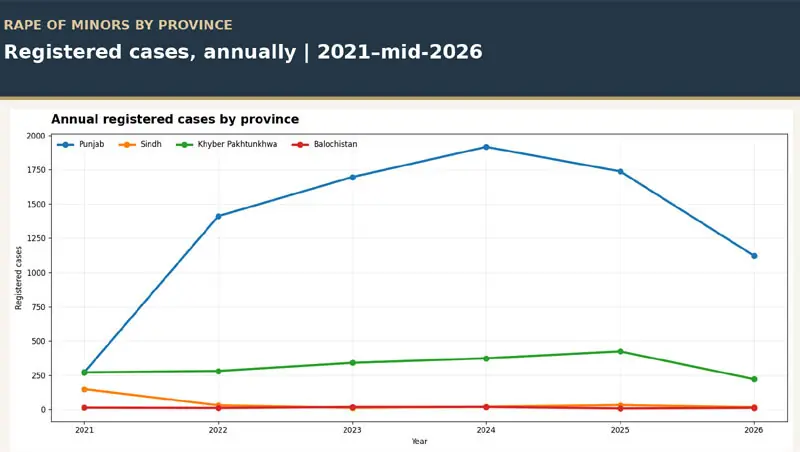
In the first half of 2026, monthly registrations of single-perpetrator rape cases ran about 40 percent below the 2025 average and the registration of gang-rape cases is also down significantly compared to the monthly average last year. Yet, child-rape cases run 29 percent higher, at 187 monthly in 2026 against 145 from 2025. Crime against children is constant. Since 2021, Punjab has registered 8,154 child-rape cases, which is 19.2 percent of its total tally. In 2024, that meant 1,916 cases — more than five a day.
Being in police custody is not safe either. From 2021 to mid-2026, Punjab has had 214 custodial rape cases. This accounts for 99.5 percent of all custodial rape cases in the national dataset, as Balochistan is the only other province to have a registered custodial rape case. The number of custodial-rape cases jumped to 68 in 2024 and is currently 36 in the first half of 2026, which is almost as many as all of 2025 (39). The result was one conviction against 51 acquittals. The province also has 151 rape-and-murder cases with 13 convictions, 43 acquittals and 83 pending cases.
The failure is not in the lack of arrests. Police reports show that 57,159 of the accused individuals — 91 percent of them — were arrested. From 2021 to mid-2026, Punjab cancelled 9,155 cases of rape (21.5 percent), including 6,995 gang-rape cases. During the same time period in Punjab, courts convicted 639 accused individuals across all categories and acquitted 12,741, hence averaging about 20 acquittals per conviction.
In gang-rape cases specifically, the ratio of acquittals to convictions is 26 to 1. This can’t just be chalked down to a slower judicial process either because, even in the oldest full-year figures, 2022 and 2023, the gang-rape tally is 194 convictions against 4,586 acquittals.
The Anti-Rape Act was meant to replace a fragmented process with a coordinated system, in which every institution, from the police station and hospital to the prosecutor’s office and courtroom, would play its part. Instead, the gaps between these institutions continue to define the experience of survivors: evidence that may not be collected properly, investigations that stall, trials that drag on, and convictions that are too few to inspire confidence.
KP: THE PROVINCE OF CHILD VICTIMS
When analysing rape data from KP, child abuse numbers are at the forefront. Of its 3,197 registered cases from 2021 to 2026, 1,907 (59.6 percent) involve child victims. The number of registered child-rape cases soared from 270 in 2021 to 423 in 2025. KP also recorded 7.4 times as many child-rape cases as Sindh.
Data regarding cases registered for adult-rape also follows the same upward trend in the province. Such registered cases rose from 194 in 2021 to 257 in 2024. There have been 24 gang-rape cases during this time period in KP, all while custodial-rape cases have remained at zero every year. Whether those zeros reflect reality or a reluctance to register is almost impossible to confirm.
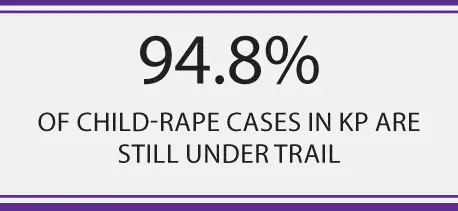
Unlike the pattern in Punjab, the police in KP sends almost every case to court, with 98 percent cases resulting in a challan being issued. However, after that, there is a quagmire. Some 2,639 cases, 82.5 percent of the total during this time period, are still stuck in trial. In child cases, 1,807 (94.8 percent) out of 1,907 cases are still under trial.
The last child-rape conviction in KP’s data is in 2021, when there were nine such convictions. From 2022 to May 2026, the province registered 1,637 child-rape cases and secured zero convictions, with eight recorded acquittals. The 38 cases of rape-and-murder in KP in this time span, all involving children, tell the same story. Of those cases, 37 are in court, and there have been no convictions or acquittals.
A senior official of the Directorate of Prosecution Khyber Pakhtunkhwa, speaking on condition of anonymity to Eos, identifies the investigation process as the biggest challenge. He says the prosecution department lacks the resources, skills and capacity building to carry out a proper investigation, stating,
“Our staff and officers lack proper training to handle such cases.”
The official also discloses that, in all districts of the Malakand Division, a majority of cases involving violence against women were compoundable — ie could be settled out of court — under the Nizam-i-Adl Regulation, 2009. According to him, “The majority of such cases end up in a compromise because that is what the law of that area allows.”
SINDH’S MISSING NUMBERS
According to data from 2021 through 2026, Sindh accounts for just 3.2 percent of all of Pakistan’s registered rape cases. Its profile is the reverse of Punjab’s. Single-perpetrator rape cases account for 64.9 percent of Sindh’s 1,510 cases and gang-rape accounts for 15 percent.
The trend in the registration of rape cases is an upward one, as annual registrations rose from 159 in 2022 to 358 in 2025, an increase of 125 percent. The first half of 2026 has seen a total of 196 cases of rape, which is already 55 percent of last year’s total. Single-perpetrator rape cases jumped from 97 in 2022 to 253 in 2025 and gang-rape cases increased from 24 to 64 during the same time span. Sindh’s 46 rape-and-murder cases are 19.6 percent of the four-province total of rape-and-murder cases.
Sindh’s central failure is actually being able to apprehend the accused. Across all cases, Sindh lists 1,073 accused in custody and 988 at large, so 48 percent are unaccounted for. In comparison, Punjab’s percentage of accused still at large is at nine percent. In Sindh’s gang-rape cases, more accused are at large (213) than in custody (159).
Investigations also tend to stall in Sindh. Only 65.8 percent of Sindh’s registered cases land in court, the lowest rate out of any province, and 295 cases (19.5 percent) are neither cancelled nor sent to trial — they’ve simply slipped through the cracks.
What makes Sindh’s data all the more murky is that Sindh’s dataset has no columns for convictions, acquittals or trials pending. These columns are just blank (not zeros, just blank). Nor does Sindh’s data have a custodial-rape category.
BALOCHISTAN’S SILENCE
From 2021 to mid-2026, Balochistan registered just 177 cases of rape across all categories. That is 0.4 percent of the national total for a province with roughly six percent of Pakistan’s population. Balochistan averages about 31 rape cases a year, roughly one every 12 days.
Of the total, registered single-perpetrator rape cases are 94, while there are 80 child-rape cases. There are two gang-rapes in this timeframe, one custodial-rape case and no rape-and-murder cases.
These numbers are so small that it begs the questions as to whether the data is accurately capturing the on-the-ground reality. Police and prosecution lawyers in Balochistan argue that societal stigma, the distance one must travel in order to reach police stations and the parallel tribal justice system are reasons why rape cases often never reach even the first information report (FIR) stage.
However, it appears that courts in Balochistan move quite swiftly, as only 48 cases are still pending — that is 27 percent of the total — against the 82.5 percent still pending in KP. Balochistan also has the best conviction ratio of any province, with 23 convictions to 90 acquittals, though that still means about four acquittals for every conviction. Its single custodial-rape case, from 2022, ended in a conviction. For child-rape, 12 cases were registered in the first half of 2026, already more than the number in all of 2025 (8).
THE PROCESS
Before examining the efficacy of the Anti-Rape Act, it is important to understand the process a rape case must navigate in Pakistan’s criminal justice system.
From the registration of an FIR and the collection of forensic and medico-legal evidence to the police investigation, the preparation of a challan, prosecution before the courts and the delivery of a verdict, each stage involves distinct responsibilities and procedural requirements.
A case can falter at any of these points, affecting whether it progresses to trial and ultimately results in a conviction or acquittal. Understanding this process is therefore essential to further interpreting the above-mentioned data.
First, a police station receives a complaint and registers it under Schedule I and Schedule II of the Act. The complainant is referred to an Anti-Rape Crisis Cell (ARCC) for medico-legal evidence. Then an FIR and support services follow. Schedule II of the Act covers sexual crimes including rape, gang rape, sexual abuse of minors, child pornography, trafficking for prostitution and related offenses against women and children.
The second step is investigation, where police register an FIR and trained officers in the Special Sexual Offenses Investigation Unit (SSOIU) take the case. At this stage, the FIR is challaned — a police report or charge sheet is formally issued — cancelled or left untraced.
Finally, the legal process begins. A dedicated special prosecutor scrutinises the case and institutes legal proceedings. Punjab has 128 prosecutors nominated for this purpose, followed by 124 in Balochistan, 34 in KP, 32 in Sindh and two in Islamabad. Special courts conduct the proceedings. The case results in either acquittal or conviction. If found guilty, the convicted sex offenders are added to the national sex offender register (SOR).
OFFENCES, REFERRALS AND GAPS
According to the data, ARCCs were not operational in Balochistan since the very start. Eos contacted the office of the Inspector General (IG) of the Balochistan Police for comment on this matter, but it did not respond.
In total, police in Pakistan referred 818 cases to ARCCs from January 2026 to March 2026, with Sindh leading with 375 referrals and eight walk-in cases. Punjab had 230 referrals and 58 walk-ins. KP had 157 referrals and 13 walk-ins.
Punjab’s Additional Inspector General (AIG) Investigations Shahzada Sultan tells Eos that several factors complicate and weaken rape cases in the country.
“The investigation officer [IO] handling the case is not just overseeing that single case,” he says, adding that one IO is overburdened with hundreds of other cases. “The IOs lack adequate funding to pursue the investigation, which is one of the challenges.”
The AIG’s claim has been backed by several police officers in Sindh and Islamabad too. They all argue that, in such cases, police IOs need training to handle them, but most have never undergone specific training or understood the sensitivity of the matter. Sultan maintains that witness protection is another challenge in sexual violence cases.
On October 31, 2025, the federal Ministry of Law formed a 30-member committee to monitor the implementation of the Act. The committee meets on a quarterly basis, reviews the data and suggests improvements and amendments.
Mehnaz Aziz, a former member of the National Assembly, is on the committee. According to her, “Women often do not come forward to register rape cases unless the matter receives attention within the community or through media.” She further notes that women commonly face pressure from men or family members to withdraw such cases. “That is one big challenge the state needs to address,” she says. Aziz also stresses the need for trained policewomen and adequate budgeting to ensure implementation of such laws.
Additionally, one of the biggest challenges surfaces at the SSOIUs level, which remains a rather underutilised branch in the investigation of sexual offence cases.
From January 2026 through March 2026, 9,079 rape-related FIRs were registered and 7,342 were assigned to SSOIUs. In comparison, a performance review from January 2025 to June 2025 recorded substantial disparity in relevant offences registered (17,795) and the medico-legal examinations that were carried out (905) within 72 hours of the cases being registered. During that period, Punjab had 16,168 relevant offences but only 480 medico-legal examinations within 72 hours.
Dr Summaiya Syed-Tariq is Sindh’s Chief Police Surgeon and a member of the special committee formed to ensure the implementation of the Act. For her, the figures are not simply a measure of hospital performance.
“The examination, documentation and preservation of samples needs to be done in an extremely careful and diligent manner,” she tells Eos. When asked what the principal problem is — delays, untrained medico-legal officers, inadequate forensic facilities, poor evidence preservation, lack of coordination between police and hospitals or something else — she says, “The main problem is an unwilling workforce and an absence of accountability.”
Data from 2025 and 2026 suggests that adult males continue to account for roughly 92 percent of the accused in sexual violence cases.
COURTROOMS AND CONVICTIONS
The most consequential test comes at the end of the process. According to data for 2025, more than a quarter of cases under the Act continue to be instituted in non-special courts.
In Punjab, 2,724 cases were heard in special courts, while 918 cases were constituted in other courts. The Islamabad Capital Territory leads in this respect, with 100 percent of cases (71) constituted in special courts. Sindh had 420 cases constituted at special courts and 92 at other courts. Similarly, KP had 180 cases at special courts and 77 in other courts. Balochistan showed a reverse trend, with 20 cases constituted in special courts and 43 in other courts.
The Act says special courts should preferably decide cases within four months. The government’s monitoring data reflects that the reality is far from this aspiration.
The Advocate General of Punjab Barrister Zafrullah Khan says that he is not hopeful about the existing mechanism for addressing sexual violence against women. He states, “The first and foremost challenge is the collection of evidence and samples. We do not have adequate mechanisms to do so.” He adds that courts, in many cases, had not admitted DNA evidence in rape cases.
“The standard set by the courts for the collection of evidence is too high and unrealistic,” he says, noting that when such standards are not met, it benefits the accused. Khan also says that social pressures and financial inducements are among other causes contributing to poor conviction rates, “In general, rape is considered a taboo in our society and expecting a woman from a far-flung area to go to a police station and register a complaint is still a distant dream.”
The Act also recommended the formation of a sex offender register (SOR), maintained through the National Database Regulatory Authority (Nadra). The register was launched in November 2024, following the Anti-Rape (Sex Offenders Register) Rules 2023.
Between March and August 2025, 380 eligible convictions were recorded and 328 entries were reported, for an overall entry rate of about 86 percent. The dashboard count subsequently jumped from 394 in March 2025 to 666 in August, 821 in November and 908 by February 2026.
The register also has a glaring issue: it does not include foreign convictions. In a meeting of the special committee on this Act on September 24, 2026, some amendments were proposed, including that deported sex offenders from abroad should be monitored in Pakistan. The amendment is likely to be presented before the federal cabinet and then before Parliament for approval.
WHAT DATA GAPS TELL US
The data points out the gaps in the system, from data collection to entering convicted offenders in the national register. It also begs the question of whether Pakistan builds a new anti-rape justice system or builds a new layer of institutions on top of an old system that still moves at its old speed.
The Anti-Rape Act was meant to replace a fragmented process with a coordinated system, in which every institution, from the police station and hospital to the prosecutor’s office and courtroom, would play its part. Instead, the gaps between these institutions continue to define the experience of survivors: evidence that may not be collected properly, investigations that stall, trials that drag on, and convictions that are too few to inspire confidence.
The figures cannot reveal how many survivors were deterred from reporting their abuse, nor can they account for every case that never entered the official record. But they do raise a fundamental question about the state’s response to sexual violence.
The measure of the law will ultimately lie not in the institutions established in its name, but in whether those institutions can deliver what the law promised.
The writer is an investigative journalist. X: @Riazhaq
Published in Dawn, EOS, October 18th, 2026