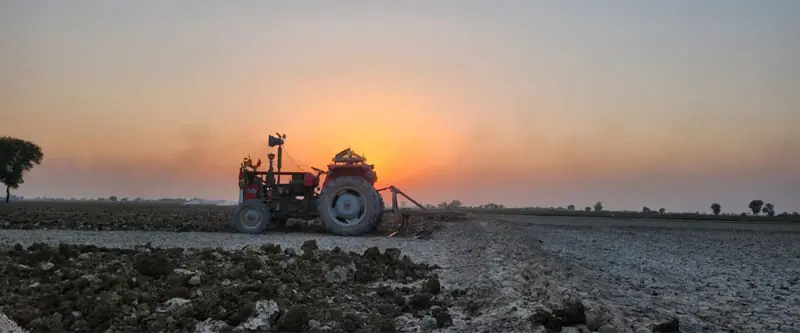
Mian Dad has spent much of his life ploughing fields on a tractor. He started as a young boy, helping drive a tractor that tilled land for a local landlord in his village in Tamboo, Nasirabad district, Balochistan.
Now, Mian drives the tractor himself, earns just Rs14,000 per month — a little over a third of the provincial minimum wage of Rs37,000. During peak cultivation season, he tells Eos, the work-day can stretch up to 16 hours — double the standard eight hours.
But Mian isn’t complaining. He now makes “a lot more” than what he earned as a tractor helper. It is still not enough, however, to feed his family, including his 11 children. “We look for odd jobs or work for food during the off-season,” he says. “When that doesn’t work, we have to beg.”
For agricultural workers in Balochistan, a lifetime of labour may still not be enough to escape poverty. Debt, unequal sharecropping arrangements and climate shocks can trap entire families in a vicious cycle of dependence
THE BOTTOM RUNG
Mian’s situation is not unusual in a province where poverty remains widespread. An estimated 47 percent of the population in Balochistan lives in poverty, compared with a national average of 28.9 percent, according to the Pakistan Economic Survey 2025-26.
Poverty is particularly acute in rural districts, where livelihoods depend mostly on agriculture. In a 2025 study by the global not-for-profit Population Council, District Vulnerability Index for Pakistan, 17 Balochistan districts were listed among the 20 most-vulnerable districts in the country. Nasirabad was towards the bottom in both provincial and national lists, ranking 11th most vulnerable out of 31 districts in Balochistan and 13th most vulnerable among the 129 districts assessed nationwide.
Agriculture is the main source of livelihood in Tamboo, Mian’s hometown, which has a population of around 130,000. As elsewhere in Balochistan, agricultural production in Tamboo involves a network of tribal chieftains, landlords, intermediaries known as bothars, farmers, tractor drivers, technicians and sharecroppers.
Workers like Mian Dad occupy the lower rungs of this hierarchy, often putting in long hours to cultivate the land. Locally, they are also referred to as begaar — which refers to a historical practice of forced, unpaid labour that was widely practised during the British era, including in princely states.
In today’s Balochistan, unpaid labour may arise from a lack of alternative employment, obligations linked to debt or, in some cases, pressure arising from tribal and social relationships.
INHERITED DEBT
It can take decades for those starting work as peasants to move up in this hierarchy.
Qadir Naseeb, whose family worked as peasants for generations in the Chattar area of Nasirabad, says his family didn’t have access to clean drinking water. He recently installed a tubewell near his hut. “Before [installing] the tubewell, the women in my family had to filter the water through a cloth to make it drinkable,” he tells Eos.
One of the reasons why upward mobility can take peasants decades, explains local researcher Muhammad Nawaz Khosa, is because they are often caught up in a cycle of debt. “Households often have to rely on interest-based loans to meet everyday expenses as well as the costs associated with cultivating the very land on which they work,” he explains.
In his book Balochistan Ki Nehri Zaraat [Canal-Irrigated Agriculture in Balochistan], Khosa writes that peasants often work as sharecroppers. In such cases, the peasants are responsible for managing production and handling expenses — often financed in the form of loans acquired from the landlord’s bothar.
The eventual harvest is then divided between the landowners and the peasant, with the peasant using his share of the harvest to pay off the loan. If the harvest fails to return a profit, the loss has to be borne by the peasant, leaving him mired in a vicious debt trap.
Such agreements also don’t factor in force majeure — whether it’s a pest attack or floods. In the case of a loss of harvest, the sharecropper has to pay off his debt to the landlord. In some instances, writes Khosa, peasants are also expected to bear the expenses associated with the landlord’s hujra [guest area], a system rooted in longstanding feudal traditions of the region.
This is something that Mian Dad and many others have experienced. Mian had to borrow Rs200,000 following the floods in 2022. The amount equals more than 14 months of his pay. While Mian was repaying the debt, a medical emergency forced him to take on another loan. He says he is now trapped in a cycle of that debt, worried that his future generations will have to work to pay it off.
Parts of Balochistan continue to exhibit forms of bonded labour, particularly within the households and estates of tribal and feudal elites, says Asad Baloch, a researcher who hails from a tribal family. Baloch says this practice has “considerably decreased” in Nasirabad as compared to previous generations. “But yes, remnants of such practices can be found in parts of the province,” he tells Eos.
In rural and remote parts of the province, he explains, the tribal chiefs function not just as cultural leaders, but as economic masters. Impoverished tribesmen often rely on their chiefs for basic survival, protection and mediation.
In some villages, there is a custom where one child from every household has to be in service of the tribal chief. In some cases, individuals work as guards or domestic workers, for minimal wages. Over time, limited economic opportunities and restricted access to education and alternative livelihoods continue to make it difficult for some individuals to pursue other means of earning a living.
RESETTING THE CLOCK
The 2022 floods that pushed Mian Dad into debt were not the first to disrupt the relationship between landlords and agricultural workers in Nasirabad. Dr Abid Mir, a lecturer at Government Degree College, Quetta, says the 2010 floods weakened some landlords’ hold over the families who worked for them.
“Widespread agricultural losses weakened some landlords’ ability to retain regular workers, prompting many peasant families to seek employment elsewhere,” he tells Eos. For some, this opened up the possibility of finding work on their own terms and seeking better education, healthcare and basic amenities for their families.
But the effects of climate-related disasters have been uneven. Families who remained in rural areas continued to face crop losses, declining incomes and mounting debts, Mir explains. For those already struggling to make ends meet, another failed harvest or flood could mean borrowing again simply to survive.
The same disaster that may loosen one family’s dependence on a landlord can deepen another’s debt to one. For agricultural workers such as Mian Dad, recovering from a disaster is not simply a matter of rebuilding a home or returning to the fields. It can mean years of repayment — and the fear that their children will inherit the debt.
The writer is a journalist and researcher.
X: @ImtiazBaluch
Additional input and editing by Hussain Dada.
X: @hydada83
Published in Dawn, EOS, October 18th, 2026