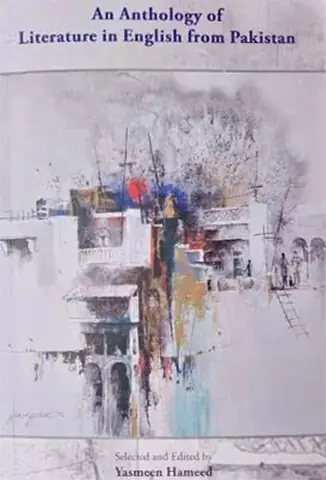
An Anthology of Literature in English from Pakistan
Edited by Yasmeen Hameed
Pakistan Academy of Letters
978-969-472-630-4
544pp.
A literary anthology doesn’t just seek to assemble a diverse array of texts into a cohesive whole but also offers a critical apparatus through which the chosen material can be examined. Compiling an anthology is, therefore, similar to organising an art exhibition, for which both skilful curation and discernment are required.
Poet and translator Yasmeen Hameed seems to grasp the formidable challenges involved in such an undertaking. As a result, her anthology sidesteps all the clichés associated with many anthologies. She doesn’t rely on a poetic title as a crutch and instead settles for one that provides a literal description of her brief.
At first glance, An Anthology of Literature in English from Pakistan comes across as a rather unimaginative title. However, the use of the indefinite article ‘an’ not only speaks to the editor’s modesty, but also reveals the dangers involved in establishing a fixed national literary canon.
In an age when Pakistani literature in English has become a force to be reckoned with, it is difficult for any anthology to truly represent its scope. Hameed’s compilation, too, isn’t wholly representative, as it overlooks significant contributions made to the canon over the last decade or more. Sceptics might even assert that it gives preference to the works of the supposed ‘old guard.’ But this claim runs the risk of needlessly politicising what is an attempt to showcase some gems of an ever-expanding body of literature.
A new, skilfully curated anthology by the Pakistan Academy of Letters brings together poetry, fiction and non-fiction to explore the diversity of Pakistani literature in English
Anthologies can’t be viewed as all-inclusive documents, as they inevitably have blind spots. In any case, it would be unfair to expect Hameed to include all the creative voices that have emerged on the country’s diverse literary landscape. This anthology is, by and large, a curated selection, and shouldn’t be construed as a definitive, up-to-date record of Pakistani literature in English. Readers shouldn’t view any omissions as a sign of a false canonisation of literature. Instead, they should be seen as an encouraging reminder of how Pakistani literature is now a beast that can’t be constrained within a single text.
In her introductory note, Hameed reveals that she not only relied on personal and public libraries, but also drew upon the work of literary historians, such as Dr Tariq Rahman and Muneeza Shamsie, as a blueprint for her selection. This adds a touch of academic precision to what could have easily become an arbitrary exercise.

An Anthology of Literature in English from Pakistan comprises four sections, each of which represents a major literary genre: poetry, short fiction, long fiction and non-fiction. Of these segments, the poetry section is the most effective, as it presents a rich panoply of verse that employs a unique blend of styles and techniques. Apart from that, the section carves out space for both established and new voices, ranging from the skilful symbolism of stalwarts such as Taufiq Rafat to the cinematic and evocative verse of Ammar Aziz. Hameed also adds some new notes to a familiar symphony, by including two hitherto unpublished sonnets by accomplished poet M. Athar Tahir.

The section on poetry prevents unparalleled gems by Zulfikar Ghose, Daud Kamal, Maki Kureishi, Salman Tarik Kureshi, Adrian A. Husain, Moniza Alvi and Hima Raza from passing into obscurity. In addition, it draws renewed attention to some forgotten poetic voices. Known as a pioneer of fine arts education in Pakistan, Anna Molka Ahmed is featured as a poet whose verse carries the same fervour as her paintings. Zeb-un-Nissa Hamidullah, who is predominantly remembered for her fearless journalism, appears in the guise of a sensitive poet who believes a “writer’s broken-hearted mind... reflects/exquisite outlines of the Almighty Himself.”

Incidentally, the titular story of Hamidullah’s only collection of short fiction — The Young Wife and Other Stories — is the opening piece of the section on short fiction. Hameed’s decision to choose this tale over Hamidullah’s frequently anthologised, more sophisticated pieces, ‘The Bull and the She-Devil’ and ‘No Music Before Mosques’, reveals a deep sensitivity to the author’s raw talent. The story features Aliya, a woman who dares to question the conservative values that have trapped her in an arranged marriage. Aliya’s personal dilemmas are set against the backdrop of the optimistic fervour surrounding the Pakistan Movement.

Key historical events figure prominently in some of the short fiction, though not as dull records of a bygone era but as a weight carried by ordinary individuals. Muneeza Shamsie’s ‘That Heathen Air’ is compelling in its evocation of the anxieties surrounding the British Raj after the 1857 uprising. Aamer Hussein’s ‘Cactus Town’ presents a personal scandal exacerbated by the 1971 war. Bina Shah’s ‘Crows Know’, which originally appeared in her debut collection titled Animal Medicine, seems to foreshadow her later work in the realm of speculative fiction. In this intriguing, immensely readable tale, a girl’s fascination with a crow turns the black-beaked bird into a symbol of death, grief and justice.
Another segment of Hameed’s anthology offers excerpts from novels by some Pakistani authors. A striking feature of this section is that it maintains a fine balance between award-winning, critically acclaimed authors and those whose works deserve to be better known. Some readers might take issue with the exclusion of a few notable names. This should be perceived as a sign of careful curation rather than erasure.
Quite a few excerpts begin with the first chapter of the novels in question. This technique could run the risk of turning a well-structured anthology into a haphazard collage of literary texts. Even so, the strategy aligns closely with the goal of the anthologist — and, by extension, of the editorial board at the Pakistan Academy of Letters — to provide a doorway into Pakistani literature for local and global audiences.
An excerpt chosen from any other part of a novel often contains spoilers and may even mislead readers. Using excerpts from the first chapter, therefore, preserves the sanctity of crucial plot points and allows readers to discover them on their own terms.
A shorter section on non-fiction writing boasts some insightful pieces by Sara Suleri Goodyear, Shaista Suhrawardy Ikramullah, Zulfikar Ghose and Fouzia Saeed. However, the sparse coverage given to the genre by no means suggests that the prospects for non-fiction writing are limited in Pakistan.
Through its focus on documenting the diverse flavours of Pakistani literature in English, Hameed’s anthology unearths some significant texts and repackages them for modern-day readers who may not have direct access to them. As a result, it serves as a valuable guide for students as well as literary historians.
The reviewer is the author of the critically acclaimed novels Typically Tanya and No Funeral for Nazia. X: @TahaKehar
Published in Dawn, Books & Authors, October 18th, 2026