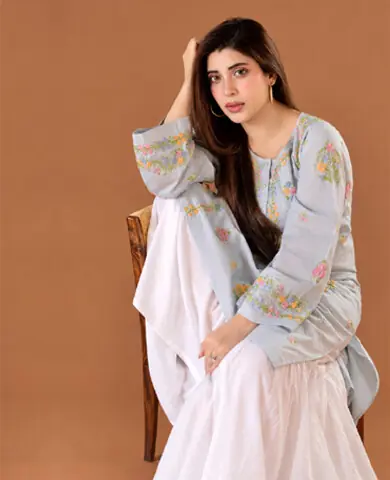
Urwa Hocane is at an interesting point in her career.
She’s spent 15 years as an actress, dabbled in glamour, made headlines and dealt with the chatter that inevitably follows a famous face. More significantly, though, she has commanded attention with her performances. But it seems she is now drifting, deliberately, towards what aligns more with her sense of self.
Urwa has ricocheted between hosting and acting, exploring cinema alongside television and trying her hand at production. Her unconventional roles, powerful performances and characters have pushed audiences to look beyond the celebrity and appreciate the actress.
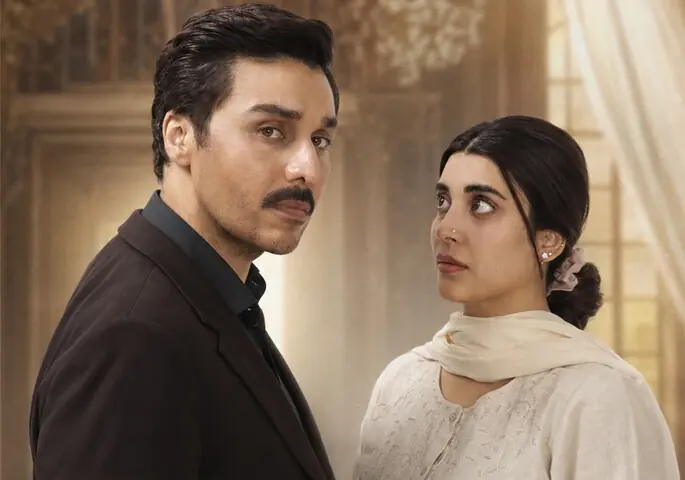
Her most recent role as Beena, in the critically and commercially successful drama Aap Ki Izzat is a case in point. Wide-eyed, her face devoid of make-up, Urwa became the vulnerable, heartbroken Beena grappling with the pain of living with a family that no longer appreciated her, and who was driven to teach them a lesson. It was a spectacular performance that had audiences crying and rooting for her, while sparking conversations about women’s rights and society’s notions of honour.
From playing the layered, unglamorous Beena in Aap Ki Izzat to turning down scripts that don’t speak to her, Urwa Hocane is in no mood to keep up with what others expect of her. After 15 years of acting, hosting, producing and glamour, she explains why she is now more content finding her own balance between career, creativity and family
It was also the kind of performance that hinted at the stories Urwa now wants to tell. Much of our conversation revolves around this, as I meet Urwa at her beautiful home in Lahore, in a room where a glorious shelf lined with awards — hers and her husband Farhan Saeed’s — takes centre stage.
It’s the kind of space that would leave you starstruck: photographs of the pair over the years on the tables, a grand piano in one corner and, at the entrance, a wall lined with framed magazine covers featuring them.
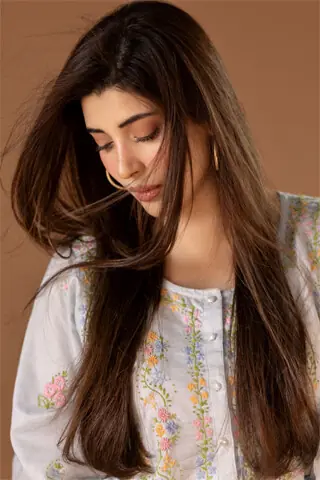
Aap Ki Izzat may have wrapped up, but its impact continues to reverberate. Sitting across from me in a lightly embroidered lawn kurta, her hair down and her face free of the anguish she recently brought on screen as Beena, Urwa is relaxed — and very happy.
THE HIGHS, THE LOWS, THE LOVE
“I have got a lot of love for Aap Ki Izzat,” she muses, “but, at the same time, I have never been someone who has taken successes too seriously, or failures to heart. Farhan says something that has always resonated with me: ‘Din yeh nahin rahay tau woh bhi nahin rahein gey’ [If these days don’t last then neither will those]. I feel that this applies to the good days and the bad days. Life is all about striking that balance, enjoying that moment and then moving on.”
Urwa immediately sets the stage for her philosophical outlook on life to dominate our talk.
She continues: “I really feel good about the camaraderie that exists within our industry. I have always gotten appreciation, but this time the magnitude was much bigger. I think everyone from the industry messaged me while Aap Ki Izzat was airing, and they didn’t just send basic congratulatory texts. They sent heartfelt messages and warm, thoughtful observations about a certain scene. It really touched me.”
What feedback did her family give her, considering her sister, Mawra Hocane, is an accomplished actress herself, and her husband, Farhan Saeed, is a successful actor and musician?
“We all give each other honest feedback, and I find it refreshing. We had plenty of conversations regarding Aap Ki Izzat. I remember Mawra called me after one particular episode and said, ‘Urwa, what have you done?’ I told her that I had channelled the performance from our mother’s life, and she exclaimed that she had known it all along! My mother told me that, after every two scenes, she would pause the drama, cry, and then resume watching it.”
Given the drama’s popularity, did people outside the industry reach out, too? “Yes,” she nods, “but it didn’t make me happy that people connected with such a sad story. Women from different economic backgrounds, including the most privileged and empowered, told me they related to Beena’s experiences.”
THE NUANCES OF BEENA
For Urwa, Aap Ki Izzat’s significance extended beyond playing a compelling character. The story also prompted her to reconsider society’s assumptions about how men and women are expected to behave.
“While reading the script and later, while playing the character, I felt that the audience would, at some point, question the emotions we associate with men and women,” she says. “As a society, we have created all these boxes for different genders when, in fact, all humans can feel things differently.
“We assume a man will react to a situation in a certain way, while women are expected to behave differently. A man can be angry and violent, but we are surprised when he cries. A woman can cry, but she shouldn’t get angry.
“It’s also considered normal to use humour to disrespect a woman. I have been calling this out for so long. As a child, I was part of the audience to my mother’s story and couldn’t say anything then, but now I can. There have been times when I have been with very close friends, and people have made ‘wife jokes’. I have looked at them, very seriously, and said, ‘That’s not funny.’”
Beena made Urwa realise that she was also conditioned with certain patriarchal notions. “While reading the script, I was taken aback when the point came when Beena leaves home,” she says. “It made me question why I had been able to understand all that had been happening to her till now but was shocked by this new turn in the story. Why was I, at times, judging her more and judging him less?
“There were so many conversations that we all would have on set: me, my co-actors Ahsan Khan and Sania Saeed, and our director Saife [Hasan] bhai. Among us, he was the biggest feminist. If I questioned something, he would come up with a good reason, and we’d have a long conversation. I think he really believes in convincing his actors. Sometimes, he would say, ‘Either you convince me, or I’ll convince you.’ A lot of my ideas changed while shooting the drama.”
AN ALIGNMENT OF STARS
The drama’s story, of course, was extremely well-knit — it was penned by Umera Ahmed and directed by Hasan. Urwa nods when I point this out, referring to a particularly long scene in a police station, where she had to deliver a long, hard-hitting monologue.
“I am generally good at learning dialogues but, in this case, I did not face any difficulty saying my lines,” she says. “The environment we worked in also played a huge part in ensuring that we all gave our 110 percent to every scene.”
She continues: “I often said to Ahsan that having him as a co-actor has spoilt me, what will I do now? Sania ji was so professional and lovely. I was lucky to work with them. They would give me space to perform and then jump in with their own performance, which would just blow me away. I feel that, a lot of times, my reactions on screen came from the way they performed. I became Beena.”
Could they all tell that they were working on something special? “I don’t think any of us ever thought about what the project would achieve. We were just having fun, and being as creative as possible. If we had started thinking about whether the project would be a hit or not, it would have taken the fun out of it.”
Did it ever perturb her that Beena, for a large part of the drama, was unglamorous, her hair tied up, wearing multiple layers under her kameez to look overweight?
“Not looking glamorous was not an issue,” responds Urwa. “I don’t think any one of us even looked in the mirror. We just wanted to give our best to the scenes. But when I came for my very first look test, I remember meeting the producer Nina Kashif and Saife bhai, and he exclaimed that I was too thin. He didn’t say it like it was a compliment. He was actually worried about it! He said that he would have to do something about it.”
She laughs, continuing, “We shot the scenes where both Ahsan and I are younger and I enjoyed wearing those clothes and shooting in that mohallah [neighbourhood]. Then, we had to shoot in the big house for the scenes in which we are older. Saife bhai looked at me and started pacing back and forth, saying this couldn’t work!
“He told the wardrobe team to get me large-sized clothes, and told them to fill me up with clothes. I was perplexed, and I even asked him why I needed to wear so many layers. Beena’s husband didn’t like her, but that didn’t mean that she had to look overweight!”
She adds, “I thought that perhaps he would forget but, soon, sweatshirts and thick leggings started coming in. Saife bhai told me to wear two shirts underneath my kameez, and suddenly I had become this ‘big’ person. There was a point when I had a meltdown, and I started crying. Saife bhai came to me and told me we could shoot without the layers underneath, but by looking a certain way, perhaps more people in the audience would be able to relate to me.
“He wanted me to hunch my shoulders and sometimes lower my face to give the effect of having a double chin. Once I understood what was required, I actually became quite comfortable wearing all those layers!”
Playing Beena must have taken its toll, I observe. “Yes, it did. When I was Beena all day, I would actually be really down by the time the day ended. But then, on the way home, I would remind myself that I had to see Jahan Aara [her two-year-old daughter].”
HER ‘FIRST’ JOB
The conversation turns towards how she managed to balance long all-day shoots with her daughter’s schedule.
“I couldn’t have done this project without the help of my mother and my mother-in-law. They were my angels who backed me throughout. I was shooting in Islamabad and I came there with an entire village: my mother, mother-in-law, my house help and, of course, Aara!” she says.
“But yes, every time I would leave in the morning, the guilt would kick in. I would then shake it off because I trusted the people who I had left her with. I would also give a lot of credit to how well-organised my drama set was.
“When I got this project, I mentioned to the producer and director that I didn’t know how I would manage working with Aara, who is still so young. They were very understanding about this, and made sure that my schedule was followed the way that it had been communicated to me. I would spend a few hours with Aara in the morning, go for the shoot and, when I returned, I would spend some more hours with her. It made my day longer and, sometimes, that does take a toll on you, but I was able to manage.”
Does having Aara in her life make her more careful about the projects that she chooses to work in, given the cost of being away from home?
“Yes, but regardless, at this point in my career, I want to trust my intuition and work on stories that hit at my heart,” says Urwa. “In the past year, I have said no to more than a couple of scripts from production houses. When offering me a story, they would say this is what audiences are watching right now. I just found that to be a really weak pitch. There is a lot that people are watching, but that doesn’t mean that I want to be part of it.”
She continues, “Every time I have not listened to my intuition, I have regretted it. So now that I am wiser and have more experience, I am not going to second-guess myself and will take on stories and characters that I believe in.”
Many of her peers say that good roles are hard to come by, I point out. “I disagree,” says Urwa. “I have played my fair share of good roles and have gotten a lot of love for them, be it in Udaari [2016], Punjab Nahin Jaungi [2017], Parizaad [2021-22] or Mushk [2020-21].”
She also clearly doesn’t feel the need to constantly be visible, whether on-screen or at networking events. “Well-wishers tell me that I should make an effort to be more in the public eye. I listen to them, but then I just do what I feel like!” she grins.
Doesn’t she experience Fomo — Fear Of Missing Out? “I experience the exact opposite — Jomo [Joy Of Missing Out]!,” she retorts with a smile. “I would rather miss out than be part of a herd without any meaning to it.”
And what is she doing now that Aap Ki Izzat has wrapped up? “I am reading scripts and contemplating production as well.”
Many described Aap Ki Izzat as her comeback and I mention that to her. Urwa laughs. “Every time I have taken my time reading scripts and then acting, people say I have made a comeback. I wonder where I have come back from, Mars?”
Urwa just wants to wait for a character that challenges her, spend time with her family and let the next chapter of her life unfold in its own time. Fomo? No, thank you. Jomo, with a side of creative freedom, seems much more her style.
The writer is a fashion and entertainment journalist with over two decades of experience.
She can be reached at maliharehman1@gmail.com
Published in Dawn, ICON, October 18th, 2026