Sometimes, not reading the source material works in your favour. Case in point: Colleen Hoover’s polarising novel Verity, which has been turned into a somewhat polarising motion picture about a catatonic novelist, her disturbing, unpublished autobiographical manuscript, a struggling writer yet to find fame who is hired to complete the celebrated novelist’s works and a husband who loses control in a flash.
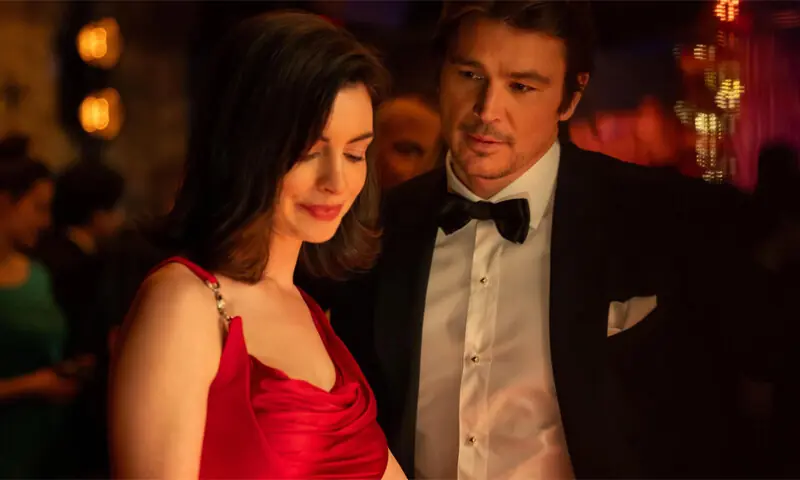
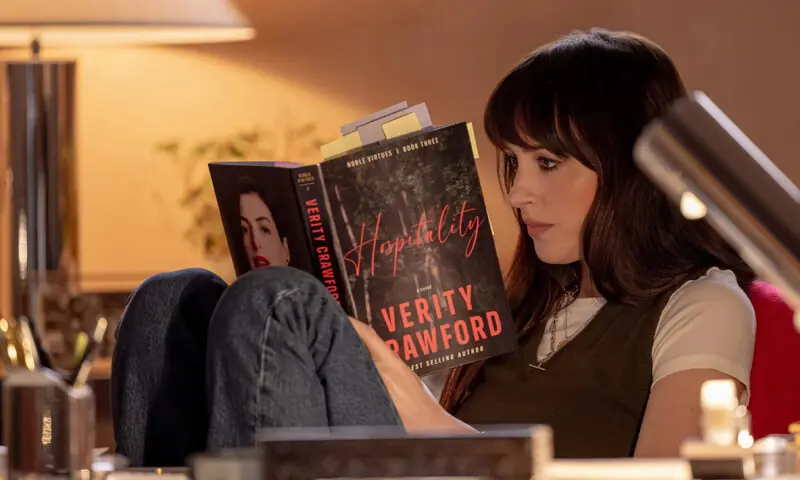
Anne Hathaway plays the celebrated novelist Verity Crawford, who writes dark, twisted novels and is left catatonic after an accident. Dakota Johnson is the struggling novelist Lowen Ashleigh, whose own dark touch might help complete Verity’s works. Josh Hartnett is the husband Jeremy — the great obsession of Verity’s life — who wants his wife to love her own children unconditionally.
That is, of course, a debate-and-a-half — or perhaps not even a matter of debate at all, depending on whom you ask. For Verity, the twin children she gave birth to are a reprehensible burden. For Jeremy, they should be a priority — perhaps even more than him. The difference in their points of view leads to disaster, setting the stage for the darker narrative turn in Hoover’s decidedly sexualised novel, and its screen adaptation.
With nearly all of the story set inside Verity and Jeremy’s remote house, the film is free to fix its gaze without blinking on three people and their twisted personal fantasies, guilt and wretched revelations. One expects — and nearly gets — a chiller. Emphasis on ‘nearly gets’. Sometimes, nearly getting is better than not getting at all.
Michael Showalter’s Verity, starring Anne Hathaway, Dakota Johnson and Josh Hartnett, has all the ingredients of a chilling thriller, but removes some of the ambiguity of its source novel
Now, I won’t discuss the plot further. In a mystery thriller, one loose clue might give everything away. The same logic applies to reading a thriller before watching its movie (though that can’t be helped if you’ve already read the novel). Knowing the plot and its turns beforehand can diminish the experience. The emotional jolt hits with less voltage when you know how the story goes.
Having neither read Hoover’s works nor followed the controversies surrounding her character choices and revelations, I was able to separate what the novel is from what the film ought to be in cinematic storytelling terms. My deliberately limited research suggests what the author wanted to depict — and why that could have posed a problem for the film.
Cinema, despite the source material, has its own set of rules for unfolding characters and storylines. A good book doesn’t necessarily make a good adaptation. Fans praise the novel for leaving the true nature of one particular character’s guilt or innocence ambiguous. A film, meanwhile, can only be as ambiguous as its audience will tolerate. One aimed at art-house and indie-cinema audiences can take greater narrative risks than one made for general viewers. The latter, in any case, needs to deliver a story with a certain level of clarity and directness.
So, I don’t see a problem with director Michael Showalter and screenwriter Nick Antosca leaning more heavily towards a specific conclusion in Verity. While it may dampen the sense of lingering, uncomfortable doubt the novel leaves its readers with, a film needs a “big finish” — a climax that resolves the immediate drama while leaving just a smidgen of doubt about the characters and their actions.
All three characters are twisted, though some are deliberately streamlined for simplicity. Hathaway is the striking centrepiece of the plot and mystery. A thriller laced with a dash of horror is often a good career choice for an actor — especially one looking to break away from old stereotypes. While Hathaway has done serious work in the past, one would have to think hard to recall her spritzy, klutzy The Princess Diaries days.
It’s also nice to see Hartnett in a career resurgence following M. Night Shyamalan’s Trap — the darker side of a family man suits him. Johnson, however, is still as obvious an actor as ever, “acting” evidently and shaking — if not breaking — whatever believability and illusion Hathaway and Hartnett bring to the film.
Johnson’s Lowen is ultimately influenced by Verity’s ominous presence and writing, though there are hints — which could have been elaborated on — of a darker nature of her own. We’re simply told Lowen writes sinister stories, like Verity. Both women can be read as representations of Hoover’s image as a writer.
Given the novelist’s notoriety, I think that’s an obvious, if commercially shrewd, way to sell both the book and the film — neither of them perfect to begin with.
Playing in cinemas now, Verity is released internationally by Amazon MGM Studios and Sony Pictures Releasing International, with HKC Entertainment handling its release in Pakistan. The film carries a PG rating for material that is too adult for just parental guidance
The writer is Icon’s primary film reviewer
Published in Dawn, ICON, October 18th, 2026