IN MEMORIAM: BEYOND THE MOSQUITO
“Aik machhar saala aadmi ko hijrra bana deta hai [Just one mosquito can reduce a fully grown man to a eunuch].”
Few actors could have made a mosquito carry the weight of an indictment against society. Yet, when Nana Patekar uttered that unforgettable line in Yeshwant [Victorious, 1997], it became much more than one of Hindi cinema’s most quoted pieces of dialogue.
As Inspector Yeshwant Lohar, he turns something almost comic into a metaphor for powerlessness: the petty humiliations, bureaucratic frustrations and daily compromises that gradually reduce an ordinary person to impotence.
I remember the force with which that scene registered when I first watched it. Patekar’s anger did not seem performed; it seemed to have escaped containment. Years later, what strikes me more is the despair underneath it. Anger was often his method, but helplessness was frequently his subject.
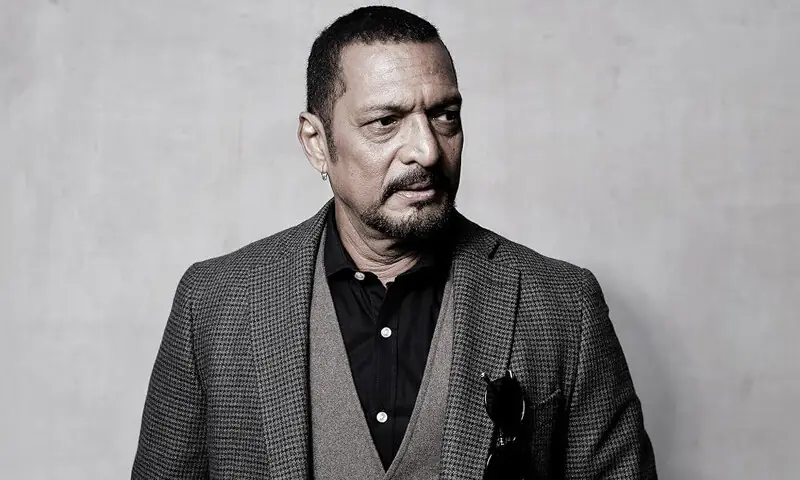
Nana Patekar, who died on October 8, 2026, carved his own path through Hindi cinema, turning volatility into an art while revealing, beneath the fury, an actor capable of extraordinary vulnerability and restraint
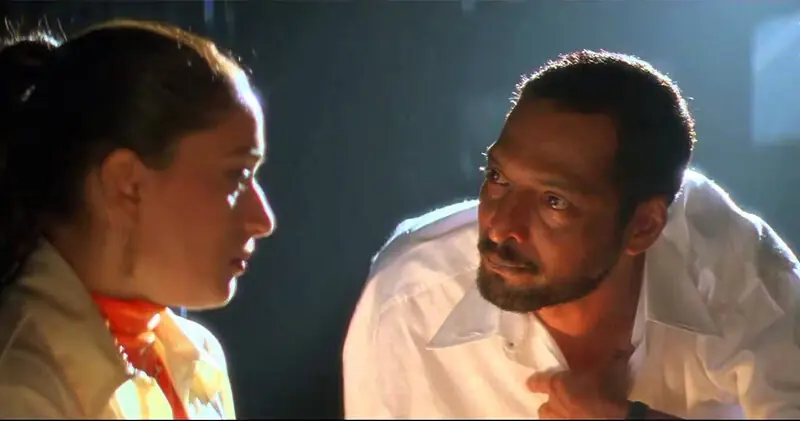
Then consider the astonishing contrast offered by Wajood [Existence, 1998]. Opposite Madhuri Dixit, Patekar recites Javed Akhtar’s beautiful poem beginning, “Kaise bataoon main tumhain… [How do I tell thee].” I have returned to that sequence several times over the years.
The gravelly voice that could make threats sound lethal suddenly becomes hesitant and vulnerable. His pauses matter as much as the words. He does not acquire the smooth romantic charm of a conventional Hindi-film hero; instead, he makes love itself appear dangerous, exposing a man who is emotionally defenceless.
The policeman raging about a mosquito and the lover reciting poetry to Madhuri Dixit’s Apoorva Chaudhry may appear to inhabit different worlds. Between them, however, lies much of Nana Patekar’s extraordinary range. In the 1980s, when my interest in Indian cinema increasingly gravitated towards what we loosely called “art films”, the male actors I admired most were Naseeruddin Shah and Om Puri. They represented an alternative India on screen: less glamorous, more troubled and considerably more believable than the universe inhabited by most commercial stars.
Both carried the seriousness associated with parallel cinema. Then, towards the end of that decade, Nana began to impress me immensely. He possessed neither Naseeruddin Shah’s cultivated detachment nor Om Puri’s melancholy gravitas. Patekar, who died in Goa on October 8, 2026, aged 75, had taken a different route.
He studied commercial art at Mumbai’s Sir J.J. Institute of Applied Art, worked in advertising and entered theatre before cinema discovered him. Perhaps that partly explains what made him distinctive. He often seemed less interested in demonstrating technique than in attacking a part. His acting could appear almost dangerously unprocessed.
I first began taking serious notice of him in N. Chandra’s Ankush [Elephant Goad, 1986]. The film belonged to the angry urban cinema of its time: unemployed young men, cramped lives, corruption and a system capable of converting frustration into violence. As Ravi, Patekar seemed to carry the accumulated grievances of the Bombay street in his body.
His anger lacked Amitabh Bachchan’s heroic grandeur. Bachchan’s angry young man could stride into history; Patekar’s might be sitting beside you on a crowded local train. Then came Mira Nair’s Salaam Bombay! [Greetings Bombay!, 1988]. As Baba, the pimp who dominates Rekha Golub (Anita Kanwar) and their daughter Manju (Hansa Vithal), Patekar was repellent without becoming a cardboard villain. I remember being struck by how little he needed to solicit attention. Amid children whose lives were collapsing almost casually around them, his menace seemed merely another feature of everyday Bombay.
A year later came Parinda [Bird, 1989], and for me it remains the performance against which much of his subsequent work should be judged. As Anna Seth, a gangster consumed by violence and psychological instability, Patekar was frightening precisely because his eruptions could not easily be predicted. He might speak softly and suddenly alter the temperature of a room. Director Vidhu Vinod Chopra understood how to exploit that volatility. Patekar won the National Film Award for best supporting actor, but awards scarcely describe what happened on screen.
His acting invites comparison with his great contemporaries. Naseeruddin Shah often makes you watch the mind working. Om Puri could make accumulated suffering visible in silence. Irrfan Khan, who emerged later, discovered an entire grammar in the smallest movement of an eye. Patekar worked differently. His body was an argument and his voice could almost function independently of the dialogue.
Among Western actors, Gene Hackman perhaps comes closest: another performer capable of making unpleasant men compelling, without pleading for the audience’s affection. There was something of Robert De Niro’s compressed danger and, at his most expansive, Al Pacino’s theatrical combustion. Yet, Patekar’s manner remained unmistakably his own, rooted in Maharashtra and in an Indian dramatic tradition where speech can become accusation.
Prahaar: The Final Attack [1991], which Patekar also directed and co-wrote, may have been his finest demonstration of discipline. Playing Major Pratap Chauhan, he brought military severity into collision with civilian indifference and corruption. The role could easily have descended into bombast. Patekar made the bombast persuasive because he excelled at portraying men unable to understand why society tolerated what they regarded as intolerable.
That quality reached its rhetorical peak in Yeshwant. The famous mosquito speech was therefore not an eccentric departure but a distillation of something central to Patekar’s screen personality: rage directed against systems larger than the individual.
Yet, Wajood reminds us that reducing Patekar to anger would be a mistake. There, vulnerability replaced aggression. The very roughness of his delivery gave the poetry its power. A man usually associated with command suddenly appeared exposed.
That was also why Abb Tak Chhappan [Still 56, 2004] suited him so perfectly. As Sadhu Agashe, an encounter specialist whose moral universe had been narrowed by years of killing, Patekar did something more difficult than shouting: he withheld. I have returned mentally to this performance more often than to many of his louder films. The actor who once seemed capable of detonating every scene had discovered the dramatic usefulness of silence.
Three years later, in Dus Kahaniyaan [Ten Stories, 2007], he appeared in Gulzar’s Ghubaaray[Balloons]. It was a much smaller part, but one I remember with particular affection. Patekar could dominate a feature film, yet he could also enter a short story and leave behind an emotional residue disproportionate to the size of the role.
Not everything he did deserved such generosity. Indeed, one puzzle of his career is why an actor of such evident ability accepted so much indifferent material. Housefull 5 [2025] gave him little worthy of his gifts. O’ Romeo [2026], despite Vishal Bhardwaj’s direction and Patekar’s spirited presence as Ismail Khan, demonstrated that distinguished ingredients do not automatically produce a distinguished meal. Subedaar [Warrant Officer, 2026] similarly left me wondering why such a formidable actor was so often obliged to lend weight to ordinary material.
Perhaps such unevenness is inevitable across nearly five decades. Great actors need work; industries need famous faces. Not every performance can be a Parinda.
There was another Nana beyond cinema. With actor Makarand Anaspure, he established the NAAM Foundation in 2015, initially responding to drought and farmer suicides in Maharashtra and later working on water conservation and rural development. This was more substantial than fashionable celebrity philanthropy.
His public record was also not without controversy. In 2018, actress Tanushree Dutta accused him of sexual harassment during the making of Horn ‘Ok’ Pleassss, a decade earlier. He denied the allegation. Mumbai police later filed a closure report, citing insufficient evidence; Dutta rejected that conclusion. An obituary should neither retry the case nor pretend it never existed. Admiration for an artist does not require manufacturing a saint.
The writer is a columnist, educator and film critic. He can be reached at mnazir1964@yahoo.co.uk
Published in Dawn, ICON, October 18th, 2026