After lunch, Sohaib and his friends were walking towards their classroom when Fasih came rushing towards them, panting. The boys helped him calm down and asked what had happened.
“Danish and his friends were saying horrible things about you, Sohaib, and wouldn’t stop laughing!” Fasih replied.
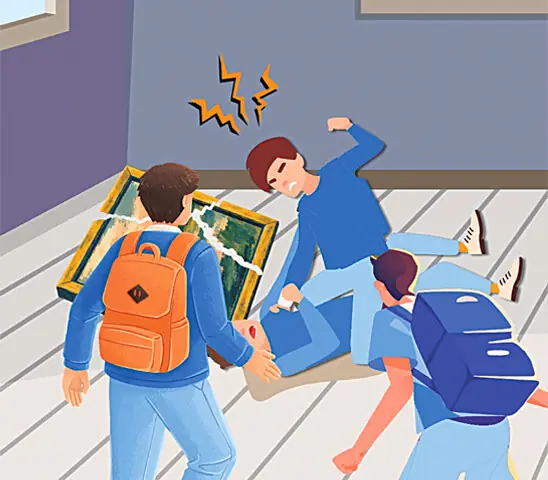
Without asking for details, Sohaib became angry and stormed down the hallway towards his Danish’s classroom. He punched Danish straight in the face, sending him backwards onto a painting that Ayra, their classmate, had spent weeks working on.
Danish got up and shoved Sohaib. No one dared to intervene. The two wrestled until Sir Aman stepped in and separated them. They were taken to the principal’s office, their hearts racing and uniforms in disarray. Danish even had a bleeding nose. They were told to wait outside under supervision while Sir Aman discussed the incident with Principal Hafsa. Soon, they were called in, one by one.
The atmosphere in the room was enough to make anyone confess to a crime. There was the dark wooden floor, the pin-drop silence, the enormous table with every pen neatly in its place and, finally, the stern principal.
Sir Aman remained silent as Ma’am Hafsa questioned the boys about the incident before calling their parents.
Danish’s parents were shocked to see their son in such a state and demanded Sohaib’s immediate suspension. Seated before the enormous table, Sohaib’s mother struggled to hold back her tears, disappointed by the violence her son had resorted to.
“Considering the three previous warnings, your son, Sohaib, is being suspended for a fortnight for physically injuring Danish and causing collateral damage to Ayra’s painting. Anger management sessions are strongly advised. If another offence is reported, Sohaib will be expelled,” Ma’am Hafsa declared firmly.
She signed the suspension letter, capped her pen, handed it to Sohaib’s mother and left. Danish’s parents followed, loudly calling Sohaib insane, while Sir Aman left soon afterwards. Sohaib stood there, dishevelled, looking at his worried mother as she stared down at his suspension letter.
The drive home was silent. The rest of the day passed as usual until Sohaib approached his mother on the terrace after dinner.
Ashamed of his behaviour, he said, “I know I’m short-tempered and get angry easily, but I don’t know how to control myself. I just lose my temper and want to hit whoever triggers me. I want to change, and for that, I need a calm mentor — you.”
His mother, who had been looking down at the street, turned to him.
“Help me help myself, Mum. I don’t want to be labelled ‘insane’.”
She gave him a faint smile and said, “Go to sleep, Sohaib.”
He glanced at his wristwatch. It was only nine, but he went to bed anyway.
At five the next morning, his mother woke him up. “Get up and offer Fajr.”
He rose reluctantly, but after the prayer, he felt surprisingly refreshed, realising he had already had eight hours of sleep.
Next, his mother guided him to the Holy Quran and asked him to recite just two pages. Although it took him longer than usual, he felt spiritually refreshed afterwards. She then took him to a nearby park for a 20-minute walk. Sohaib breathed in the fresh morning air and watched the mesmerising sunrise.
“The rising sun is a symbol of hope,” his mother explained. “Physical strength is important, but you also need to be strong to be gentle.”
She taught him to take ten deep breaths whenever he felt enraged, explaining that his anger would begin to subside before he even finished counting.
They followed this routine throughout the fortnight. Sohaib’s father was happy to see his short-tempered son waking up at dawn with discipline and handling problems without creating a scene.
One Sunday, during their walk in the park, his mother introduced an important lesson.
“Do you know who suffers the greatest losses when a war breaks out?”
Sohaib thought for a moment. “Soldiers?”
His mother nodded. “Soldiers do suffer, but so do innocent civilians who never wanted to be involved in the fighting. They face terrible losses because some people in power cannot resolve their differences peacefully. These unintended losses are called ‘collateral damage’. In your case, what was Ayra’s fault?”
Sohaib lowered his head in shame. “I never meant to hurt her.”
“Yet she suffered the loss. Weeks of her hard work were destroyed in seconds.”
Sohaib began to understand how Ayra must have felt.
“Tomorrow is a brand-new day, Sohaib,” his mother said. “Your first step is to sincerely apologise to Ayra and ask how you can make things right. Then, make peace with Danish and put an end to this rivalry.”
On Monday, Sohaib woke up at dawn, prayed, showered and dressed neatly. He greeted his teachers politely and apologised to Ayra, promising to help her with her next project during his free periods. He also learnt to verify rumours before jumping to conclusions and to resolve conflicts through conversation or by seeking a teacher’s help.
By December, Sohaib felt happier than ever. His grades had improved and he was doing better in sports. Meanwhile, Ayra’s new painting received great praise at the school’s arts exhibition.
Published in Dawn, Young World, October 17th, 2026