Afghan Taliban’s ‘cheap but deadly’ drone campaign
• Islamabad reported 23 drone incursions in September alone
• Afghan drones run on 55cc engines commercially available online; low-cost ‘suicide weapons’ can carry up to 1kg explosives, posing hard-to-detect threat to infrastructure
• Experts warn UAVs can inflict ‘heavy psychological damage’
BUILDING an air force no longer requires a proper defence budget, it just takes a 3D printer, open-source autopilot software and an internet connection. Over the skies of Pakistan, the Afghan Taliban are proving just how low the barrier to aerial warfare has fallen.
In a conflict where one side commands modern fighter jets and aerial superiority, the other is fighting back with makeshift quadcopters and two-metre fixed-wing drones powered by online-bought piston engines.
These unmanned aircraft are built to haunt the skies and fray the nerves of the other side, according to a report by France’s state-owned media outlet France24.
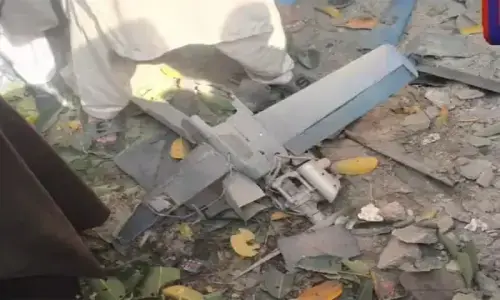
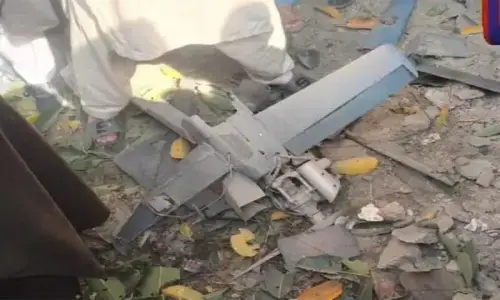
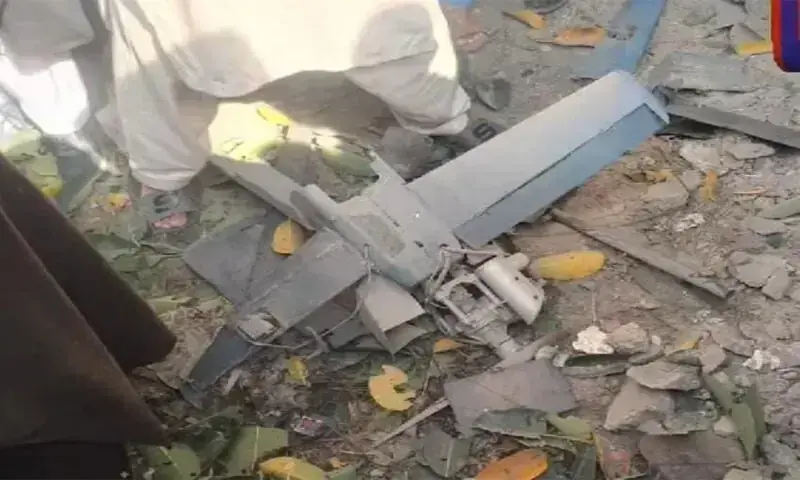
On September 23, Pakistan’s military forces shot down at least eight fixed-wing drones in Khyber Pakhtunkhwa fewer than 1,000 metres from the Afghan border, marking the latest cross-border unmanned aerial assault targeting Pakistan.
Five days later, on Sept 28, the Foreign Ministry issued a diplomatic protest note to the Taliban over what it called “provocative incursions”, reporting that 23 drones had entered Pakistani airspace from Afghanistan since the beginning of September.
The Taliban have increasingly relied on unmanned aircraft since open conflict erupted between the two neighbours in February.
Psychological warfare
An examination by France24 of photographs and videos showing drones intercepted by the Pakistan Army revealed that Taliban’s suicide aircraft appear to run on DLE55 engines. Those 55cc single-piston engines are readily available for commercial purchase online.
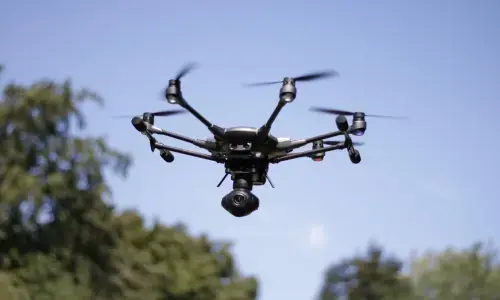
Unmanned aerial vehicle expert Mark Grozel told France24 that these drones measure approximately two metres across and carry between half a kilogram and one kilogram of explosives.
Because they fly slowly and at low altitudes, they offer limited military effectiveness and are simple to shoot down once spotted, though detecting them remains a challenge, Grozel said.
While a foreign government could be supplying the aircraft, Grozel noted that building a homemade fixed-wing drone is no longer difficult.
Autopilot trajectory software is widely accessible, engines and batteries are sold on the e-commerce platform Alibaba, and airframes that are cheap to make can be constructed using 3D printers, polystyrene or balsa wood, according to Grozel.
Despite relying on rudimentary radio navigation, basic engines and small payloads, the unmanned aircraft inflict heavy psychological damage.
“They allow you to tell your adversary: ‘I can threaten your infrastructure at any moment’. If one hits a school or a fuel facility, the consequences could be catastrophic. Their main power is their psychological impact,” Grozel said.
Open conflict
Islamabad and Kabul saw their relationship collapse roughly eight months ago when Pakistani Defence Minister Khawaja Mohammad Asif publicly stated that “relations with the Taliban had deteriorated into an ‘open war’.”
Tensions boiled over after Pakistan launched airstrikes inside Afghanistan targeting the Tehreek-i-Taliban Pakistan (TTP).
The TTP is an internationally designated terrorist organisation. Pakistan accuses the Afghan Taliban of harbouring and aiding the TTP, which has waged an insurgency inside Pakistan for nearly 20 years.
Possessing aerial superiority, Pakistan has struck suspected TTP hideouts deep within Afghan territory. The Afghan Taliban have answered such strikes with ground assaults and drone attacks.
Throughout 2025, routine border fighting reportedly claimed around 4,000 lives, and on Sept 18, 2026, a TTP suicide car bombing at a mosque in the Pakistani border city of Kohat killed 21 people.
Mukhtar Wafaei, an Afghan affairs specialist and expert on the Taliban, told France24 that the alliance between the two groups dates back to the 1980s Soviet-Afghan War, when religious schools in Pakistan sent Afghan and Pakistani fighters to wage “jihad” against Soviet troops.
After the US-led invasion toppled the first Taliban regime following the Sept 11, 2001, attacks, Taliban fighters fled into Pakistan’s border areas, including Balochistan, Waziristan and KP.
Shared roots
According to France24, there is a very deep ideological relationship between the Afghan Taliban and the TTP, rooted in their shared background of attending religious schools in Pakistan. They share the same ideology, come from the same religious tradition and follow the same teachings. They can no longer be separated. They are effectively one group.
A few months after the Afghan Taliban returned to power, the TTP leader stated very clearly in Pashto that TTP and the Islamic Emirate of Afghanistan, meaning the Afghan Taliban, were one group. He said: “We are not two groups. We are one group, following one programme, one ideology and one method.”
This is particularly revealing because the TTP leader himself explicitly described the two movements as one.
Published in Dawn, October 15th, 2026